
 by
by 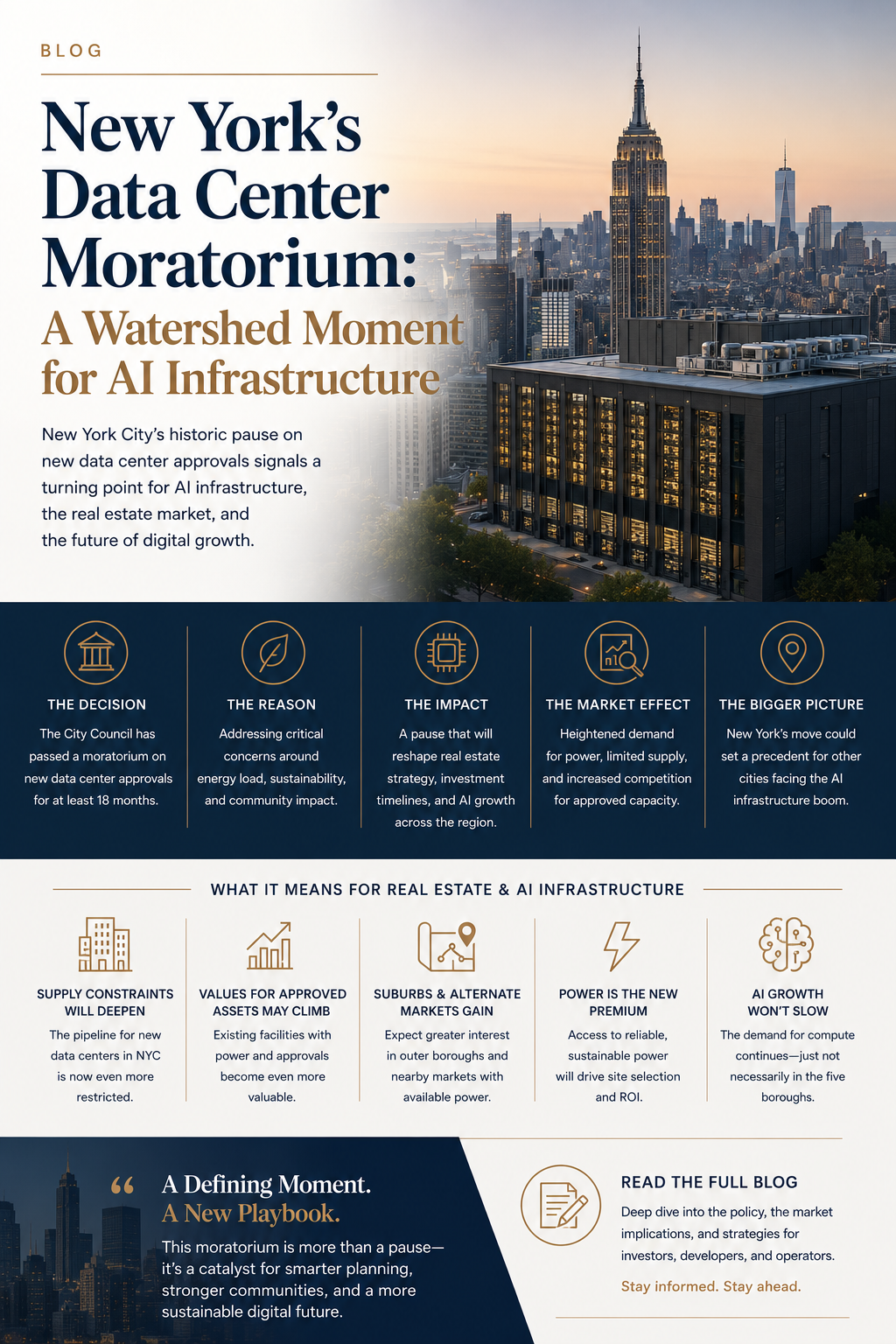
The First Domino Falls
New York State has made history, becoming the first jurisdiction in the nation to pause large-scale data center development. Governor Kathy Hochul’s executive order establishes a one-year moratorium on facilities consuming 50 megawatts or more—enough electricity to power roughly 50,000 homes continuously. This isn’t merely a regulatory speed bump; it represents a fundamental recalibration of how states will approach the explosive growth of artificial intelligence infrastructure.
The significance cannot be overstated. With more than 1,500 data centers in various planning stages nationwide and AI adoption accelerating at breakneck speed, New York’s action sends shockwaves through an industry accustomed to a more welcoming regulatory environment. The moratorium signals that the era of unfettered data center expansion is ending, replaced by an era of scrutiny, negotiation, and conditional approval.
At its core, this policy shift reflects a growing recognition that digital infrastructure carries physical consequences. Every data center represents not merely a technological investment but a concrete commitment of resources—land, water, electricity, and community goodwill. The aggregate impact of these facilities has reached a tipping point where individual project approvals can no longer be considered in isolation. New York’s action, whether ultimately sustained or modified, has permanently altered the terms of debate around data center development.
The Rationale Behind the Pause
The Energy Conundrum
Data centers are among the most electricity-intensive facilities in the modern economy. A single 50-megawatt facility consumes enough power to support a small city, and when clustered in regions like Northern Virginia’s “Data Center Alley,” these facilities strain grid infrastructure to its breaking point. The concern isn’t theoretical—utilities across the country have warned that data center growth threatens grid reliability and could force rate increases for residential customers.
The numbers are staggering. According to the Electric Power Research Institute, data centers could consume up to 9% of U.S. electricity generation by 2030, up from approximately 4% currently. This exponential growth curve collides with the reality that most regional grids were not designed for such concentrated loads. In some markets, the queue for new utility connections stretches years into the future, creating a bottleneck that threatens to choke the AI revolution before it fully matures.
The timing of New York’s moratorium is particularly significant given broader energy trends across the Northeast. The region’s grid faces unique challenges, including limited transmission capacity, aging infrastructure, and the retirement of fossil fuel generation. Adding massive new loads without corresponding grid investments risks a cascade of reliability challenges, particularly during extreme weather events when both heating and cooling demands peak.
Beyond grid capacity, the carbon implications of data center energy consumption merit scrutiny. While many technology companies have made ambitious renewable energy commitments, the reality is that data centers draw power from the grid, and most U.S. grids remain heavily reliant on fossil fuels. The gap between corporate sustainability pledges and actual electricity consumption continues to widen as AI workloads proliferate.
The Resource Depletion Question
Beyond electricity consumption, data centers require enormous quantities of water for cooling—often in regions already experiencing water stress. A typical hyperscale facility can consume 3-5 million gallons of water per day, equivalent to the daily usage of a town of 30,000 residents. This puts data centers in direct competition with municipalities, agriculture, and ecosystems for increasingly scarce water resources.
The water consumption issue intersects with climate change in concerning ways. Regions projected to experience increased drought frequency, including the Southwest and parts of the Southeast, are precisely the areas where data center development has been most active. This creates a fundamental mismatch between resource availability and industry demand, one that moratoriums and stricter regulation seek to address.
The environmental justice dimension adds another layer of complexity. Data centers tend to cluster in lower-income communities that offered attractive incentives during earlier development waves. These same communities often bear the brunt of environmental impacts, including air pollution from backup generators, noise from cooling equipment, and visual blight from sprawling industrial campuses. The cumulative effect of multiple facilities in proximity compounds these impacts, raising legitimate concerns about the equitable distribution of infrastructure burdens.
The Tax Incentive Debate
Perhaps the most contentious element of New York’s action is the plan to repeal sales tax exemptions currently offered to large data center developments. These incentives have been central to the industry’s expansion model, effectively subsidizing construction costs and creating a race-to-the-bottom competition among states to offer the most generous packages.
The economic argument for these incentives has always been employment—data centers create construction jobs and a modest number of permanent positions. However, critics have long pointed out that the jobs-to-investment ratio is remarkably poor. A $1 billion data center might create only 50-100 permanent jobs, representing an effective subsidy of $10-$20 million per job created. This math has become increasingly difficult to justify to taxpayers and legislators, particularly when the facilities generate significant environmental impacts and grid costs.
The incentive landscape is further complicated by the fact that data centers generate substantial property tax revenue, creating a fiscal benefit that is difficult to quantify precisely but is nonetheless substantial. The question is whether sales tax exemptions are necessary to secure this property tax base, or whether developers would proceed regardless of the marginal incentive. The evidence suggests that data center growth is driven primarily by demand for computing capacity rather than by tax incentives, but the industry has successfully argued that exemptions are essential to maintain competitiveness.
New York’s move to repeal these exemptions signals a broader reassessment of whether tax incentives actually achieve their stated objectives. The trend across states and municipalities suggests that the era of unquestioning incentive packages is ending, replaced by a more skeptical approach that demands tangible returns for any public investment.
The National Ripple Effect
A Tipping Point in State Policy
New York’s action has ignited a legislative firestorm. At least 14 other states are actively considering similar moratoriums or bans, including Georgia, New Hampshire, Oklahoma, Pennsylvania, South Carolina, South Dakota, and Vermont. This represents a dramatic shift from just two years ago, when states competed aggressively to attract data center investment.
What explains this rapid policy evolution? Several factors converge:
Grid constraints have become impossible to ignore. In Virginia, Dominion Energy has frozen new data center connections in parts of Northern Virginia due to capacity limitations. In Texas, ERCOT has warned that data center growth could threaten grid reliability during extreme weather events, particularly during winter storms when natural gas supply is constrained.
Residential ratepayer impact has emerged as a potent political issue. Utilities often recover the costs of grid upgrades from all ratepayers, meaning that residential customers effectively subsidize the infrastructure required to serve data centers. This regressive subsidy structure has drawn bipartisan criticism, with both conservative and liberal legislators questioning why homeowners should bear costs that benefit multinational technology corporations.
Environmental concerns have moved from niche to mainstream. The carbon footprint of AI training and inference is substantial, with some estimates suggesting that training a single large language model produces as much CO2 as five cars over their entire lifetimes. As AI applications proliferate, the cumulative emissions become increasingly difficult to reconcile with climate commitments.
Community opposition has intensified as more residents become aware of the impacts of data centers. No longer a niche concern, data center development now draws organized opposition, with neighbors concerned about noise, aesthetics, property values, and quality of life.
The Industry Response
Attorney David Rubenstein, who represents data center developers across 15 states, captured the industry’s anxiety: the spreading moratoria will have a chilling effect in states that appear vulnerable to this policy trend. The development pipeline will inevitably shift toward reliably friendly jurisdictions like Texas and Virginia—at least in the short term.
However, this migration may prove temporary. Texas faces its own grid challenges, and Virginia’s capacity constraints are already biting. No state remains immune to the fundamental tension between data center growth and infrastructure capacity. The developers who succeed in this environment will be those who embrace the inevitable shift toward more responsible development rather than resisting regulatory evolution.
Rubenstein’s analysis points to a broader industry reality: data center development has historically been treated as a relatively straightforward real estate proposition, with site selection driven primarily by power availability, connectivity, and tax incentives. The emerging regulatory environment demands a more sophisticated approach, incorporating community engagement, sustainability, and long-term relationship management as core competencies.
The Geopolitical Dimension
The data center moratorium debate occurs against a backdrop of intensifying competition with China in artificial intelligence. The United States seeks to maintain technological leadership while ensuring that critical AI infrastructure is secure from foreign interference. This creates tension with efforts to restrict data center development—how can the U.S. compete globally if it cannot build the facilities required for AI advancement?
The Department of Energy has identified data center development as a national security priority, and federal agencies are exploring streamlined permitting for facilities that support national security applications. This federal-state tension will likely be resolved through a tiered regulatory framework, with defense-related facilities receiving expedited approvals while commercial projects face continued scrutiny.
The national security dimension also intersects with supply chain considerations. The concentration of AI chip manufacturing in Taiwan adds another layer of vulnerability, with geopolitical uncertainty around the Taiwan Strait influencing data center planning. Developers are increasingly considering “onshoring” strategies to reduce geopolitical risk, but these efforts are constrained by domestic manufacturing capacity and the lack of a robust domestic semiconductor ecosystem.
The Regulatory Innovation Frontier
Beyond Simple Bans
The most sophisticated jurisdictions are moving beyond simple moratoriums toward more nuanced regulatory frameworks. New York’s “community investment framework” represents one approach—requiring developers to provide tangible benefits to host communities in exchange for approval rights.
This model draws on lessons from renewable energy development, where community benefit agreements have become standard practice. These agreements might include:
- Direct payments to local governments to offset infrastructure costs and provide fiscal benefits to host municipalities
- Community solar or battery storage projects that benefit local residents and contribute to renewable energy goals
- Workforce development programs that provide training and job placement for local residents, extending benefits beyond the limited permanent employment data centers directly provide
- Environmental mitigation measures that go beyond regulatory minimums, including preservation of open space, green building standards, and habitat restoration
Oregon has taken a different approach, becoming the first state to impose a price hike on electricity used by large data centers—raising fees nearly 30%. This pricing signal encourages efficiency while generating revenue for grid improvements. The Oregon model could prove influential, as it addresses the cost-causation principle directly, ensuring that data centers bear the full cost of their infrastructure demands rather than passing these costs to residential ratepayers.
Other jurisdictions are exploring requirements for renewable energy matching, water recycling, and backup power emissions controls. The regulatory toolkit is expanding rapidly, and developers who engage proactively with regulators may find opportunities to shape requirements that are both effective and achievable.
The Community Benefit Framework
New York’s commitment to developing a “data center community investment framework” within 60 days represents a significant policy innovation. While the details remain to be determined, the framework is expected to address several key dimensions:
Financial compensation to communities for infrastructure costs, including grid upgrades, water system improvements, and transportation infrastructure. This compensation might take the form of direct payments, tax revenue sharing, or infrastructure investments that benefit the broader community.
Environmental standards that go beyond baseline requirements, including renewable energy mandates, water efficiency targets, and emissions limits. These standards would ensure that data centers contribute to rather than undermine state climate goals.
Community engagement requirements that mandate meaningful consultation with residents, businesses, and other stakeholders before project approval. This engagement would be ongoing, ensuring that community concerns are addressed throughout the development lifecycle.
Labor standards that ensure data center construction and operation create quality jobs with fair wages and benefits. This dimension addresses the persistent concern that data centers create few jobs, ensuring that the jobs they do create provide meaningful economic benefits.
Decommissioning requirements that ensure facilities are responsibly closed and sites restored at the end of their useful life. This forward-looking provision addresses concerns about stranded assets and environmental liability.
The Federal Dimension
Federal regulators are also entering the fray. The Federal Energy Regulatory Commission has directed utilities nationwide to improve infrastructure and adjust fees to ensure data center operators pay the costs of needed capacity upgrades. This “cost-causation” principle, if fully implemented, could transform the economics of data center development by eliminating cross-subsidies from residential ratepayers.
The Federal Communications Commission has also shown interest in data center regulation, particularly regarding backup generator emissions and emergency power systems. These facilities operate under different regulatory regimes depending on their classification, creating a patchwork of oversight that industry observers expect to be rationalized in coming years.
Federal agencies are also exploring their own data center initiatives. The General Services Administration, which manages federal real estate, has initiated a review of data center leasing and development practices. The Department of Defense, the largest single user of data center services, is developing its own standards for sustainability and security.
The federal role will likely grow as data centers become increasingly recognized as critical infrastructure with national security and economic implications. The challenge for federal regulators is to balance national interests with state and local concerns, recognizing that data centers have both national significance and local impacts.
Strategic Implications for Developers
The Adaptive Reuse Opportunity
Rubenstein’s suggestion that developers pursue “adaptive reuse” of vacant buildings with existing power connections offers a compelling path forward. This approach addresses many objections to new data center development while potentially reducing construction timelines and costs.
Several trends align to make adaptive reuse increasingly viable:
Office vacancy rates in many cities exceed 20%, creating a vast inventory of potential conversion sites. The shift toward remote work has left many office buildings underutilized, and some may find new purpose as data centers. This conversion can breathe new life into struggling urban cores while repurposing existing infrastructure.
Industrial building stock offers high ceilings, robust floor loading, and existing power infrastructure. Former manufacturing facilities, warehouses, and distribution centers often possess the physical characteristics that data centers require, including robust structural systems and high-capacity electrical connections.
Retail mall conversions are gaining traction as department store spaces are reimagined as data halls. The decline of traditional retail has created a glut of large-format retail space, much of which offers favorable locations and existing infrastructure.
Former data centers from earlier technology waves are becoming available as their original tenants consolidate or upgrade. These facilities offer ready-to-use infrastructure that can be updated and expanded.
However, adaptive reuse presents its own challenges. Building codes for data centers differ significantly from those for offices or retail, and existing buildings may require substantial structural upgrades. The power connections, while existing, may not be adequate for modern high-density computing loads. Cooling systems designed for human occupancy are typically inadequate for high-density computing environments.
Developers pursuing adaptive reuse must also navigate complex zoning and permitting issues, as many jurisdictions have not anticipated data center conversions in their land-use frameworks. However, communities may be more welcoming to projects that reuse existing buildings than to greenfield development, suggesting that adaptive reuse could become an increasingly important development pathway.
The Smaller-Footprint Strategy
The industry may see a shift away from gigawatt-scale projects toward smaller, more distributed facilities. This trend is already visible in edge computing, where smaller data centers are located closer to end users. The distributed model reduces transmission costs, improves latency, and may be more palatable to local communities.
Smaller facilities also enable developers to navigate regulatory hurdles more nimbly. Projects below certain size thresholds may avoid the most stringent review processes, allowing faster deployment while still meeting growing demand for computing capacity.
The economics of smaller facilities differ significantly from hyperscale campuses. While unit costs may be higher, the reduced regulatory friction and community opposition may offset these costs. Additionally, smaller facilities may be better positioned to match capacity to demand, avoiding the stranded capacity risk that plagues large-scale developments during market downturns.
The shift toward smaller facilities aligns with broader industry trends toward modular construction and prefabrication. These approaches reduce on-site disruption, shorten construction timelines, and improve quality control. As communities become more sensitive to construction impacts, modular approaches may offer compelling advantages.
The Storytelling Imperative
Rubenstein emphasized that the industry “has to start telling a different story” about data centers. This narrative shift would highlight:
Municipal budget benefits from property taxes and fees. Data centers can generate substantial property tax revenue, often exceeding the cost of municipal services they require. This fiscal benefit should be more effectively communicated to communities.
School funding through local tax allocations. In many jurisdictions, property taxes from data centers directly support local schools, providing a tangible community benefit that resonates with families.
Grid resiliency improvements that benefit all ratepayers. Data center development often drives grid upgrades that improve service reliability for all customers, including residential and commercial users.
Technological innovation that drives economic growth. Data centers enable the digital economy, supporting everything from healthcare advances to educational technology to business innovation.
This reframing is essential. The current narrative—of giant, power-hungry facilities that create few jobs while imposing costs on communities—is politically unsustainable. Industry stakeholders must demonstrate that data centers can be good neighbors, contributing meaningfully to host communities beyond mere economic output.
The storytelling imperative extends to transparency about environmental impacts. Developers who acknowledge and address sustainability concerns, rather than dismissing them, will build greater trust with communities and regulators. This includes honest communication about energy consumption, water usage, and emissions, combined with concrete action to minimize environmental footprints.
The Deeper Implications
The Social License of Technology
The data center moratorium debate raises profound questions about the social license of technology. Does society owe the tech industry unlimited access to resources in pursuit of digital advancement? Or must technological progress be reconciled with community interests and environmental constraints?
The technology industry has historically enjoyed a privileged regulatory position, with many jurisdictions competing aggressively to attract facilities. This competition has often resulted in generous incentives, expedited approvals, and limited scrutiny. The emerging regulatory environment suggests that this era is ending.
Several factors have eroded the industry’s social license. The concentration of wealth and power in technology companies has generated backlash, as has the industry’s perceived indifference to social and environmental concerns. Data center development, as the physical manifestation of digital infrastructure, has become a focal point for broader anxieties about the technology industry’s role in society.
Rebuilding social license requires genuine engagement with communities, transparency about operations, and demonstrable commitment to public benefit. This is not merely a public relations exercise but a fundamental reorientation of how the industry approaches its relationships with host communities.
The Geography of Innovation
The AI revolution will not be evenly distributed geographically. The data center moratorium debate will influence where innovation happens, with implications for regional economic development, workforce distribution, and national competitiveness.
Regions that welcome data center development may gain economic advantages, attracting technology investment and supporting the digital economy. However, these benefits come with costs, including environmental impacts, infrastructure demands, and community disruption. Regions that restrict data center development may maintain community character and environmental quality but risk economic marginalization.
The geography of data center development also intersects with the geography of energy production. Regions with abundant renewable energy resources may have competitive advantages, as data center developers seek to reduce their carbon footprints. This could accelerate the transition to renewable energy while channeling development toward areas with favorable resource endowments.
The concentration of data centers in certain regions, particularly Northern Virginia, raises concerns about resilience and security. Geographic concentration creates single points of failure, where a natural disaster or targeted attack could disrupt critical digital infrastructure. More distributed development patterns may enhance resilience while reducing the regulatory scrutiny that concentration attracts.
The Distribution of Benefits
How can the economic benefits of data centers be more equitably shared, ensuring that host communities receive meaningful returns rather than merely bearing environmental and infrastructure costs?
This question cuts to the heart of the regulatory challenge. The current model of data center development often leaves communities with the costs while benefits flow to distant shareholders and technology users. The shift toward more robust community benefit frameworks seeks to redress this imbalance.
Potential models for more equitable benefit distribution include:
Revenue sharing that allocates a percentage of data center revenues to community development funds. This model ensures that as data centers grow and become more profitable, host communities share in that growth.
Community ownership models where communities hold equity stakes in data center facilities. While complex to implement, this model aligns community interests with project success.
Targeted workforce development that creates pathways to permanent employment for local residents. This includes apprenticeships, training programs, and hiring preferences for qualified local applicants.
Infrastructure investments that benefit the broader community, including broadband deployment, electric vehicle charging infrastructure, and renewable energy projects.
These models require creative policy design and developer willingness to share value. As community opposition to data centers grows, developers may find that generous benefit sharing is more cost-effective than fighting regulatory restrictions.
The Environmental Cost of AI
What is the acceptable carbon and water footprint of artificial intelligence, and who decides?
This question has no easy answer. AI offers immense benefits, from medical breakthroughs to climate modeling to scientific discovery. However, these benefits come at environmental costs that are just beginning to be understood.
The environmental cost of AI extends beyond data centers to chip manufacturing, network infrastructure, and device production. The full lifecycle carbon footprint of AI is substantial, and the industry has not fully grappled with these implications.
Transparency about AI environmental costs is essential. Currently, few companies disclose comprehensive environmental data for AI systems, and there are no standardized metrics for comparing the environmental efficiency of different AI approaches. This information asymmetry makes informed public debate difficult.
Regulatory intervention may be necessary to ensure that environmental costs are considered in AI development decisions. This could include requirements for environmental impact assessments for large AI training runs, carbon pricing for data center electricity consumption, and water usage disclosure requirements.
The environmental cost question also intersects with AI policy more broadly. If AI offers the benefits its proponents claim, then environmental investments to support its infrastructure may be warranted. However, if AI systems are deployed for marginal applications, the environmental costs may be difficult to justify.
Looking Ahead: The New Normal
The data center industry is undergoing a fundamental transformation comparable to the shift from mainframe computing to client-server architecture. The era of abundant land, cheap power, and welcoming communities has ended. What follows will be characterized by:
Heightened regulatory scrutiny: Data centers will face the same level of environmental and land-use review as other industrial facilities, with community engagement processes that are both more demanding and more time-consuming. The era of expedited approvals and limited oversight is ending.
Higher development costs: The combination of reduced incentives, infrastructure requirements, and regulatory compliance will increase project costs substantially. This may accelerate consolidation among smaller developers while benefiting larger companies with the resources to navigate complex regulatory environments.
Stronger community partnerships: Developers who engage meaningfully with host communities—offering tangible benefits and addressing legitimate concerns—will be rewarded with smoother approvals and stronger community support. Those who resist this shift will face increasing opposition.
Decarbonization pressure: The climate implications of data center energy consumption will receive increased attention, with pressure to match electricity consumption with renewable generation and to improve energy efficiency. This pressure will come from regulators, investors, and communities.
Infrastructure investment: The data center boom will drive substantial investment in grid capacity, water infrastructure, and transportation networks. This investment will create opportunities for infrastructure development partnerships between the private sector and communities.
Technological innovation: The constraints on data center development will accelerate innovation in computing efficiency, cooling technology, and renewable energy integration. The industry will need to do more with less, driving efficiencies that may ultimately benefit all users of digital services.
Market consolidation: The increasing complexity of data center development will favor large developers with the resources to navigate regulatory challenges and the capital to invest in innovative sustainability solutions. Smaller developers may struggle to compete.
Sustainability as competitive advantage: Developers who can demonstrate superior environmental performance will have advantages in site selection, permitting, and community acceptance. Sustainability will move from a corporate social responsibility consideration to a core business competency.
Key Takeaways for Industry Stakeholders
Regulatory Risk Is Real and Growing: Developers should plan for more rigorous review processes in most jurisdictions, anticipating that moratoriums may become the exception rather than the rule. The trend line is clear and will not be reversed by industry lobbying alone.
Community Engagement Is Essential: Passive acceptance of data center development is ending. Developers must proactively address community concerns and demonstrate tangible local benefits. Engagement must begin early and continue throughout the project lifecycle.
Incentive Models Will Evolve: Tax exemptions and other financial incentives will face increasing scrutiny. Future projects should be underwritten with conservative assumptions about incentive availability, and developers should anticipate that incentives may be reduced or eliminated during project development.
Alternative Development Models Deserve Exploration: Adaptive reuse and distributed facilities may offer attractive alternatives to traditional hyperscale development, particularly in regulated jurisdictions. These approaches require different skills and partnerships but may offer superior risk profiles.
Grid Capacity Is the Binding Constraint: In many locations, utility connection limitations will constrain development more than regulatory restrictions. Early engagement with utilities is essential to identify viable sites and to develop realistic project timelines.
The Long-Term Trend Is Toward Integration: The most successful jurisdictions will integrate data center planning with broader infrastructure, economic development, and environmental objectives. Developers who can align their projects with these broader objectives will find more welcoming environments.
Sustainability Is Becoming Mandatory: Investors, communities, and regulators increasingly demand environmental performance. Developers who cannot demonstrate sustainability commitments will struggle to gain approvals and financing.
Partnerships Matter: The complexity of modern data center development requires sophisticated partnerships across technology, real estate, energy, and community sectors. Developers who can build and maintain these partnerships will have competitive advantages.
Transparency Builds Trust: Communities increasingly demand transparency about data center operations and impacts. Developers who resist transparency will face opposition, while those who embrace it may build credibility that facilitates approvals.
Adaptability Is Essential: The regulatory environment will continue to evolve, requiring developers to remain flexible and responsive. Projects that are designed with regulatory change in mind will be more resilient than those built on assumptions of regulatory stability.
Final Reflection
New York’s moratorium is not the beginning of the end for data center development, but rather the end of the beginning. The industry will adapt, evolve, and continue to grow—but the path forward will look different from the road behind. The communities that host these facilities, and the stakeholders who develop them, must navigate this transition with eyes wide open to both the opportunities and the challenges ahead.
The pause provides an opportunity—for developers to reconsider their approaches, for communities to articulate their needs, and for regulators to craft frameworks that serve all interests. Whether this opportunity translates into lasting change depends on the willingness of all parties to move beyond entrenched positions toward genuine solutions.
What is certain is that the old model is unsustainable. The era of data center development as a purely private enterprise with minimal public oversight has ended. What replaces it will be determined by the choices made in the coming months and years—choices that will shape not only the digital infrastructure of the United States but also the relationship between technological progress and democratic accountability.
The conversation is just beginning, but its outcome will define the contours of the AI era. Getting it right matters—for the industry, for the communities, and for the future of American technological leadership. The stakes could not be higher, and the time for thoughtful engagement is now.
Conclusion: The New Era of Data Center Development
A Fundamental Reckoning
New York’s moratorium on large-scale data center development represents far more than a temporary regulatory pause—it signifies a fundamental reckoning with the unbridled growth of digital infrastructure. The state’s action crystallizes tensions that have been building for years, bringing into sharp focus the uncomfortable trade-offs between technological advancement and community wellbeing.
What we are witnessing is the maturation of an industry that has outgrown its adolescent phase of rapid, unregulated expansion. Data centers are no longer exotic facilities hidden from public view; they are industrial operations with tangible impacts on electricity grids, water supplies, property values, and neighborhood character. The era of building first and asking questions later has ended, replaced by a more deliberative approach that balances competing interests.
The Enduring Tension
The fundamental tension at the heart of this debate will not be resolved by moratoriums alone. The demand for computing capacity—driven by artificial intelligence, cloud computing, and digital transformation—continues its exponential trajectory. Yet the physical infrastructure required to meet this demand cannot be conjured without consequence. Every data center represents a concrete commitment of resources that might otherwise serve residential communities, agricultural needs, or natural ecosystems.
This tension is particularly acute given the geopolitical context. The United States finds itself in a technological arms race with China, where AI supremacy carries national security implications. Restricting domestic data center development could be interpreted as unilateral disarmament, ceding technological leadership to authoritarian competitors. Yet failing to address legitimate concerns about energy consumption, environmental impact, and community disruption is equally untenable.
The path forward lies not in choosing one side of this tension, but in navigating it intelligently. This requires regulatory frameworks sophisticated enough to distinguish between beneficial development and harmful expansion, community engagement processes genuine enough to build trust, and industry practices responsible enough to warrant public acceptance.
A Policy Framework for the Future
Several principles should guide the evolution of data center regulation:
Transparency must become the default rather than the exception. Communities deserve clear information about the impacts of proposed facilities, including energy consumption, water usage, emissions profiles, and grid effects. This transparency should extend to ongoing operations, with real-time monitoring and public reporting.
Compensation should follow the polluter-pays principle. Data centers should bear the full cost of their infrastructure demands, eliminating cross-subsidies from residential ratepayers. This includes grid upgrades, water infrastructure, and environmental mitigation, with costs fully internalized rather than socialized.
Conditional approval replaces blanket denial as the standard regulatory response. Facilities that meet rigorous performance standards, offer demonstrable community benefits, and align with broader sustainability goals should receive expedited approvals.
Phased development accommodates growth while maintaining regulatory oversight. Rather than approving massive campuses in their entirety, communities should consider incremental expansion with regular performance reviews and the option to withdraw approval if commitments are not met.
Integration with broader planning ensures that data centers are considered as part of comprehensive infrastructure, economic development, and environmental strategies rather than as isolated projects.
The Path Forward for Developers
For industry stakeholders, the new regulatory environment demands adaptation:
Proactive community engagement must begin well before formal permitting processes. Developers who build relationships, address concerns transparently, and demonstrate genuine commitment to community wellbeing will find smoother paths than those who engage only when legally required.
Alternative development models deserve serious consideration. Adaptive reuse of existing buildings, distributed smaller-scale facilities, and innovative cooling technologies can reduce environmental footprints while still meeting growing computational demands.
Sustainability leadership offers competitive advantage. Developers who can demonstrate carbon neutrality, water efficiency, and grid compatibility will be preferred partners in increasingly selective jurisdictions.
Political sophistication has become essential. Understanding the regulatory landscape, building relationships with policymakers, and anticipating policy trends are critical to successful project execution.
Resilience planning for the post-incentive era is necessary. The era of generous tax exemptions and subsidies is ending. Future projects must be viable without assumption of public subsidies, with economic models built on intrinsic rather than subsidized returns.
The Broader Implications
The data center moratorium debate extends far beyond the facilities themselves. It raises profound questions about the social license of technology, the geography of innovation, the distribution of benefits, and the environmental cost of AI. These questions have no easy answers. They require ongoing public deliberation, robust democratic processes, and a willingness to make difficult choices that will inevitably displease some stakeholders.
The ultimate resolution will require all stakeholders—developers, communities, regulators, and technology users—to accept shared responsibility for ensuring that the digital infrastructure of the future serves the public good. This means acknowledging that data centers are necessary but not sufficient, valuable but not unlimited, and beneficial only when developed responsibly.
A Call for Balance
The data center industry stands at a crossroads. One path leads toward continued conflict, escalating community opposition, and increasingly restrictive regulation. The other path requires genuine transformation—embracing sustainability, community partnership, and responsible growth as core values rather than public relations strategies.
New York’s moratorium is not the final word on data center development, but it is a powerful signal. Communities are paying attention, and they will not be passive recipients of facilities that impose costs without offering commensurate benefits. Developers who understand this shift, and who adapt accordingly, will thrive in the new regulatory environment. Those who resist change will face increasing headwinds.
The pause in New York provides an opportunity—for developers to reconsider their approaches, for communities to articulate their needs, and for regulators to craft frameworks that will serve all interests. Whether this opportunity translates into lasting change depends on the willingness of all parties to move beyond entrenched positions toward genuine solutions.
What is certain is that the old model is unsustainable. The era of data center development as a purely private enterprise with minimal public oversight has ended. What replaces it will be determined by the choices made in the coming months and years—choices that will shape not only the digital infrastructure of the United States but also the relationship between technological progress and democratic accountability.
The conversation is just beginning, but its outcome will define the contours of the AI era. Getting it right matters—for the industry, for the communities, and for the future of American technological leadership. The path forward demands not confrontation but collaboration; not denial of challenges but acknowledgment and action; not defense of the status quo but embrace of necessary transformation. The future of data center development, and the digital economy it supports, depends on the choices made today.

Join The Discussion