
 by
by 
Wall Street’s New Apartment Debt Strategy: Multifamily-Only CMBS Deals Signal a Shift in Commercial Real Estate Finance
JPMorgan Chase and Citigroup have launched apartment-only CMBS offerings totaling more than $1.5 billion — a structural break from decades of diversified commercial mortgage pools. The hero infographic below maps how commercial real estate finance is shifting toward multifamily housing as bond investors accept sector concentration in exchange for stronger fundamentals, and why Wall Street lenders view apartment securitizations as the next evolution in multifamily-only CMBS capital markets.

This hero infographic presents a comprehensive visual overview of Wall Street’s emerging apartment debt strategy and the rise of multifamily-only CMBS as a distinct segment within commercial real estate finance. The graphic frames the central thesis of the article: after decades in which CMBS investors relied on diversification across office, retail, hotel, industrial, and apartment collateral, major banks are now testing securitizations backed exclusively by multifamily loans. Key deal callouts reference JPMorgan Chase’s $734.2 million multifamily-focused offering and Citigroup’s planned $816.9 million apartment-only securitization, positioning both transactions as evidence that bond buyers are willing to concentrate risk in one of commercial real estate’s strongest-performing sectors. Visual elements likely contrast the traditional mixed-property CMBS model against the new single-sector structure, highlighting why lenders and investors see apartment fundamentals — steady renter demand, lower historical default rates, and support from agency programs at Fannie Mae and Freddie Mac — as sufficient compensation for reduced diversification. The infographic also situates these deals within the broader post-pandemic financing landscape shaped by higher interest rates, housing affordability pressures, and weakness in sectors such as office real estate. For readers tracking private capital flows into defensive real estate assets, this visual establishes the article’s core narrative: apartment-only CMBS may become an important new financing channel for the next generation of multifamily investment, complementing rather than replacing government-sponsored lending programs.
The hero infographic above anchors the article’s central argument: multifamily-only CMBS is not a minor product tweak but a meaningful departure from how commercial mortgage markets have operated for decades. By visualizing JPMorgan and Citigroup’s apartment-only pipelines alongside the forces reshaping multifamily financing, the graphic gives investors, borrowers, and analysts a quick reference for understanding why Wall Street is betting on housing-backed bonds at a moment when other property types face structural headwinds.
A New Chapter Begins in the Commercial Mortgage Market
For decades, diversification has been the foundation of the commercial mortgage-backed securities (CMBS) market. Investors typically bought bonds backed by a mix of property types — office buildings, hotels, retail centers, industrial assets, and apartments — to spread risk across sectors.
That model is now being tested.
JPMorgan Chase and Citigroup, two of Wall Street’s biggest players, have introduced a new approach: CMBS deals backed exclusively by apartment properties.
These apartment-only securitizations mark a real shift in investor behavior. Rather than seeking broad diversification, investors seem increasingly willing to concentrate their exposure in one of commercial real estate‘s strongest-performing segments: multifamily housing.
The trend fits into a larger transformation in real estate finance, as capital markets adjust to a post-pandemic landscape shaped by higher interest rates, housing affordability pressures, uncertainty in the office sector, strong rental demand, and a growing investor appetite for defensive assets.
If it holds, apartment-only CMBS could become a new financing model for the next generation of multifamily investment.
JPMorgan and Citigroup Test a New CMBS Structure
These recent deals mark a real departure from standard CMBS practice.
JPMorgan launched a $734.2 million multifamily-focused CMBS offering, and Citigroup followed shortly after with a planned $816.9 million apartment-only securitization.
What sets these transactions apart is the absence of the usual property mix. Traditional CMBS pools typically combine loans secured by office properties, retail centers, hotels, industrial facilities, and apartment communities. These new deals strip that mix down to a single sector, creating a far more specialized investment product.
The open question is whether this is a passing trend or the start of a lasting shift in how commercial real estate gets financed.
Why Investors Are Favoring Multifamily Assets
The growing appetite for apartment-backed securities reflects the strong fundamentals behind rental housing.
With mortgage rates and home prices staying elevated, many households are delaying homeownership, which is building a larger, longer-term pool of renters. Apartments also benefit from a kind of demand few other commercial sectors can claim: housing is a basic need, not a discretionary purchase. Historically, multifamily properties have posted lower default rates and stronger recoveries than office or retail assets. And the sector has an added layer of support from government-backed liquidity, through programs at Fannie Mae and Freddie Mac.
Together, these factors make multifamily one of the most attractive segments for both lenders and bond investors.
The Market Is Trading Diversification for Quality
CMBS investors have long relied on cross-sector diversification to manage risk — but the comparison chart below illustrates why many bond buyers are now prioritizing asset quality over property-type breadth. As office real estate faces hybrid-work headwinds and refinancing pressure, the infographic maps how multifamily housing concentration is replacing the traditional mixed-collateral CMBS model that defined commercial mortgage markets for decades.
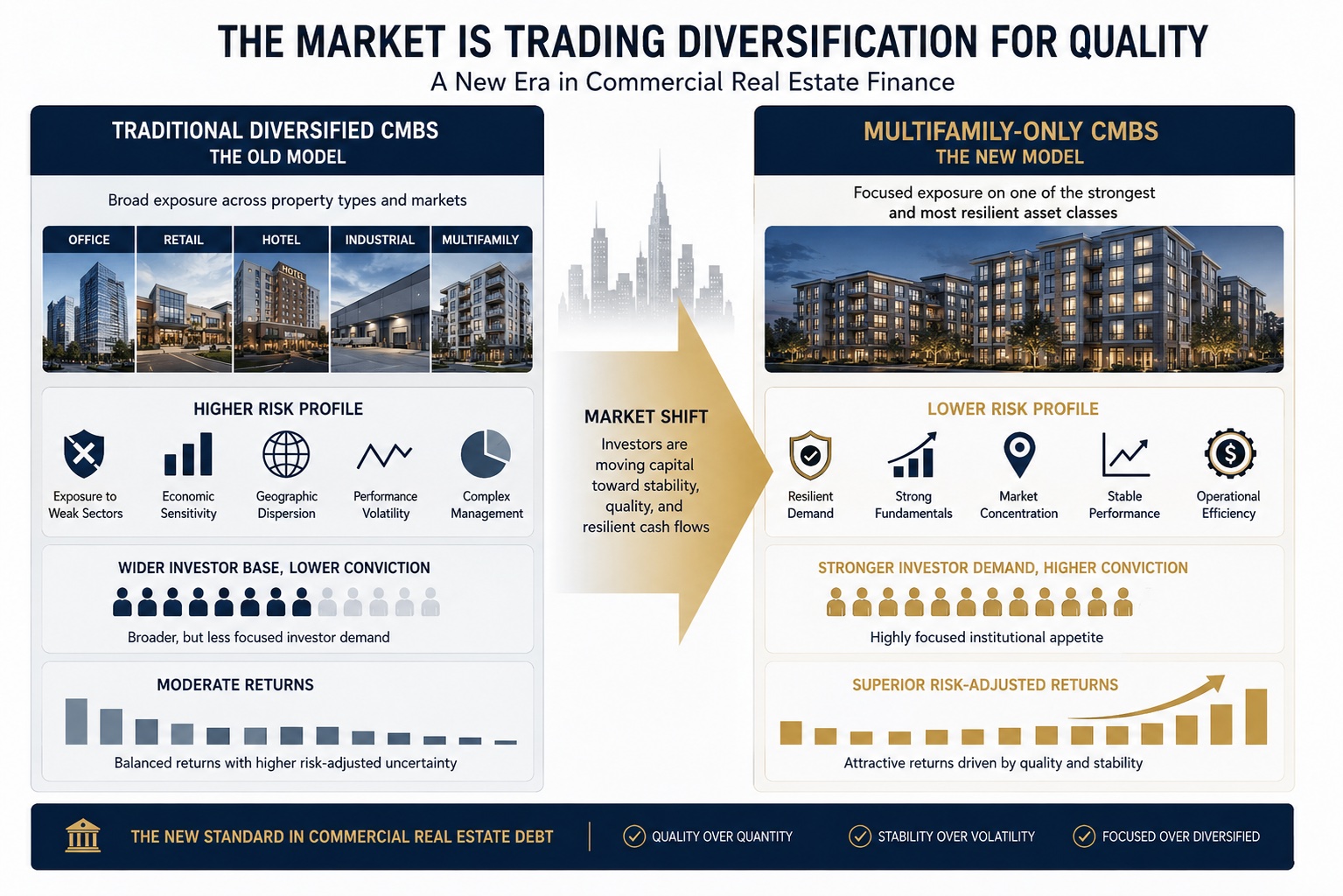
This infographic visualizes one of the most important structural shifts in the CMBS market today: the trade-off between diversification and quality. For decades, commercial mortgage-backed securities were structured around a simple premise — if office properties underperformed, stronger results from hotels, retail, or industrial assets could offset losses within the same bond pool. The graphic likely presents a side-by-side or comparative framework showing how that logic is breaking down across major property sectors. On one side, struggling categories such as office — burdened by hybrid work, rising vacancies, and costly refinancings — and selective retail and hotel segments face persistent economic headwinds. On the other, multifamily apartments have maintained relatively strong occupancy, steady rental demand, and favorable long-term demographic support. The visual may quantify or categorize performance differentials, default histories, or investor preference trends that explain why bond buyers increasingly accept concentration risk in apartments rather than maintain broad sector diversification. Callouts may reference the broader move toward defensive assets in commercial real estate, the role of private capital in filling financing gaps, and how specialized CMBS products align with the JPMorgan and Citigroup apartment-only deals discussed elsewhere in this article. For analysts evaluating whether multifamily-only securitizations represent a lasting market shift or a temporary response to sector divergence, this chart provides the comparative context needed to understand why quality and stability may now outweigh diversification itself as the primary driver of CMBS investor behavior.
The diversification-versus-quality chart above makes the sector divide tangible for CMBS investors evaluating apartment-only deals. With office real estate continuing to absorb losses while apartments hold steady, the visual explains why bond buyers may willingly forgo cross-sector protection — a dynamic that directly supports the rise of multifamily-only CMBS and the broader reallocation of institutional capital toward defensive multifamily assets.

Join The Discussion