 by
by 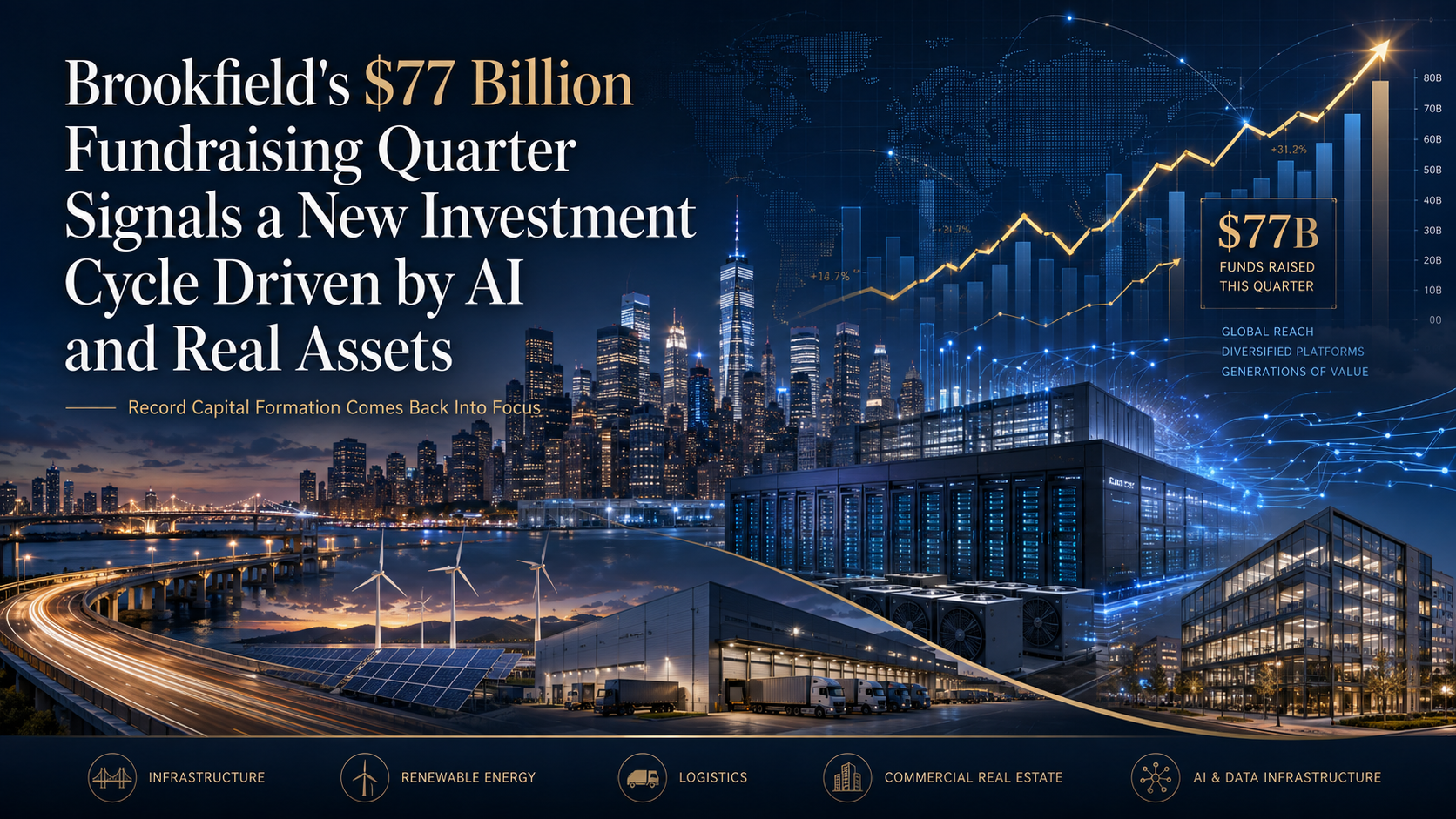
Brookfield’s $77 Billion Fundraising Quarter Signals a New Investment Cycle Driven by AI and Real Assets
Brookfield raised a record $77 billion in Q2 as institutional capital returns to real estate and AI infrastructure, data centers, power and real assets reshape the next investment cycle.
Record Capital Formation Comes as Institutional Investors Return to Real Estate and Brookfield Expands Its AI Infrastructure Strategy
Artificial intelligence is no longer just reshaping the technology industry — it’s starting to redirect where some of the world’s largest institutional investors put their money.
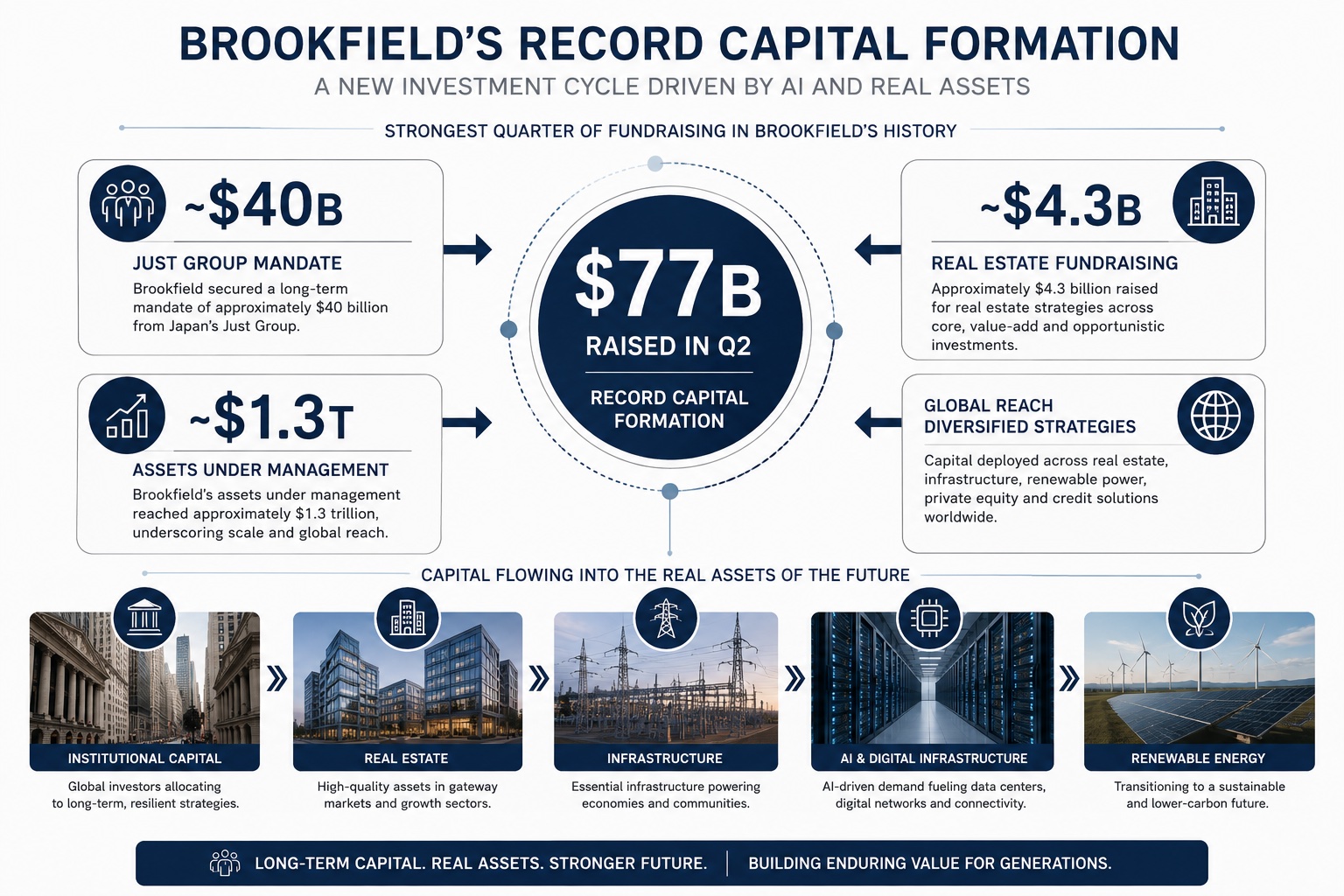
Brookfield Asset Management raised approximately $77 billion during the second quarter, a quarterly record for the global alternative asset manager, as demand grows for infrastructure, real estate, energy, and assets tied to the buildout of artificial intelligence.
The scale is notable even for a firm of Brookfield’s size, which oversees roughly $1.3 trillion in assets across its investment businesses.
A large share of the quarter’s total came from an agreement under which Brookfield will manage approximately $40 billion for UK retirement and insurance company Just Group. Beyond that mandate, capital kept flowing into Brookfield’s other strategies, including about $4.3 billion raised specifically for real estate.
The timing matters. After several years defined by higher interest rates, valuation uncertainty, and thin transaction volume, Brookfield says institutional investors are starting to come back to the market. At the same time, AI infrastructure investment is creating an entirely new category of large-scale investment opportunity — one built around data centers, power generation, transmission, digital connectivity, and industrial-scale development.
Real Estate Investment Activity Is Accelerating Again
One of the most telling signals from the quarter is the pickup in real estate transaction activity.
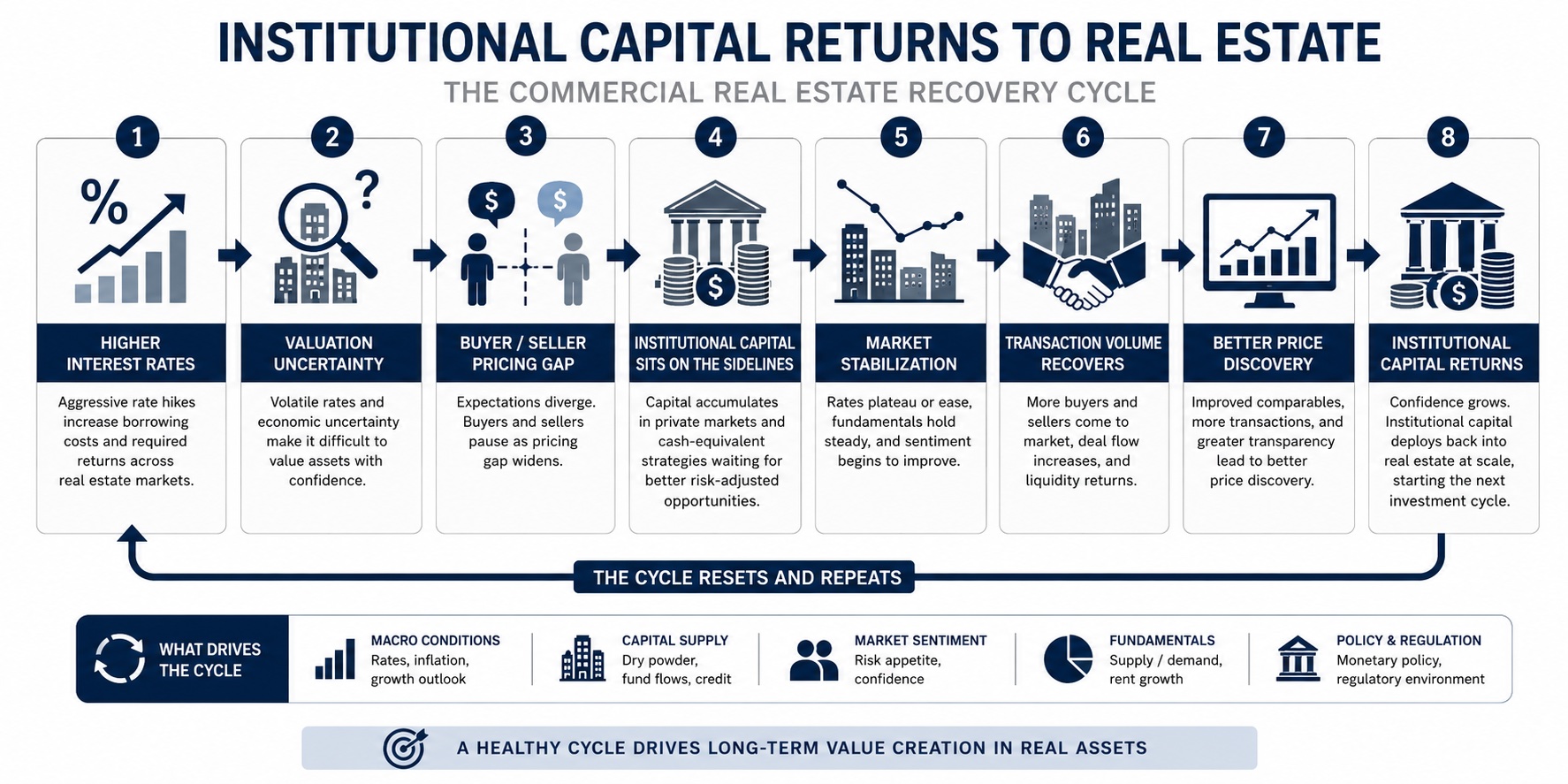
Commercial property has spent much of this cycle adjusting to higher financing costs. Rising rates pushed capitalization rates higher across many sectors, clouded valuations, and left both buyers and sellers reluctant to transact. The result was a persistent gap between what owners wanted for their properties and what buyers were willing to pay. Large institutional investors responded by sitting on the sidelines, building up capital while waiting for clearer pricing.
Brookfield now says that period of hesitation is beginning to ease. Management noted that investor sentiment has improved and that sidelined capital is gradually moving back into deals.
If that trend holds, the implications could ripple across the broader commercial real estate industry. More transaction volume means more comparable sales, better price discovery, and clearer information for lenders, buyers, appraisers, and owners trying to gauge current asset values. In effect, transactions themselves can help unlock a market that uncertainty has kept frozen.
Brookfield Deploys $5.2 Billion Into Real Estate
Brookfield wasn’t just raising capital — it was putting it to work. The firm deployed approximately $5.2 billion into real estate during the second quarter, a sign of its willingness to move on large acquisitions as opportunities surface.

Among the deals was the acquisition of a major privately held manufactured-housing portfolio reported to be Yes! Communities, along with Brookfield’s participation in the take-private acquisition of Peakstone Realty Trust.
These transactions point to a defining feature of the current cycle: institutional investors aren’t returning to every property type equally. Capital is concentrating in sectors with durable demand, constrained supply, attractive entry pricing, or clear room to improve operations. That’s producing an increasingly segmented commercial real estate market — a high-quality industrial portfolio, manufactured-housing platform, data center, or modern logistics asset can draw strong institutional interest, while an aging office property in a structurally challenged location faces a very different financing environment.
The recovery, in other words, may have less to do with a broad rebound in property values and more to do with capital aggressively chasing favored sectors.
Record Fundraising Creates Acquisition Firepower
Brookfield’s record fundraising also hands it a strategic edge: dry powder. Periods of market disruption often produce some of the best buying opportunities for large alternative asset managers. Owners facing loan maturities, refinancing troubles, fund expirations, or shifting portfolio strategies may need to sell even in an imperfect market — and investors with substantial committed capital can move quickly when those situations arise.
That dynamic is especially relevant in commercial real estate, where the adjustment to higher rates is still playing out. Many properties financed during the low-rate era now face refinancing under very different lending conditions. As those maturities hit, some owners will recapitalize, others will inject additional equity, some properties will be refinanced at lower leverage — and some will simply be sold. Large pools of institutional capital are well positioned to capture that transition, a theme explored further in Brookfield’s capital deployment and realization cycle.
AI Infrastructure Is Becoming a New Real Asset Investment Class
Artificial intelligence is one of the clearest examples of where institutional capital is now concentrating. The extraordinary growth of generative AI depends on physical infrastructure at enormous scale. AI models don’t run in the abstract — they depend on facilities packed with specialized computing hardware, networking equipment, and sophisticated cooling systems. Those facilities need land, buildings, and above all, enormous amounts of reliable electricity.
That’s why the AI investment boom increasingly overlaps with several traditional real asset categories: data centers, power generation, electrical transmission, utilities, industrial land, fiber networks, and broader infrastructure development.
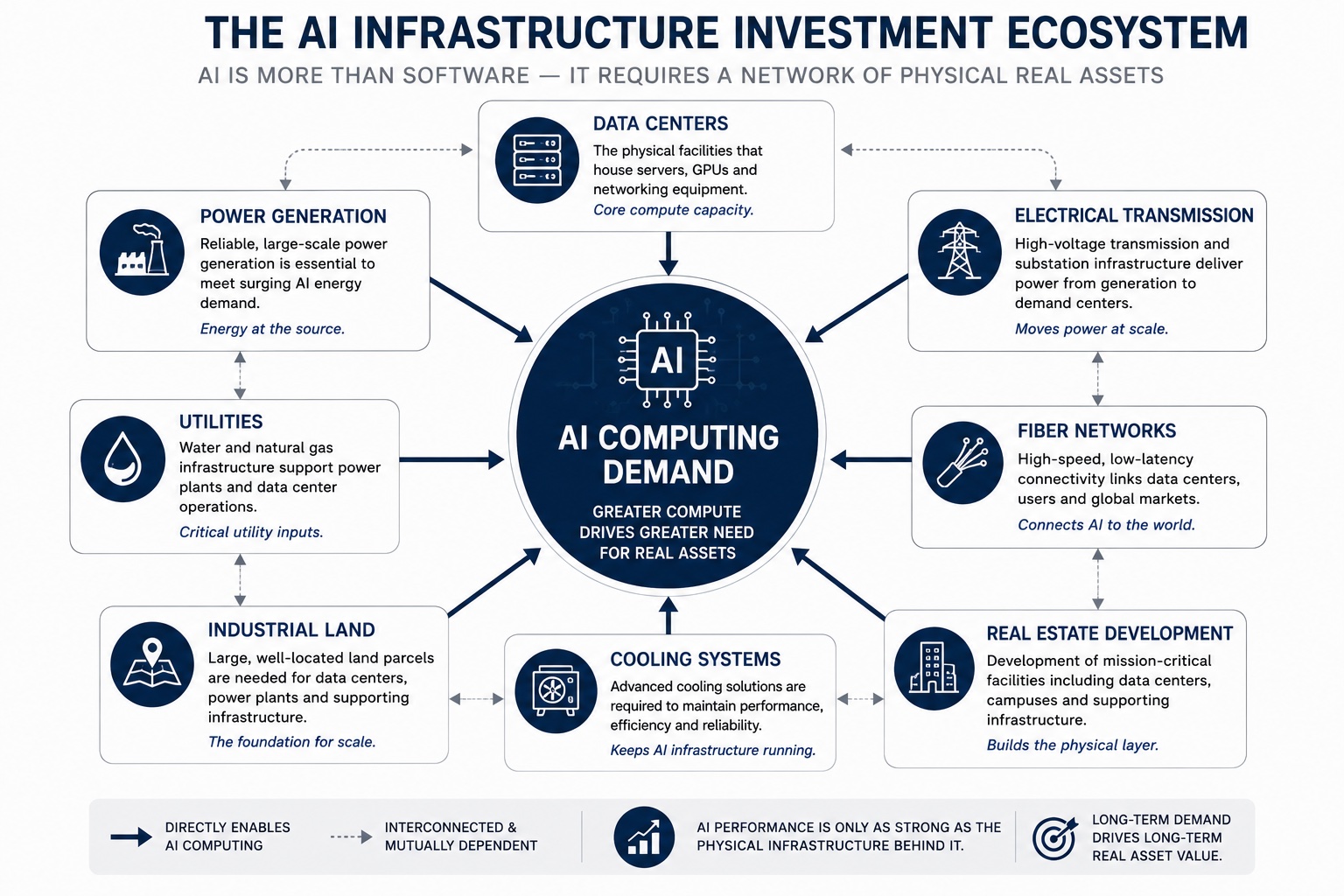
For asset managers that can invest across all of these categories, the opportunity extends well beyond simply owning data center buildings. Brookfield is particularly well positioned here, since its investment businesses already span real estate, infrastructure, renewable power, energy transition strategies, and private capital.
Why Power Is Becoming as Important as Location
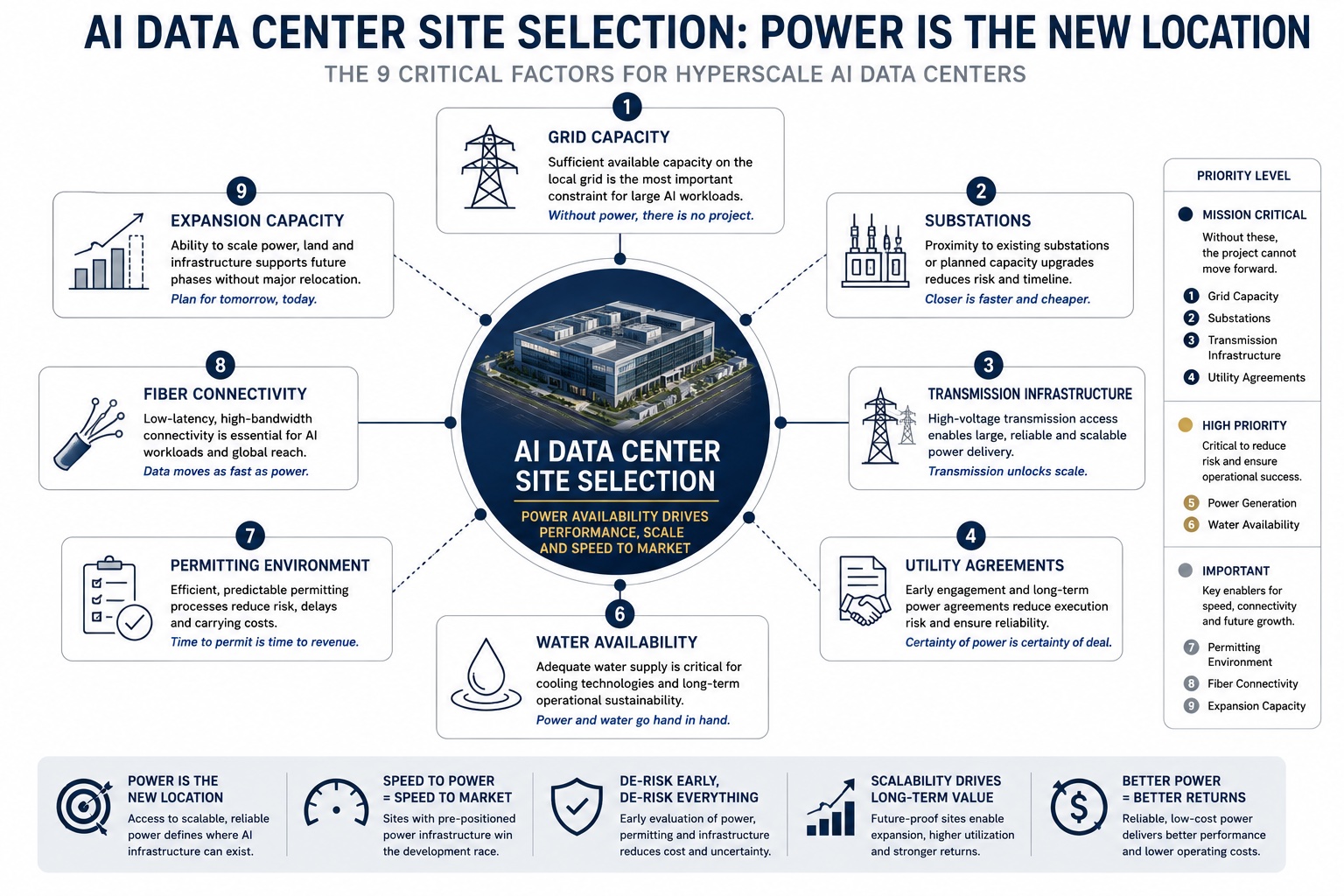
Traditional commercial real estate has always been driven by location. For data centers supporting AI, another factor is quickly becoming just as important: access to electricity.
The next generation of AI computing facilities can require extraordinary amounts of power, and that’s changing how sites get chosen. Developers now have to weigh grid capacity, proximity to substations, transmission infrastructure, utility agreements, generation resources, permitting environments, water availability, and room to expand energy capacity over time. In some markets, securing enough power availability has become harder than acquiring the land itself.
As a result, properties near substantial energy infrastructure can carry strategic value even when they sit far from traditional commercial real estate hubs. The relationship between technology and energy infrastructure is quickly becoming one of the defining real estate themes of the AI era.
Technology, Energy and Commercial Real Estate Are Converging
AI may look like a technology story on the surface, but its expansion carries enormous physical requirements. Those requirements create demand for land. Land creates development opportunities. Development requires financing. Data centers require electrical infrastructure, and electrical infrastructure requires generation and transmission capacity. An AI investment can therefore become a technology, infrastructure, energy, and commercial real estate investment all at once.
Few global asset managers operate at meaningful scale across all of those categories. Brookfield does — which helps explain why the firm is pushing aggressively into AI infrastructure while simultaneously ramping up real estate investment.
Inside Brookfield’s AI Infrastructure Strategy
Brookfield has been steadily building out its exposure to this opportunity. The firm previously launched an AI infrastructure investment initiative alongside Nvidia and the Kuwait Investment Authority, pairing institutional capital with technology-sector expertise. It also appointed longtime executive Sikander Rashid as global head of AI infrastructure — a signal that Brookfield views AI infrastructure as a distinct, long-term investment category rather than a side extension of its existing data center business.
The Scale of Future AI Development
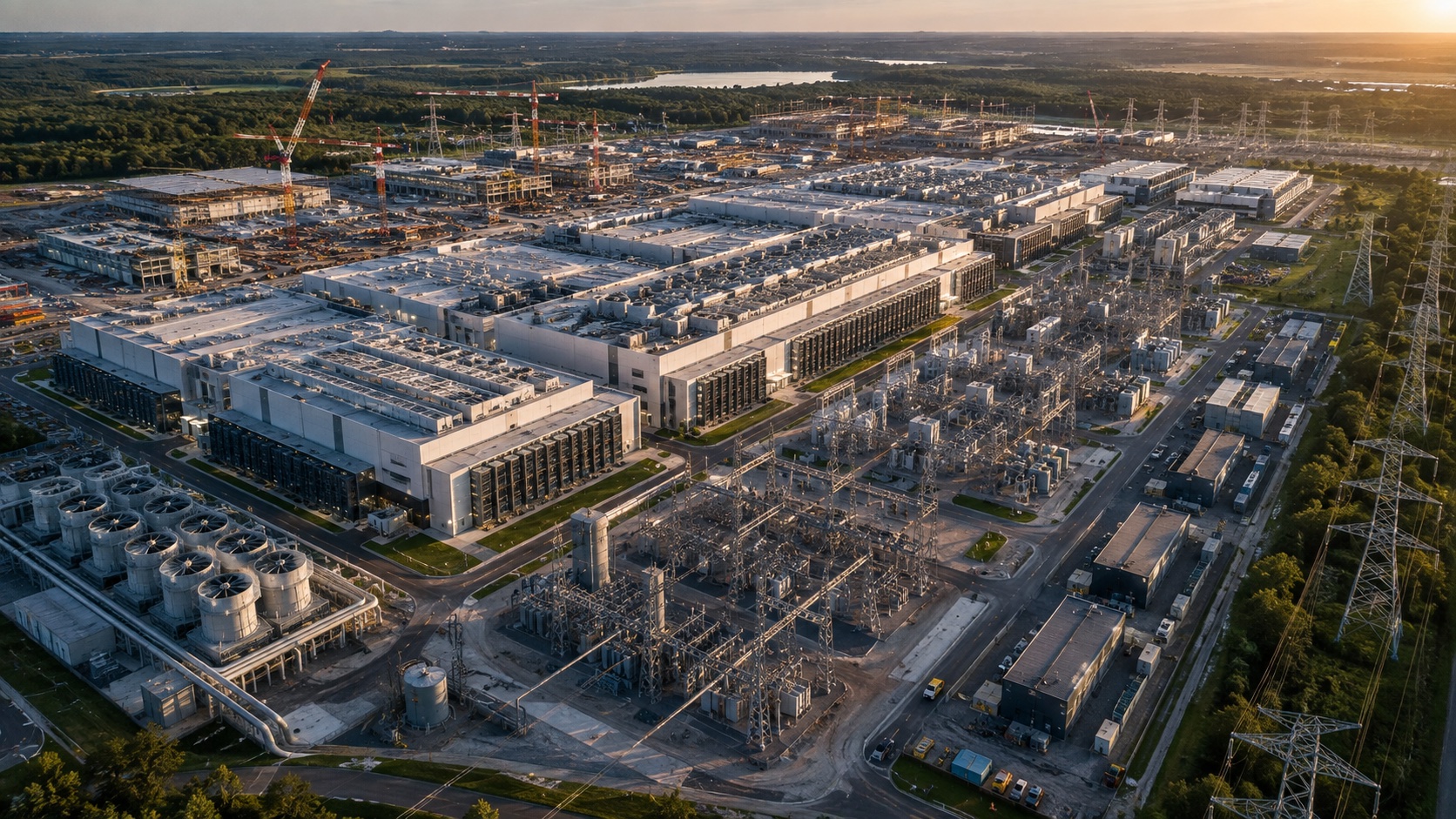
The firm’s ambitions extend to some genuinely massive projects. Among them is a proposed $100 billion AI-focused data center campus in Kentucky, supported through a U.S. Department of Energy-related initiative.
Projects at this scale show just how much data center development has changed. A conventional commercial building gets evaluated mainly on construction cost, rent, occupancy, and cap rate. A hyperscale AI campus requires analysis of a far larger ecosystem — energy generation, utility capacity, transmission, computing infrastructure, environmental considerations, financing, and potentially government involvement. That makes AI infrastructure look increasingly like major industrial and energy development, rather than conventional commercial property construction.
Could the Data Center Market Become Overbuilt?
The sheer volume of capital flowing into AI infrastructure has inevitably raised concerns about overbuilding. Data center announcements have accelerated across the U.S. and internationally as technology companies and investors compete for computing capacity, and whenever capital enters a sector this fast, questions about speculative development follow.
The risk is straightforward: if developers build capacity faster than technology companies ultimately need it, some markets could end up with excess supply, weaker economics, and declining returns.
Brookfield’s management has acknowledged those concerns but maintains that its own approach is disciplined, saying it doesn’t intend to deploy capital simply because AI infrastructure has become popular with investors. That distinction is likely to matter more as the sector matures. The strongest projects will probably be those backed by contracted demand, credible technology tenants, secure power access, solid infrastructure, and realistic development economics — while projects built mainly on expectations of unlimited AI growth could carry considerably more risk. For a parallel look at how another major alternative manager is approaching digital infrastructure, see our analysis of AI data center investment through Blackstone REIT.
Brookfield’s Investment Machine: Raise, Deploy and Realize Capital
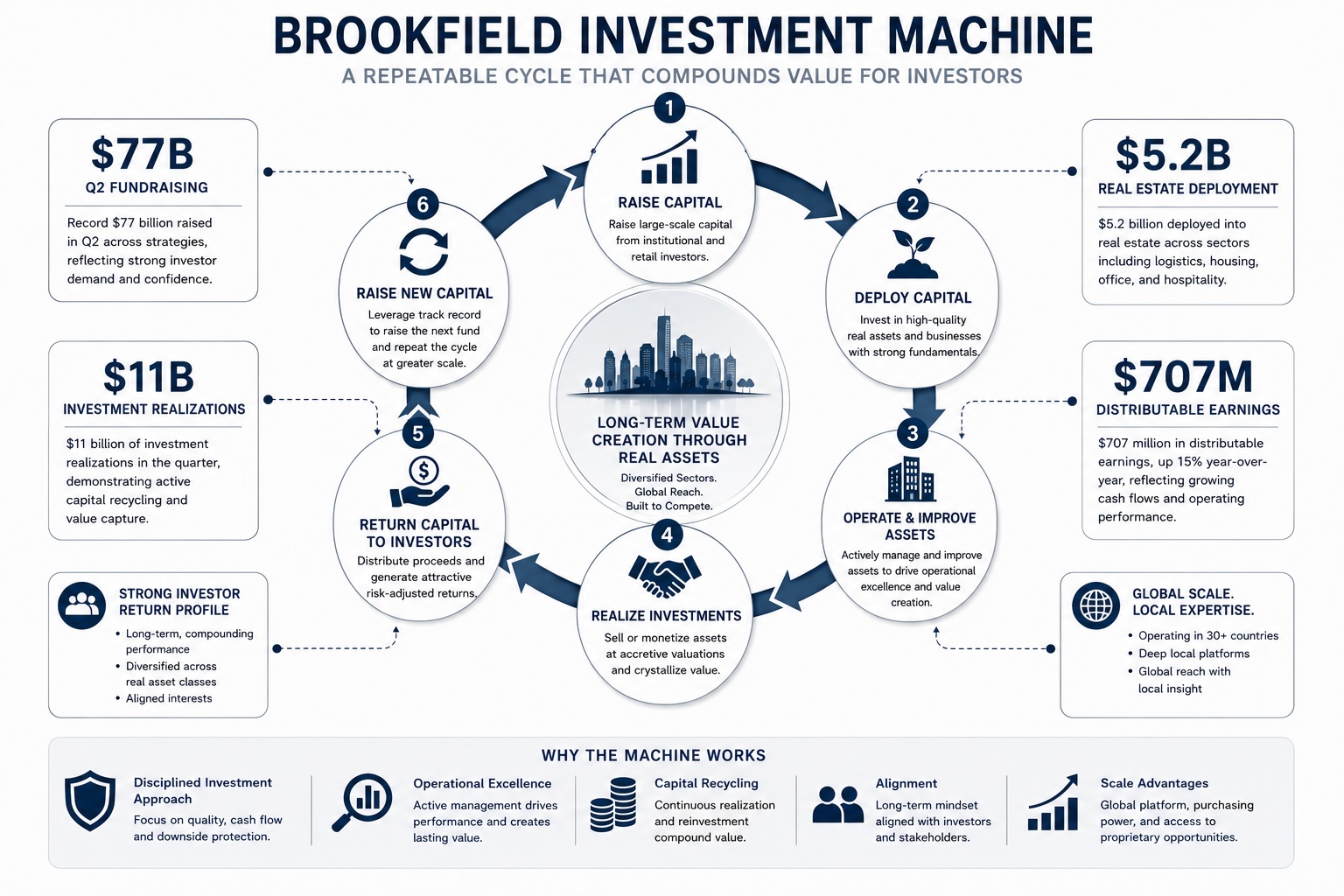
Brookfield’s second-quarter results show how a large alternative asset manager operates across the full investment cycle.
Distributable Earnings Rise 15%
Brookfield’s operating results also improved during the quarter. The firm reported approximately $707 million in distributable earnings, up about 15%. Distributable earnings are closely watched among alternative asset managers because they reflect the cash-generating capacity of the underlying investment management platform.
Taken together, higher distributable earnings, record fundraising, and rising deployment suggest Brookfield is entering the next phase of the investment cycle from a position of real financial strength. Newly appointed CEO Connor Teskey said the firm’s fundraising momentum could continue through the rest of the year and potentially push well past Brookfield’s previous annual record.
$11 Billion in Asset Sales Returns Capital to Investors
Buying assets is only half the cycle. Large asset managers also need to sell investments and return capital to investors, and Brookfield generated approximately $11 billion from asset sales and other realizations during the quarter.
That figure matters because exit activity had grown harder throughout the higher-rate environment. When transaction volumes fall and public market valuations become uncertain, private equity and real estate managers often struggle to monetize their holdings. Improving exit markets let firms convert existing positions into cash, distribute proceeds to investors, and set the stage to raise new funds.
Data Centers Are Also Creating Exit Opportunities
Brookfield kept that process going after the quarter closed. In July, the firm generated more than $1 billion by monetizing part of its stake in data center operator CSquare through its public-market debut — another sign of how much value investors are now placing on digital infrastructure businesses.
Brookfield Strengthens Its U.S. and New York Presence
Brookfield’s corporate structure is evolving alongside its strategy. The firm relocated its headquarters to New York in late 2024, deepening its presence in the world’s largest institutional capital market. Combined with Brookfield’s acquisition of the remaining stake in credit manager Oaktree, the changes are expected to push its U.S.-based workforce above 60% of total headcount.
Chief Financial Officer Hadley Peer Marshall has said the shift could also improve Brookfield’s eligibility for S&P 500 inclusion — a move that would carry both symbolic and financial weight, since index membership tends to increase exposure to passive capital as funds tracking the S&P 500 are required to hold shares of constituent companies. More broadly, the move reflects Brookfield’s continuing shift from a globally diversified real asset investor toward an increasingly U.S.-centered alternative investment platform. The deepening New York presence also places Brookfield closer to the city’s active multifamily and commercial real estate markets, where institutional capital continues to reshape pricing and development across the boroughs.
What Brookfield’s Strategy Means for the Next Commercial Real Estate Cycle
Brookfield’s results offer a useful window into where institutional real estate is heading. The last cycle was shaped heavily by low interest rates and cheap leverage. The emerging one looks set to operate on different terms.
Capital Is Becoming More Selective
Operational performance matters more. Financing structures matter more. Access to electricity and digital infrastructure is becoming a real estate consideration in its own right. And institutional investors are increasingly looking past conventional property categories — data centers, logistics facilities, manufactured housing, and energy infrastructure can now compete directly with offices, apartments, and retail properties for institutional capital.
Traditional Site Selection Is Changing
That shift has real consequences for developers. A site once evaluated mainly for residential, industrial, or office use might now be judged on its proximity to power infrastructure, fiber connectivity, and suitability for digital infrastructure. The old real estate principle of “location, location, location” isn’t going away — but for some of the most capital-intensive developments of the AI era, power, connectivity, and infrastructure capacity are becoming part of what makes a location valuable.
What Commercial Real Estate Investors Should Watch Next
Brookfield’s second-quarter performance offers several signals about where institutional capital may be heading.
Real Estate Transaction Volume: Transaction markets appear to be gradually reopening after an extended period of uncertainty. Continued growth in activity would strengthen price discovery and could draw additional institutional capital back into the market.
Interest Rates and Refinancing: A large amount of commercial real estate debt still needs to be refinanced under conditions very different from the low-rate environment in which many of those loans originated. That process could produce acquisitions, recapitalizations, and distressed opportunities — a dynamic also reshaping real estate capital markets as lenders adapt to sector-specific risk.
AI Data Center Development: The pace of AI-related development will be critical. Investors will need to separate projects backed by contracted demand from speculative ones riding on aggressive growth assumptions.
Power Availability: Access to electricity could increasingly determine which markets are capable of supporting the next generation of hyperscale computing infrastructure.
Institutional Fundraising: Fundraising provides the acquisition capital that lets large investors move when opportunities emerge — and Brookfield’s record quarter suggests substantial institutional capital is already preparing for that next phase.
The Bottom Line
With approximately $77 billion raised in a single quarter, $5.2 billion deployed into real estate, $11 billion generated through investment realizations, and distributable earnings rising to $707 million, Brookfield is operating with substantial capital just as global investment markets begin shifting direction. Its growing commitment to AI infrastructure adds another dimension to that strategy.
There are legitimate questions about whether the extraordinary pace of AI-related development will eventually produce excess capacity. Brookfield’s challenge will be separating projects backed by sustainable long-term demand from those built on overly optimistic growth assumptions. At the same time, improving commercial real estate transaction activity could open up opportunities unrelated to AI altogether, as assets change hands following several years of valuation adjustment and refinancing pressure.
Those two trends — the reopening of real estate investment markets and the extraordinary capital demands of artificial intelligence — could define the next phase of Brookfield’s growth. The firm’s record fundraising quarter suggests institutional investors are already positioning for it. For a concise summary of the signals investors should monitor, see the key trends commercial real estate investors should watch.
AI may run on algorithms, but the infrastructure behind those algorithms is becoming one of the largest real asset investment opportunities in the global economy.
Frequently Asked Questions
How much capital did Brookfield raise during the second quarter?
Brookfield raised approximately $77 billion, a quarterly fundraising record for the firm.
How much did Brookfield invest in real estate?
Brookfield deployed approximately $5.2 billion into real estate during the quarter.
How much does Brookfield Asset Management manage?
Brookfield oversees approximately $1.3 trillion in assets across its investment businesses.
Why is Brookfield investing in AI infrastructure?
AI requires massive computing capacity, which drives demand for data centers, electricity, power infrastructure, industrial land, and digital connectivity — all of which overlap with several of Brookfield’s core real asset businesses.
Why is electricity important for AI data centers?
Large AI computing facilities can require enormous amounts of reliable electricity, so access to grid capacity, substations, transmission systems, and generation increasingly determines where new data center campuses can be built.
What are the risks of AI infrastructure investment?
Key risks include speculative overbuilding, insufficient tenant demand, power constraints, construction costs, financing conditions, regulatory challenges, and technological change.