
 by
by 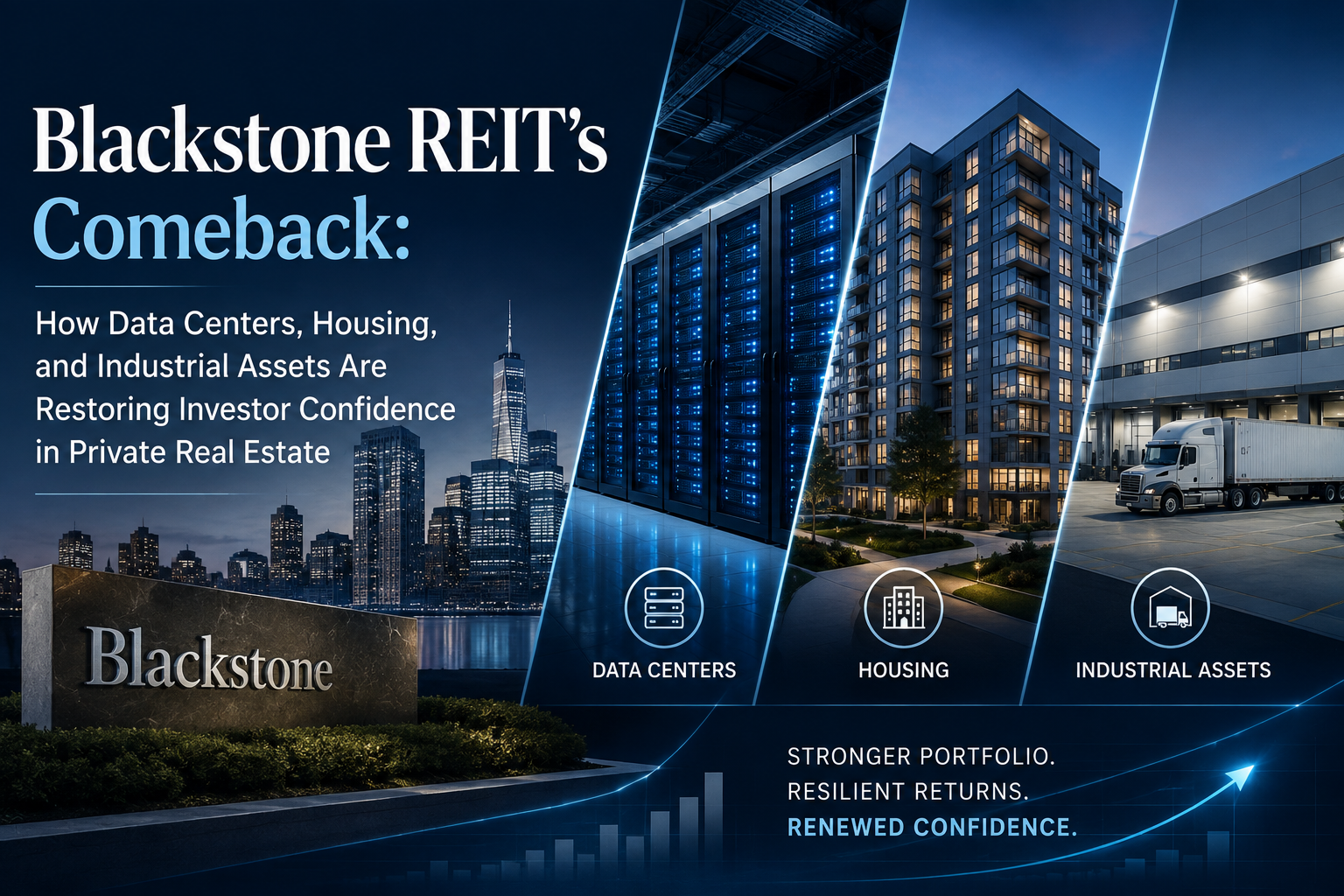
Blackstone REIT’s Comeback: How Data Centers, Housing, and Industrial Assets Are Restoring Investor Confidence in Private Real Estate
Blackstone REIT returns to positive investor inflows as data centers, rental housing, and industrial real estate restore confidence in private commercial real estate investing.
- Introduction: A Turning Point for Private Real Estate Investment
- From Redemption Crisis to Capital Recovery
- Investor Sentiment Improves as Capital Returns to Hard Assets
- The New Alternative Investment Landscape: Selectivity Over Expansion
- Blackstone’s Winning Strategy: Investing in the Future Economy
- Data Centers Become Blackstone REIT’s Growth Engine
- Industrial Real Estate Continues to Benefit From Supply Constraints
- Housing Remains a Long-Term Investment Theme
- The Sun Belt Strategy: Following Population Growth
- What Blackstone REIT’s Recovery Means for Commercial Real Estate
- Conclusion: Blackstone REIT’s Recovery Signals a New Era for Real Estate Investing
Introduction: A Turning Point for Private Real Estate Investment
Blackstone Real Estate Income Trust’s return to positive net inflows marks one of the most closely watched milestones in private real estate since the 2022 redemption cycle. The infographic below summarizes how BREIT crossed back above the withdrawal threshold — with nearly $94 billion in assets under management — and why institutional investors are once again committing capital to nontraded real estate vehicles tied to the future economy.
This vertical infographic frames Blackstone REIT’s comeback as a defining moment for private real estate investing after nearly four years of redemption pressure. The top section establishes the headline milestone — new investor capital once again exceeding withdrawals — and positions BREIT among the world’s largest nontraded real estate vehicles with approximately $94 billion in assets under management. A timeline visual traces the arc from late-2022 rate-driven valuation pressure through withdrawal limits and defensive portfolio management to the current recovery phase marked by positive net inflows. Key performance callouts reference Q2 2026 metrics including roughly $1.2 billion in new investment, declining redemption requests, and five consecutive months of positive monthly flows. Sector allocation icons emphasize the fund’s pivot toward data centers, rental housing, industrial logistics, and digital infrastructure — the demand drivers reshaping commercial real estate allocation. Bottom panels contrast the old expansion model with today’s selective capital deployment, reinforcing that investor confidence is returning not to every property type, but to assets connected to artificial intelligence, demographics, and long-term economic transformation. For readers tracking private real estate fund flows, this visual distills why BREIT’s turnaround is being interpreted as a sector-wide signal rather than an isolated fund event.
The turning-point infographic above captures why BREIT’s first positive net inflows since 2022 matter far beyond a single quarterly report. With redemption pressure easing and capital redirecting toward data centers, rental housing, and logistics, the visual confirms that institutional investors are not abandoning private real estate — they are demanding exposure to sectors aligned with long-term growth rather than legacy office and retail exposure.
After nearly four years of investor pressure, redemption requests, and uncertainty across the private real estate sector, Blackstone Real Estate Income Trust (BREIT) has reached a major milestone: new investor capital is once again exceeding withdrawals.
The recovery marks a significant shift for one of the largest nontraded real estate investment vehicles in the world, with nearly $94 billion in assets under management.
It also reflects a broader change taking place across commercial real estate markets. Investors aren’t abandoning private real estate — they’re becoming more selective, redirecting capital toward sectors supported by long-term demand drivers such as artificial intelligence, digital infrastructure, logistics, and housing.
Blackstone REIT’s recovery points to a new reality for institutional real estate investing: the market isn’t returning to the old model. It’s rewarding assets connected to the future economy.
From Redemption Crisis to Capital Recovery
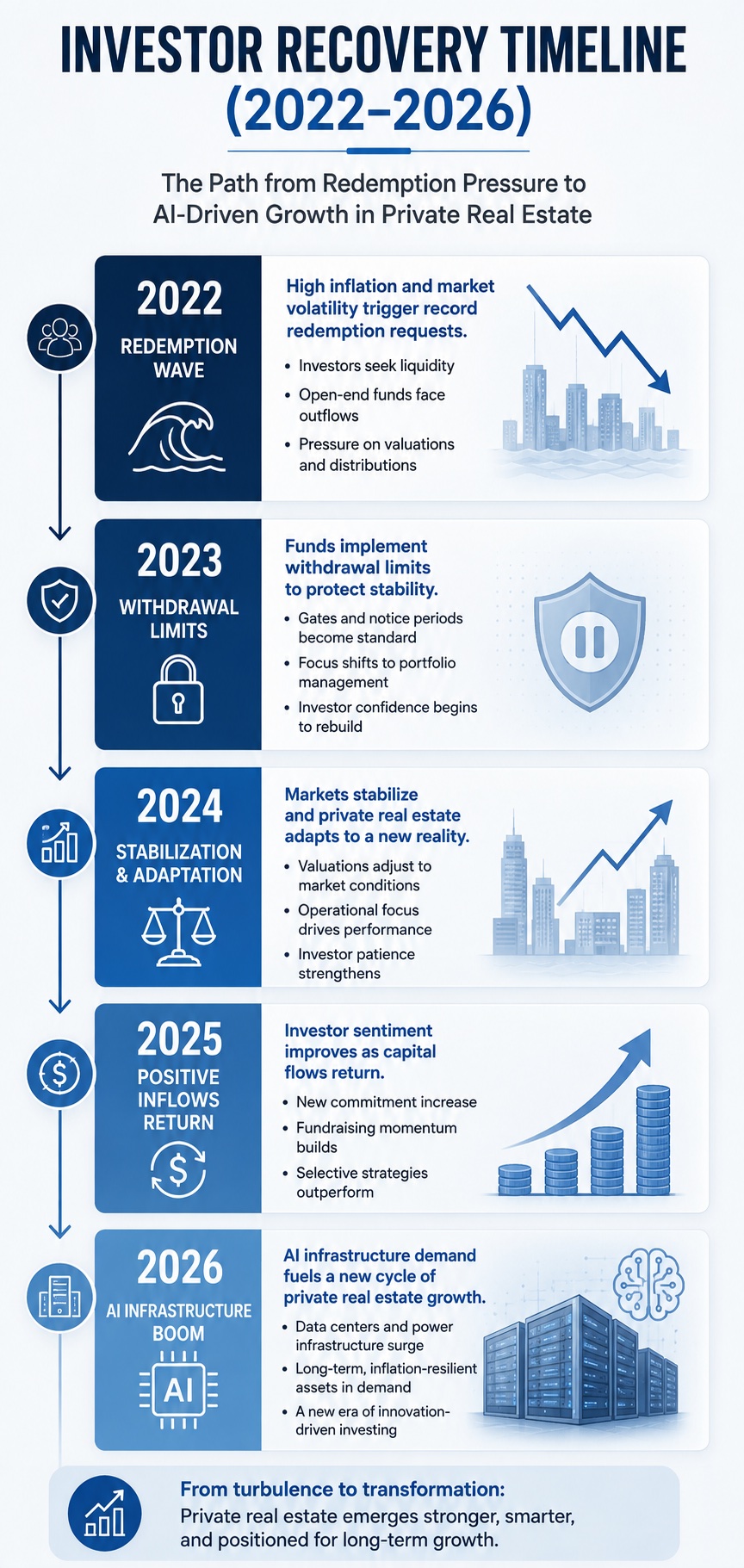
Blackstone REIT’s recent performance marks a dramatic reversal from the challenges that began in late 2022. As interest rates rose rapidly, commercial real estate valuations came under pressure, and investors faced a difficult choice: stay invested in illiquid private assets, move capital into higher-yielding alternatives, or reduce exposure to commercial real estate altogether.
The result was a wave of redemption requests across nontraded REITs. Like other private real estate funds, Blackstone REIT was forced to limit withdrawals to avoid selling assets under unfavorable market conditions.
For almost two years, the fund’s strategy shifted from expansion to defense, with priorities centered on managing investor withdrawals, protecting portfolio value, maintaining liquidity, and avoiding forced asset sales. The recent return to positive net inflows suggests investor confidence is beginning to recover.
Investor Sentiment Improves as Capital Returns to Hard Assets
During the second quarter, Blackstone REIT attracted approximately $1.2 billion in new investment while redemption requests declined significantly. Key indicators of improvement include positive net inflows for the first time since 2022, five consecutive months of positive monthly flows, lower withdrawal activity, and larger average investor commitments.
This shift reflects a broader trend across alternative investments, as institutional investors increasingly favor assets with physical value, long-term demand, inflation protection, and strong demographic or technological tailwinds. Rather than exiting alternatives altogether, they’re reallocating toward sectors with stronger growth potential.
The New Alternative Investment Landscape: Selectivity Over Expansion
After years of easy capital and aggressive expansion across commercial real estate, private markets have entered a more disciplined phase — and the infographic below maps the two-tier divide now separating winning sectors from structurally challenged assets. For investors evaluating private real estate allocation, this visual clarifies why capital is concentrating in data centers, logistics, and rental housing while older office buildings and weak retail continue to lose favor.
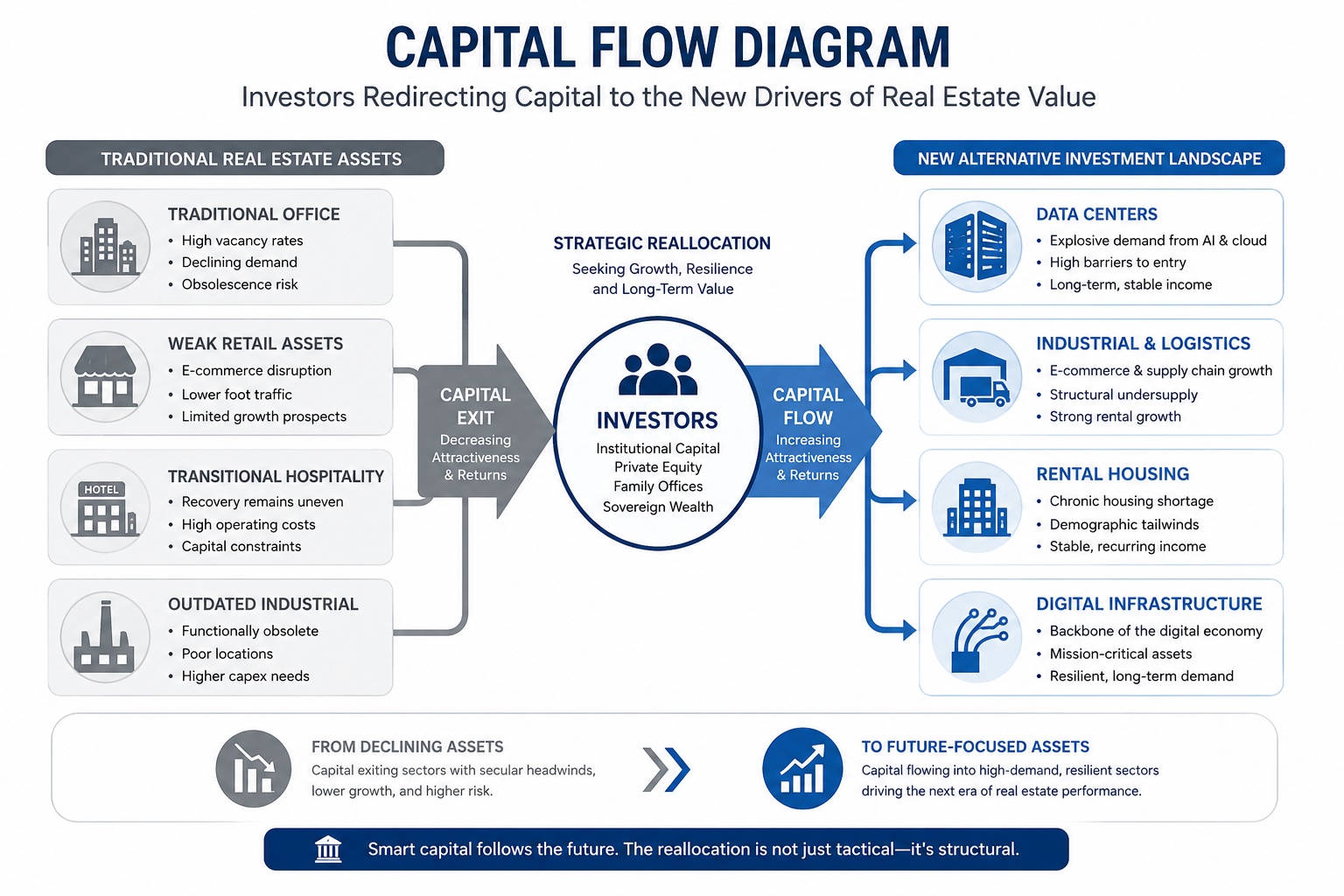
This landscape infographic illustrates the fundamental split reshaping private markets after the post-2022 correction in commercial real estate. The left panel catalogs assets facing structural headwinds: aging office buildings burdened by remote-work demand shifts, underperforming retail properties, and overleveraged commercial assets struggling under higher interest rates and declining valuations. Visual cues such as downward trend arrows and caution indicators reinforce that these categories continue to absorb redemption pressure and forced-sale risk across nontraded REIT portfolios. The right panel highlights sectors supported by durable demand drivers — data centers powering artificial intelligence and cloud expansion, logistics facilities benefiting from e-commerce and supply chain modernization, rental housing supported by affordability gaps and population growth, and broader infrastructure tied to digital and demographic trends. Connecting arrows show capital flowing from expansion-era diversification toward concentrated, thesis-driven allocation. Callout boxes reference Blackstone REIT’s own pivot as a case study in selectivity over breadth. For allocators comparing institutional investors‘ evolving strategies, the graphic makes clear that the alternative investment landscape is not shrinking — it is bifurcating, rewarding managers who concentrate in future-economy real estate while avoiding legacy property types that no longer fit long-term return profiles.
The selectivity infographic above reinforces a central theme of BREIT’s recovery: capital is not returning uniformly across commercial real estate. Investors are explicitly choosing between structurally impaired property types and sectors with visible tailwinds — a dynamic that explains why funds emphasizing industrial real estate, rental housing, and digital infrastructure are attracting inflows while traditional office-heavy portfolios remain under pressure.
Blackstone REIT’s recovery reflects a larger transformation in private markets. After years of easy capital and aggressive expansion, investors are becoming more disciplined, effectively splitting the market into two categories.
Assets facing structural challenges include older office buildings, weak retail properties, and overleveraged commercial assets. Assets supported by long-term demand include data centers, logistics facilities, rental housing, and infrastructure.
This divide explains why certain areas of real estate are attracting significant capital while others continue to struggle.
Blackstone’s Winning Strategy: Investing in the Future Economy
Blackstone REIT’s portfolio concentration tells the story of modern private real estate investing more clearly than any earnings call summary — and the strategy infographic below breaks down how data centers, rental housing, and industrial warehouses now dominate the fund’s holdings. With roughly 90% of assets aligned to future-economy sectors and data centers alone approaching 27% of the portfolio, the visual explains why institutional investors view BREIT as a blueprint for post-redemption portfolio construction.
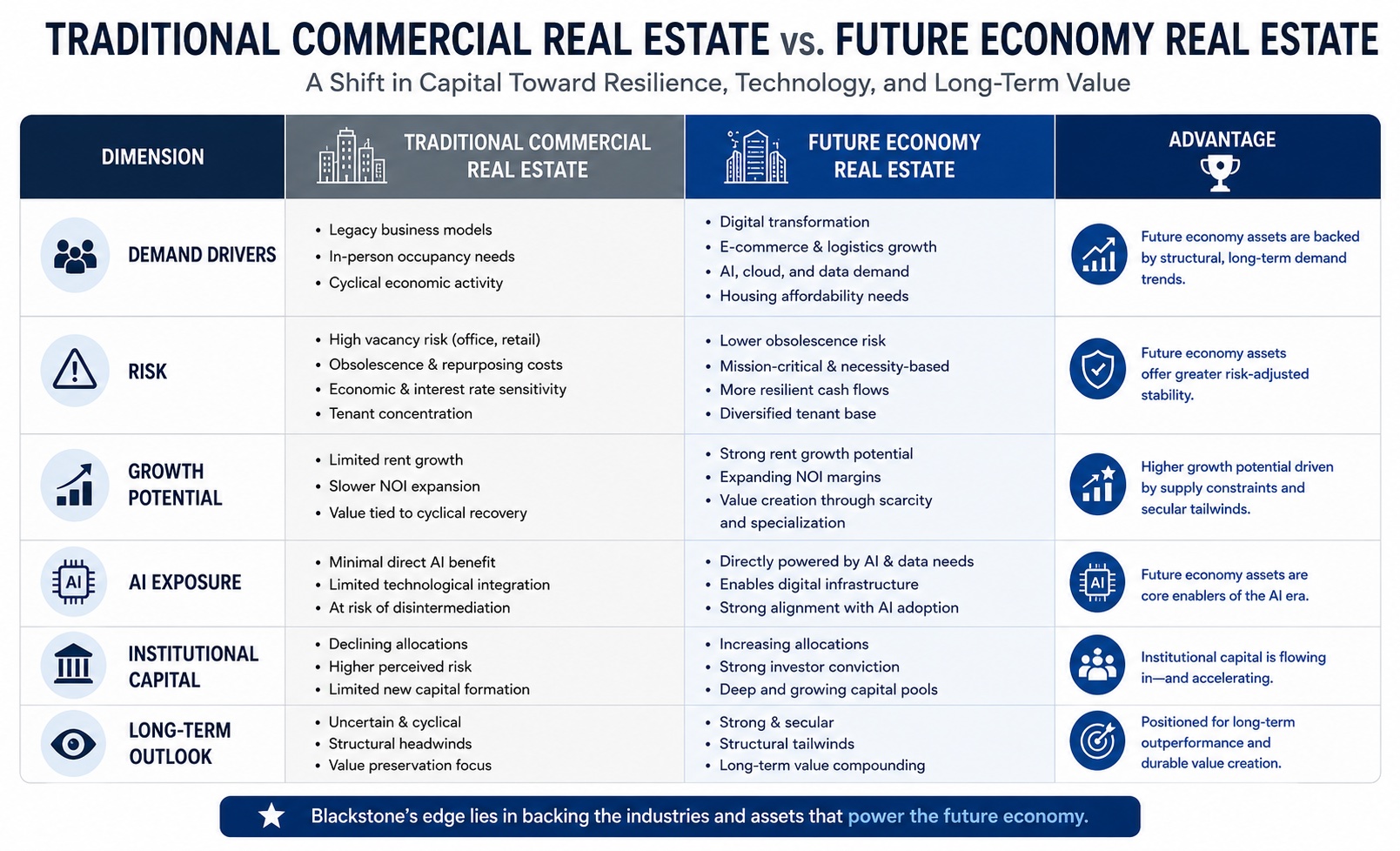
This strategy infographic presents Blackstone REIT’s portfolio as a deliberate bet on the future economy rather than a traditional diversified real estate allocation. A central allocation chart shows three dominant pillars — data centers, rental housing, and industrial warehouses — combining for approximately 90% of total holdings, with data centers alone representing roughly 27% of the portfolio and ranking among the fund’s largest single strategic exposures. Supporting panels detail the demand thesis behind each segment: AI computing and cloud expansion fueling data center investment including $5.7 billion deployed in pre-leased projects during the first half of 2026; demographic and affordability trends sustaining rental housing demand and tenant retention; and e-commerce-driven logistics needs keeping industrial warehouses supply constrained with strong rent growth on new leases. A geographic overlay notes that approximately 65% of assets sit in Sun Belt markets benefiting from population migration and business expansion. The bottom section contrasts this model with the legacy commercial real estate playbook driven by office demand, retail spending, and corporate footprint expansion — illustrating why Blackstone’s approach aligns with how AI infrastructure and digital consumption are rewriting property sector priorities. For readers comparing nontraded REIT strategies, the infographic demonstrates that BREIT’s recovery is rooted in sector concentration and thematic clarity, not a broad-based rebound across all property types.
The future-economy strategy infographic above makes BREIT’s investment thesis tangible for allocators weighing private real estate exposure. By concentrating roughly nine-tenths of the portfolio in data centers, housing, and industrial real estate, Blackstone has effectively built a proxy for the sectors defining the next decade of commercial property demand — a positioning that helps explain why redemption pressure is easing while new capital commitments are growing again.
A major factor behind Blackstone REIT’s recovery has been its focus on sectors benefiting from long-term economic trends. The portfolio is now heavily concentrated in three categories — data centers, rental housing, and industrial warehouses — which together account for approximately 90% of total holdings.
This marks a significant shift in real estate investing. Traditional commercial real estate was historically driven by office demand, retail spending, and corporate expansion. Today’s environment is increasingly shaped by artificial intelligence, e-commerce, population growth, housing shortages, and digital infrastructure.
Data Centers Become Blackstone REIT’s Growth Engine
The strongest-performing segment of the portfolio has been data centers, which now represent approximately 27% of holdings — making them one of Blackstone REIT’s largest strategic investments.
Through its ownership of QTS, a major data center operator, Blackstone has positioned itself at the center of the artificial intelligence infrastructure boom. Growth in this segment is being driven by AI computing demand, cloud expansion, enterprise technology growth, and increased digital consumption.
During the first half of 2026, Blackstone REIT invested approximately $5.7 billion in pre-leased data center projects — a clear signal that data centers are no longer viewed simply as industrial properties. They’re becoming essential infrastructure for the global economy.
Why AI Infrastructure Is Changing Real Estate Investment
Artificial intelligence is creating an entirely new category of real estate demand. Companies developing AI systems require massive computing capacity, reliable energy sources, advanced cooling systems, and large-scale facilities.
As a result, properties with access to power infrastructure, fiber networks, and strategic locations are becoming increasingly valuable. This trend has drawn in major institutional investors who previously focused primarily on traditional property sectors, and it shows how real estate is evolving from physical space into digital infrastructure.
Industrial Real Estate Continues to Benefit From Supply Constraints
Beyond data centers, Blackstone REIT’s industrial portfolio is also performing well. Warehouse demand remains supported by e-commerce growth, supply chain modernization, limited new construction, and distribution network expansion.
The fund reported increased leasing activity, strong rent growth on new leases, and improved market conditions driven by reduced warehouse supply. While industrial development has slowed in some markets, high-quality logistics properties continue to attract demand.
Housing Remains a Long-Term Investment Theme
Rental housing is another major pillar of Blackstone REIT’s strategy. Although apartment rent growth has moderated in certain markets, underlying fundamentals remain strong, supported by housing affordability challenges, limited homeownership opportunities, population growth, and continued demand for rental flexibility.
Blackstone REIT reported strong tenant retention levels, suggesting demand for professionally managed rental communities remains stable. The sector continues to benefit from a structural imbalance between housing supply and population needs.
The Sun Belt Strategy: Following Population Growth
Approximately 65% of Blackstone REIT’s portfolio is located in Sun Belt markets, reflecting a broader investment trend toward regions experiencing population growth, business expansion, migration, and infrastructure investment.
States such as Texas, Florida, Arizona, and the Carolinas have attracted significant institutional capital as companies and residents continue relocating there. Still, future performance will depend on whether these markets can sustain growth while managing affordability and infrastructure challenges.
What Blackstone REIT’s Recovery Means for Commercial Real Estate
The recovery offers several lessons for the broader market:
- Capital is returning, but not everywhere. Investors are coming back selectively, favoring sectors with strong fundamentals.
- Technology infrastructure is becoming real estate’s growth sector. Data centers are emerging as one of the most important property categories.
- Traditional office assets face continued challenges. Capital continues shifting toward sectors aligned with long-term economic trends.
- Institutional investors are changing their strategy. They are prioritizing resilience, technology, and demographic growth over traditional asset allocation.
Frequently Asked Questions
Why is Blackstone REIT recovering?
Blackstone REIT is recovering because new investor capital is once again exceeding withdrawals after nearly four years of redemption pressure. During Q2 2026, the fund attracted approximately $1.2 billion in new investment while redemption requests declined significantly, marking the first positive net inflows since 2022 and five consecutive months of positive monthly flows.
What sectors are driving BREIT’s growth?
BREIT’s growth is driven by three core sectors that together account for approximately 90% of total holdings: data centers (roughly 27% of the portfolio), rental housing, and industrial warehouses. These sectors benefit from long-term demand drivers including artificial intelligence, e-commerce, population growth, and housing shortages.
Why are data centers attracting investors?
Data centers are attracting investors because they serve as essential infrastructure for the AI and cloud computing boom. Blackstone REIT invested approximately $5.7 billion in pre-leased data center projects during the first half of 2026. Through its ownership of QTS, Blackstone is positioned at the center of surging demand for computing capacity, reliable energy, and advanced cooling systems.
How does AI affect commercial real estate?
Artificial intelligence is creating an entirely new category of real estate demand. Companies developing AI systems require massive computing capacity, reliable energy sources, advanced cooling systems, and large-scale facilities. Properties with access to power infrastructure, fiber networks, and strategic locations are becoming increasingly valuable, drawing major institutional investors into digital infrastructure.
Why is industrial real estate outperforming?
Industrial real estate is outperforming due to sustained e-commerce growth, supply chain modernization, limited new warehouse construction, and distribution network expansion. Blackstone REIT reported increased leasing activity, strong rent growth on new leases, and improved market conditions driven by reduced warehouse supply across key logistics markets.
What is Blackstone’s Sun Belt strategy?
Approximately 65% of Blackstone REIT’s portfolio is located in Sun Belt markets, reflecting an investment strategy focused on regions experiencing population growth, business expansion, migration, and infrastructure investment. States such as Texas, Florida, Arizona, and the Carolinas have attracted significant institutional capital as companies and residents continue relocating there.
What does BREIT’s recovery mean for investors?
BREIT’s recovery signals that investor confidence is returning to private real estate, but in a more selective form. Capital is flowing toward sectors with strong fundamentals — data centers, rental housing, and logistics — while traditional office and weak retail assets face continued challenges. Institutional investors are prioritizing resilience, technology exposure, and demographic growth over broad real estate allocation.
Which real estate sectors have the strongest outlook?
The strongest outlook is in sectors supported by long-term demand drivers: data centers and AI infrastructure, logistics and industrial warehouses, and rental housing. These categories benefit from technology adoption, e-commerce, housing affordability challenges, and population growth. Older office buildings, weak retail properties, and overleveraged commercial assets face structural headwinds.
Conclusion: Blackstone REIT’s Recovery Signals a New Era for Real Estate Investing
Blackstone REIT’s return to positive investor flows represents more than a recovery for one fund — it reflects a broader transformation taking place across commercial real estate.
The market has moved past the simple question of whether investors believe in real estate. The new question is which types of real estate will define the next decade. Increasingly, the answer points toward artificial intelligence infrastructure, data centers, rental housing, logistics networks, and digital economy assets.
Blackstone REIT’s turnaround shows that investor confidence is returning — but to a new version of real estate, one built around technology, demographic change, and long-term economic transformation.


Join The Discussion