
 by
by 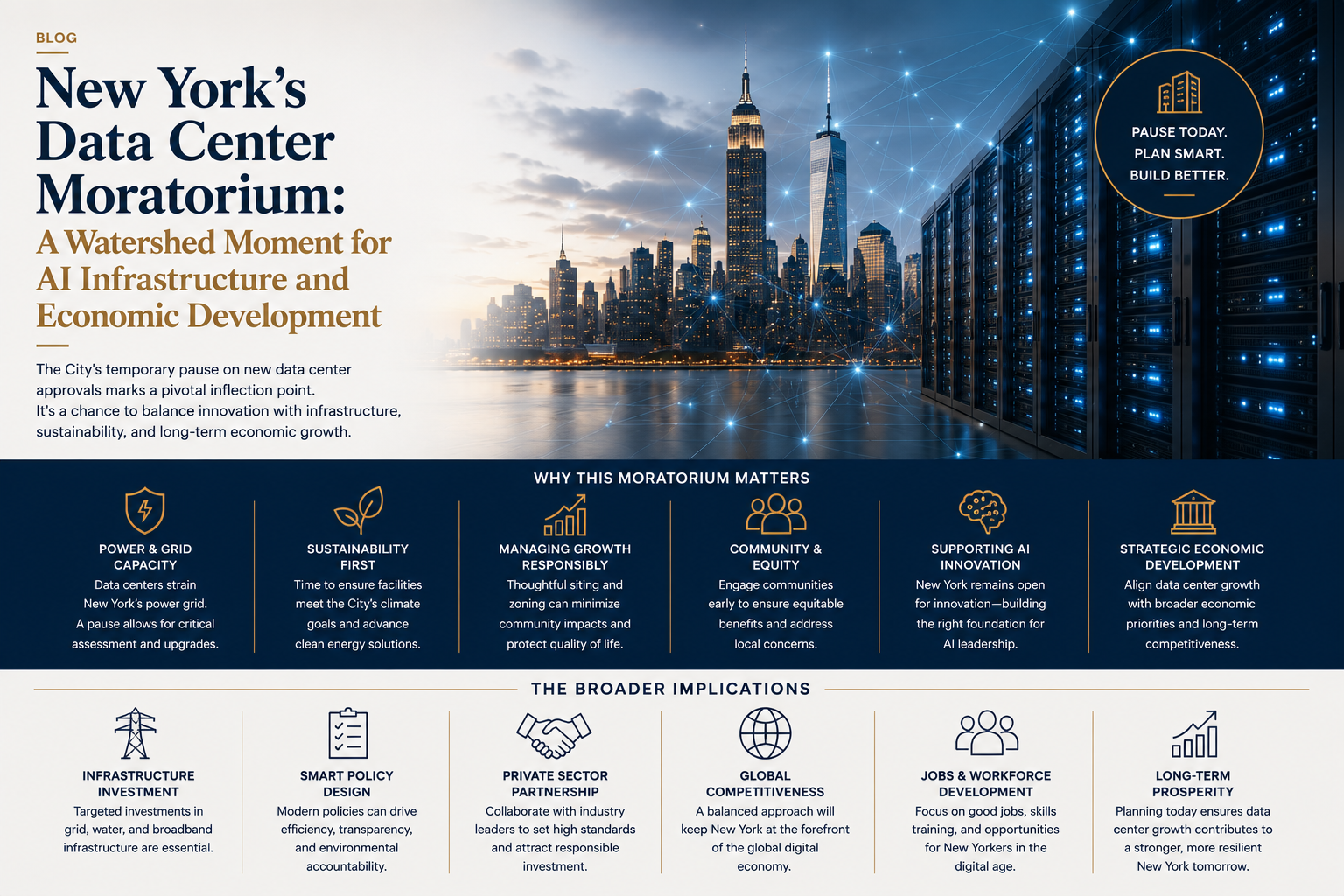
How the nation’s first statewide pause on large data center development could reshape the future of artificial intelligence infrastructure, energy policy, and commercial real estate.
Introduction: New York Draws a Line in the AI Infrastructure Race
The rapid expansion of artificial intelligence has created a new era of digital infrastructure investment. Across the United States, companies are racing to build massive data centers capable of supporting advanced computing, cloud services, and AI applications.
However, New York has taken a historic step in slowing that expansion.
The state has become the first in the nation to pause the development of large-scale data centers, introducing a one-year moratorium on facilities requiring 50 megawatts or more of electricity for computing operations.
The decision represents a major turning point. It places New York at the center of a national debate: How can governments encourage technological innovation while protecting energy systems, communities, and affordability?
The outcome could influence not only where future data centers are built, but also how cities and states approach the next generation of digital infrastructure.
The Rise of AI Infrastructure and the Pressure on Energy Systems
The growth of artificial intelligence has dramatically increased demand for computing power.
Unlike traditional office or industrial developments, modern data centers require:
- Massive electricity capacity
- Advanced cooling systems
- High-speed network connections
- Large-scale land availability
- Reliable infrastructure
A single large data center can consume electricity comparable to tens of thousands of residential homes.
As AI investment accelerates, communities across the country are facing new questions:
- Can existing power grids handle the demand?
- Who pays for infrastructure upgrades?
- How will energy costs affect residents and businesses?
- Should communities receive greater benefits from these developments?
New York’s moratorium reflects growing concerns that technological growth must be balanced with local economic impacts.
Why New York Took Action
The state’s decision is based on several concerns surrounding large-scale data center development.
Rising Energy Costs
One of the primary concerns is the potential impact on electricity prices.
Large computing facilities require significant power consumption, creating pressure for additional energy generation and grid upgrades.
The key question is whether those costs will be absorbed by technology companies or passed on to consumers through higher utility rates.
Environmental and Resource Concerns
Data centers require significant resources, including:
- Electricity
- Cooling infrastructure
- Land
- Water resources in certain locations
As communities evaluate new projects, environmental impact has become a major factor in approval decisions.
Community Benefits and Local Investment
New York’s new framework emphasizes ensuring that communities receive measurable benefits from major infrastructure projects.
Future developments may face stronger expectations regarding:
- Local job creation
- Infrastructure investment
- Tax contributions
- Community improvements
- Workforce development
The policy shift suggests that economic development will increasingly be evaluated by broader community impact—not only investment dollars.
The Commercial Real Estate Impact: A New Development Challenge
The data center industry has become one of the fastest-growing segments of commercial real estate.
Unlike traditional office or retail projects, data centers require specialized locations with:
- High-capacity electrical connections
- Fiber infrastructure
- Large land parcels
- Long-term energy availability
The New York moratorium introduces new uncertainty for developers and investors.
Future projects may face:
- Longer approval timelines
- Higher infrastructure costs
- Additional regulatory requirements
- More community negotiations
For real estate owners and developers, access to power may become just as important as location.
A National Trend: States and Cities Reconsider Data Center Growth
New York’s decision is part of a broader national conversation.
More than 150 cities, towns, and counties are considering restrictions on data center development.
Other states are evaluating:
- Temporary moratoriums
- Updated zoning rules
- Revised tax incentive programs
- New energy requirements
The trend reflects a shift in how governments view technology infrastructure.
Previously, data centers were often seen as attractive economic development opportunities because of:
- Construction jobs
- Tax revenue
- Technology investment
Today, communities are also examining:
- Energy consumption
- Environmental impacts
- Long-term infrastructure costs
The End of Traditional Data Center Incentives?
For years, tax incentives have played an important role in attracting large technology projects.
States competed to secure major investments by offering:
- Sales tax exemptions
- Property tax incentives
- Economic development packages
However, the new regulatory environment could change that model.
If incentives disappear, developers may need to reconsider project economics by:
- Reducing construction costs
- Selecting different locations
- Building smaller facilities
- Partnering more closely with utilities
- Creating stronger community benefit agreements
The competition between states may increasingly depend not only on incentives, but also on energy availability and regulatory certainty.
The Shift Toward Smaller and More Adaptive Data Centers
One possible outcome of increased regulation is a change in development strategy.
Instead of building extremely large facilities requiring enormous power capacity, developers may explore:
- Smaller regional data centers
- Distributed computing facilities
- Adaptive reuse of existing buildings
- Redevelopment of underutilized industrial properties
Adaptive reuse could become especially attractive because existing buildings may already have:
- Electrical infrastructure
- Transportation access
- Established community relationships
This approach could reduce neighborhood disruption while meeting growing demand.
New York’s Competitive Position in the AI Economy
The biggest challenge for policymakers is maintaining competitiveness.
Artificial intelligence infrastructure represents a major economic opportunity.
Data centers can support:
- Technology companies
- Research institutions
- High-paying jobs
- Innovation ecosystems
- Digital transformation
However, excessive restrictions could push investment toward states with fewer regulatory barriers.
Markets such as Texas and Virginia may benefit if companies seek faster approvals and lower development constraints.
The challenge for New York is creating a framework that attracts investment while protecting public interests.
The Future of AI Infrastructure Development
The debate surrounding data centers represents a larger question about the future of economic growth.
The next generation of infrastructure will require cooperation between:
- Technology companies
- Government agencies
- Utility providers
- Real estate developers
- Local communities
Successful projects will likely need to demonstrate more than technological capability. They will need to show:
- Responsible energy use
- Economic benefits
- Community support
- Long-term sustainability
Conclusion: A New Era of Digital Development Regulation
New York’s decision to pause large data center development marks a significant moment in the evolution of the AI economy.
The state is not rejecting technology investment—it is demanding a new framework for how that investment occurs.
The coming years will determine whether stricter standards create a more sustainable model for digital infrastructure or whether they push investment toward more business-friendly markets.
For developers, investors, and technology companies, one message is clear:
The future of AI infrastructure will not be determined only by computing power. It will also be shaped by energy, regulation, and the ability to create value for the communities where these projects are built.
Join The Discussion