 by InRealEstate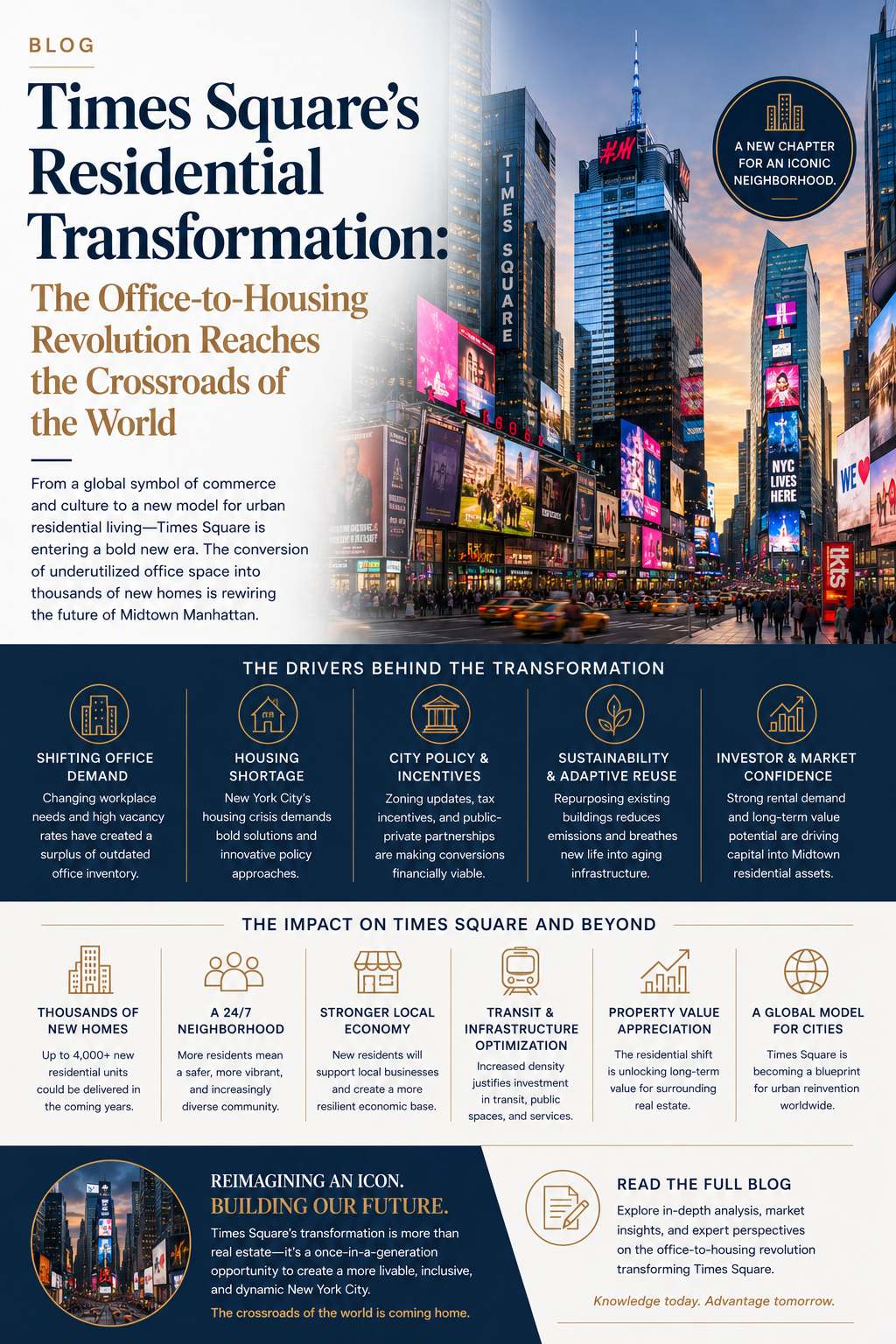
A Symbolic Shift at the Heart of New York
In a development that signals a fundamental reimagining of one of the world’s most iconic urban districts, New York State has approved a plan to convert the former headquarters of accounting giant EY at 5 Times Square into a mixed-use residential tower. The project, which will transform approximately 918,000 square feet of underutilized office space into 1,250 apartments, represents one of the largest office-to-housing conversions in New York City history and marks a pivotal moment in the evolution of Times Square from a tourism-and-entertainment mecca into a true 24/7 neighborhood.
The significance of this approval extends far beyond the boundaries of a single building. It reflects a broader strategic reorientation of how New York is approaching its commercial districts in the aftermath of pandemic-driven shifts in work patterns, occupancy patterns, and urban living preferences. By converting a building that once housed thousands of white-collar workers into a residential community with a quarter of its units designated affordable, the city and state are signaling that the future of central business districts lies in their transformation into mixed-use neighborhoods where people can live, work, and play in equal measure.
The timing of this approval is particularly noteworthy given the pressures facing New York’s housing market. With multifamily vacancy rates below 3%—a near-record low—and office vacancy rates hovering around 13.5%, the economic logic of conversion has never been more compelling. The 5 Times Square project demonstrates that even the most commercial of districts can be reimagined to meet the city’s critical need for housing while addressing the persistent challenges of office property obsolescence.
The Building: From Corporate Icon to Residential Beacon
A Brief History of 5 Times Square
The 38-story tower at 5 Times Square was constructed in 2002 as a signature headquarters for EY, then known as Ernst & Young. The building represented a major investment in the Times Square district at a time when the area was undergoing its transformation from a gritty, crime-ridden neighborhood into a family-friendly tourist destination. The tower’s prominent location at the intersection of 42nd Street and Broadway placed it at the center of one of the world’s most visited urban spaces.
For two decades, the building served as a corporate anchor for the district, housing thousands of professionals in a state-of-the-art office environment. However, the pandemic fundamentally altered the economics of office occupancy, and EY vacated the premises in 2022, leaving the building with a staggering 77% vacancy rate. The departure of the building’s primary tenant created an opportunity for reimagining the property’s role in the district.
The ownership structure of 5 Times Square reflects the complexity of converting a building where the land is publicly owned. The tower is owned by a partnership between developers RXR Realty and SL Green Realty, along with investment giant Apollo Global Management, while the city retains ownership of the underlying land. This public-private partnership model enables the city to maintain control over the development’s outcomes while leveraging private sector expertise and capital.
The Conversion Plan
Under the approved plan, approximately 917,745 square feet of office space will be converted to 1,250 residential units, with a breakdown of 1,050 studios and 200 one-bedroom apartments. The existing 37,311 square feet of retail space will remain, preserving the building’s connection to the vibrant street life of Times Square. A quarter of the residential units—approximately 312 apartments—will be designated affordable, ensuring that the conversion contributes to the city’s broader goals of housing equity and economic diversity.
The unit mix reflects the district’s characteristics and the target demographic for the project. The predominance of studio units suggests a focus on young professionals, singles, and couples who are drawn to the convenience and energy of a central location. The limited number of one-bedroom units acknowledges that the district may appeal to residents who prioritize location over space, particularly given the premium pricing that such a central location can command.
The conversion is being facilitated by the city’s 467-m tax incentive program, which is specifically designed to encourage conversions of commercial buildings to housing. The program offers significant tax benefits in exchange for a commitment to include affordable units. The 467-m program has proven particularly attractive to developers because it does not impose minimum construction wage requirements, unlike the alternative 485-x program for ground-up residential development. This distinction has been crucial in making conversions economically viable for large-scale projects.
The Economic Logic: Why Conversions Make Sense
The Office Market Reality
The conversion of 5 Times Square is driven by the fundamental mismatch between office supply and demand in New York’s commercial districts. The pandemic permanently altered work patterns, with hybrid arrangements reducing the need for office space even as economic activity has recovered. The result has been persistent office vacancy rates that have strained building owners and created opportunities for repurposing underutilized assets.
The 77% vacancy rate at 5 Times Square is extreme but not unique. Across Manhattan, office vacancy rates remain elevated, and many older or less desirable buildings face uncertain futures. The cost of converting these buildings to residential use has historically been a barrier, but declining office property values have changed the economic calculus. As the value of some office buildings has fallen, demolition and reconstruction have become more competitive with conversion in some cases.
The conversion of 5 Times Square is notable for its scale, but it is part of a broader trend. Other major office-to-residential conversions are underway across Manhattan, including 25 Water Street with more than 1,300 units and the former Pfizer headquarters at 219 and 235 E. 42nd Street, which is expected to yield more than 1,600 units. These projects demonstrate that office-to-residential conversion has become a significant component of New York’s housing strategy.
The Housing Market Imperative
The conversion’s importance is magnified by the extraordinary tightness of New York’s housing market. Multifamily vacancy rates have fallen below 3%, representing a near-record low that reflects the severe shortage of available housing. In this environment, every additional unit of housing contributes to relieving pressure on the market, and large-scale conversions like 5 Times Square can have a meaningful impact.
The affordable housing component of the project is particularly significant. With a quarter of units designated as affordable, the conversion will add hundreds of below-market-rate apartments to a district that has historically been dominated by commercial uses and tourist-oriented amenities. This contributes to the city’s goal of creating mixed-income neighborhoods and ensuring that central locations are accessible to households across the income spectrum.
The 5 Times Square project also demonstrates that the city can leverage its land ownership to achieve policy objectives. By controlling the underlying land, the city can ensure that developments on its property contribute to its housing goals, including affordability requirements and sustainable design standards.
The Incentive Structure
The financial viability of the 5 Times Square conversion is significantly enhanced by the 467-m tax incentive program, which provides property tax abatements that can substantially reduce the cost of conversion. The program is designed to encourage the repurposing of obsolete office buildings, particularly those that have become economically unviable in their current use.
A critical feature of the 467-m program is its exemption from minimum construction wage requirements. This distinguishes it from the 485-x program, which applies to ground-up residential development and imposes wage requirements that can significantly increase construction costs for larger projects. The distinction has had a notable impact on development patterns, with a overwhelming majority of proposed ground-up residential projects being designed to fall below the 100-unit threshold that triggers wage requirements.
The availability of 467-m incentives has made large-scale conversions more attractive, enabling projects like 5 Times Square to proceed at a scale that would not be economically viable without the tax benefits. The program represents a significant public investment in housing development, but it is justified by the urgent need for additional housing supply and the fiscal benefits that result from repurposing underutilized properties.
The Times Square Transformation: From Tourist Zone to Neighborhood
The Changing Character of the District
The conversion of 5 Times Square is the latest and most significant step in the evolution of Times Square from a tourism-and-entertainment hub into a true mixed-use neighborhood. While the district has long been associated with Broadway theaters, massive digital billboards, and throngs of visitors, it has historically lacked a substantial residential population that would make it a 24/7 community.
The transformation began in recent years with the development of high-end residential properties like The Ellery at 312 W. 43rd Street. The 330-unit luxury rental property, which CoStar data identifies as the only Class A rental property to open in the neighborhood in at least 35 years, was fully leased in approximately 10 months—with market-rate rents well above the New York average. The rapid leasing of The Ellery demonstrated that there is substantial demand for high-quality residential options in Times Square, particularly among tenants who value the district’s unparalleled transportation access and vibrant amenities.
The conversion of 5 Times Square will dramatically expand the residential footprint of the district, adding more than 1,000 new households to an area that has historically been dominated by commercial and tourist uses. This influx of residents will change the character of the district, creating demand for neighborhood-serving retail, schools, and community facilities that have been largely absent from the area.
The Transportation and Accessibility Advantage
One of the key attractions of Times Square as a residential location is its unparalleled transportation access. The district is served by a dozen subway lines, numerous bus routes, and the nearby Port Authority Bus Terminal, making it one of the most transit-accessible locations in the country. For residents who work elsewhere in the city, the convenience of commuting from Times Square is unmatched.
The transportation advantage is particularly significant in the context of New York’s push for reduced car dependency and increased use of public transportation. Residents of 5 Times Square will be able to access virtually any part of the city without relying on private vehicles, supporting environmental goals while reducing the need for parking infrastructure in a dense urban environment.
The proximity to transportation also enhances the appeal of the location for residents who value access to the city’s cultural and entertainment offerings. Theaters, restaurants, museums, and other cultural institutions are within easy reach, making Times Square an ideal location for residents who want to maximize their engagement with the city.
The 24/7 Vision
The conversion of 5 Times Square is central to the vision of Times Square as a 24/7 live, work, and play destination. By adding residents to a district that is already active around the clock due to its entertainment and tourism uses, the project will create the conditions for a genuinely round-the-clock neighborhood.
This vision aligns with broader urban planning principles that emphasize the importance of mixed-use districts in creating vibrant, resilient, and sustainable cities. Neighborhoods that combine residential, commercial, and entertainment uses tend to be more active throughout the day and night, reducing the “dead zones” that can occur in single-use districts after business hours.
The addition of 1,250 households to Times Square will create a residential population that supports neighborhood-serving businesses, enhances safety through increased pedestrian activity, and contributes to the district’s economic vitality. The 24/7 character of the district will be reinforced by the presence of residents who have a stake in the neighborhood’s quality of life and who can provide a counterweight to the interests of businesses and tourists.
The Technical Challenges: Why Conversions Are Complex
The Physical Limitations of Office Buildings
Office-to-residential conversions are technically challenging because office buildings and residential buildings are fundamentally different in their design requirements. The physical characteristics of 5 Times Square, like most office towers, present significant obstacles to conversion.
One of the most significant challenges is the building’s layout. Office buildings are typically designed with deep floor plates that provide flexibility for large, open workspaces. Residential buildings, by contrast, require narrower floor plates to ensure that all units have access to windows and natural light. This fundamental difference means that many office buildings cannot be converted without extensive interior reconstruction that may be economically prohibitive.
The mechanical systems of office buildings are also designed for different uses. Office buildings typically have centralized heating, cooling, and ventilation systems that are optimized for daytime occupancy and high-density use. Residential buildings require different systems that can support 24-hour occupancy and provide individual unit control. The cost of replacing or modifying these systems can be substantial.
The infrastructure requirements for residential units—including kitchen gas hookups, plumbing, electrical systems, and fire safety provisions—are often absent from office buildings. Installing this infrastructure requires substantial construction work that can significantly increase the cost of conversion.
The Economic Calculation
The economic viability of office-to-residential conversion depends on the relationship between conversion costs and the value of the resulting residential units. As the value of some office buildings has declined, the economics of conversion have become more favorable, but the costs remain substantial.
The 467-m tax incentive program reduces the tax burden on converted properties, improving the economic calculus. However, even with these incentives, the cost of conversion can be comparable to or greater than the cost of ground-up construction. The calculation depends on the specific characteristics of the building, the condition of its systems, and the design requirements of the residential units.
For developers, the decision to convert rather than demolish and rebuild depends on a variety of factors, including the condition of the building, the feasibility of demolition, the availability of incentives, and the time required for each approach. In some cases, demolition and reconstruction may be more cost-effective, particularly for buildings with significant physical limitations.
The Success Factors
Despite the challenges, successful conversions like 5 Times Square demonstrate that office-to-residential conversion can be viable when certain conditions are met. These include a building with floor plates that can be adapted to residential use, a location with strong residential demand, access to incentives that reduce the cost of conversion, and a developer with experience in complex adaptive reuse projects.
The conversion of 5 Times Square has several advantages that contribute to its viability. The building’s relatively modern construction (2002) means that its systems may be in better condition than older buildings. Its iconic location provides access to strong residential demand, as demonstrated by the rapid leasing of The Ellery. The availability of 467-m tax incentives reduces the cost burden. And the development team includes experienced developers with substantial resources.
These advantages suggest that 5 Times Square is well-positioned for successful conversion, though the project will still face significant technical and economic challenges.
The Market Context: What the Conversion Means for New York
The Housing Supply Impact
The 5 Times Square conversion will add 1,250 units to New York’s housing supply at a time when the city is facing a severe housing shortage. While this represents a small fraction of the city’s total housing stock, it is a meaningful addition in a high-demand neighborhood and a demonstration of what is possible through office-to-residential conversion.
The affordable component of the project—approximately 312 units—will provide below-market-rate housing in an area that has been largely inaccessible to moderate-income households. This contributes to the city’s goal of creating economically diverse neighborhoods and ensuring that central locations are available to a broad range of residents.
The conversion also demonstrates the potential for office-to-residential conversion to contribute to the city’s housing supply in a way that is consistent with its sustainability and density goals. By repurposing an existing building rather than developing a greenfield site, the project avoids the environmental impacts associated with new construction while adding density to a well-served transit location.
The Office Market Implications
The conversion of 5 Times Square will reduce office supply in Manhattan by nearly 1 million square feet, helping to address the imbalance between office demand and supply that has persisted since the pandemic. While a single conversion will not solve the office market’s challenges, it represents a meaningful reduction in inventory and a demonstration that underutilized office space can be repurposed for other uses.
The conversion may also encourage other office building owners to consider conversion as an alternative to continued ownership of underperforming assets. If the 5 Times Square project proves successful, it could catalyze additional conversions in the Times Square district and elsewhere, contributing to a more balanced commercial real estate market.
The project also demonstrates that conversion can be viable even in prime locations. While many conversions are focused on less desirable office properties, 5 Times Square is in one of the most prominent locations in the city. This suggests that conversion is not limited to distressed assets but can be a viable strategy for repositioning prime properties that have become obsolete in their current use.
The Neighborhood Impact
The conversion will have significant implications for the character of Times Square, adding a substantial residential population to a district that has historically been dominated by commercial and tourist uses. This influx of residents will create demand for new types of retail, services, and amenities, potentially changing the mix of uses in the district.
The addition of residents may also enhance the safety and vitality of the district, as increased pedestrian activity and presence of residents can deter crime and contribute to a more vibrant street life. The 24/7 character of the district will be reinforced by the presence of residents who have a stake in the neighborhood’s quality of life.
However, the conversion also raises questions about the character of Times Square. Will the addition of thousands of residents suburbanize the district, creating a more conventional residential neighborhood? Or will the district’s unique character be preserved, with residents embracing the energy and excitement that makes Times Square a global destination? The answers will depend on how the development is designed and how residents interact with the district’s existing amenities.
The Future: A New Model for Urban Development
The Potential for Replication
The 5 Times Square conversion may serve as a model for other office-to-residential conversions in New York and beyond. The project demonstrates that even iconic commercial districts can be reimagined to include substantial residential components, and that public-private partnerships can effectively leverage underutilized assets for housing development.
The success of the conversion depends on the effectiveness of the 467-m incentive program and the ability of the development team to overcome the technical challenges of conversion. If the project is completed successfully and leases up quickly, it may encourage other property owners and developers to pursue similar conversions.
The model of converting office towers to residential use is likely to be most effective in locations with strong residential demand, accessibility to transportation, and existing amenities. These conditions are present in many central business districts across the country, suggesting that the New York model could be replicated in other cities facing similar challenges of office market obsolescence and housing shortage.
The Policy Lessons
The 5 Times Square conversion offers several policy lessons for cities seeking to encourage office-to-residential conversion. The success of the 467-m tax incentive program suggests that targeted tax benefits can be effective in making conversions economically viable, particularly when combined with affordable housing requirements.
The project also demonstrates the importance of public-private partnerships in enabling large-scale conversions. By leveraging public land ownership and incentive programs, the city can ensure that private development serves public policy goals, including affordable housing production and neighborhood revitalization.
However, the conversion also highlights the limits of market-based approaches to housing development. While the 467-m program has encouraged conversion, it has also been criticized for providing significant tax benefits without sufficient public benefit in some cases. The balance between encouraging development and ensuring public benefit will continue to be a subject of policy debate.
The Long-Term Vision
The conversion of 5 Times Square is part of a broader vision for the future of Times Square and other commercial districts. The vision is of neighborhoods that are active around the clock, with a mix of uses that supports economic vitality, social interaction, and environmental sustainability.
This vision aligns with emerging urban planning principles that emphasize density, mixed use, transit orientation, and sustainability. By adding residents to a district that is already well-served by public transportation and cultural amenities, the conversion supports these principles while addressing the city’s housing shortage.
The long-term success of the vision depends on continued investment in public infrastructure, including transportation, schools, and community facilities. As Times Square gains residents, the demand for neighborhood-serving amenities will grow, requiring ongoing public investment to meet that demand.
Conclusion: A Pivotal Moment for New York’s Urban Future
The approval of the 5 Times Square conversion represents a pivotal moment in New York’s ongoing transformation. By reimagining one of the world’s most iconic commercial districts to include a substantial residential component, the city is signaling a fundamental shift in how it thinks about its central business districts and their role in the 21st-century city.
The conversion addresses two of New York’s most pressing challenges: the shortage of housing and the obsolescence of office space. By repurposing underutilized office space for residential use, the project creates new housing while reducing office vacancy, addressing both sides of the commercial-real-estate equation.
The success of the project will depend on the ability of the development team to overcome the technical challenges of conversion and create a residential product that meets the demands of the market. The availability of tax incentives and the strong demand for housing in Times Square suggest that the project has a favorable outlook, but the challenges should not be underestimated.
Beyond its immediate impact, the 5 Times Square conversion offers a model for other cities facing similar challenges. As office markets continue to evolve and housing shortages persist, the conversion of underutilized office buildings to residential use will become an increasingly important tool for urban policymakers and developers.
For Times Square, the conversion marks the beginning of a new chapter. A district that has been known as the “Crossroads of the World” is becoming a place where people can live as well as visit, creating the conditions for a truly 24/7 neighborhood. The transformation will take years, but it is underway, and its success will shape the future of not just Times Square but of New York City itself.