 by InRealEstate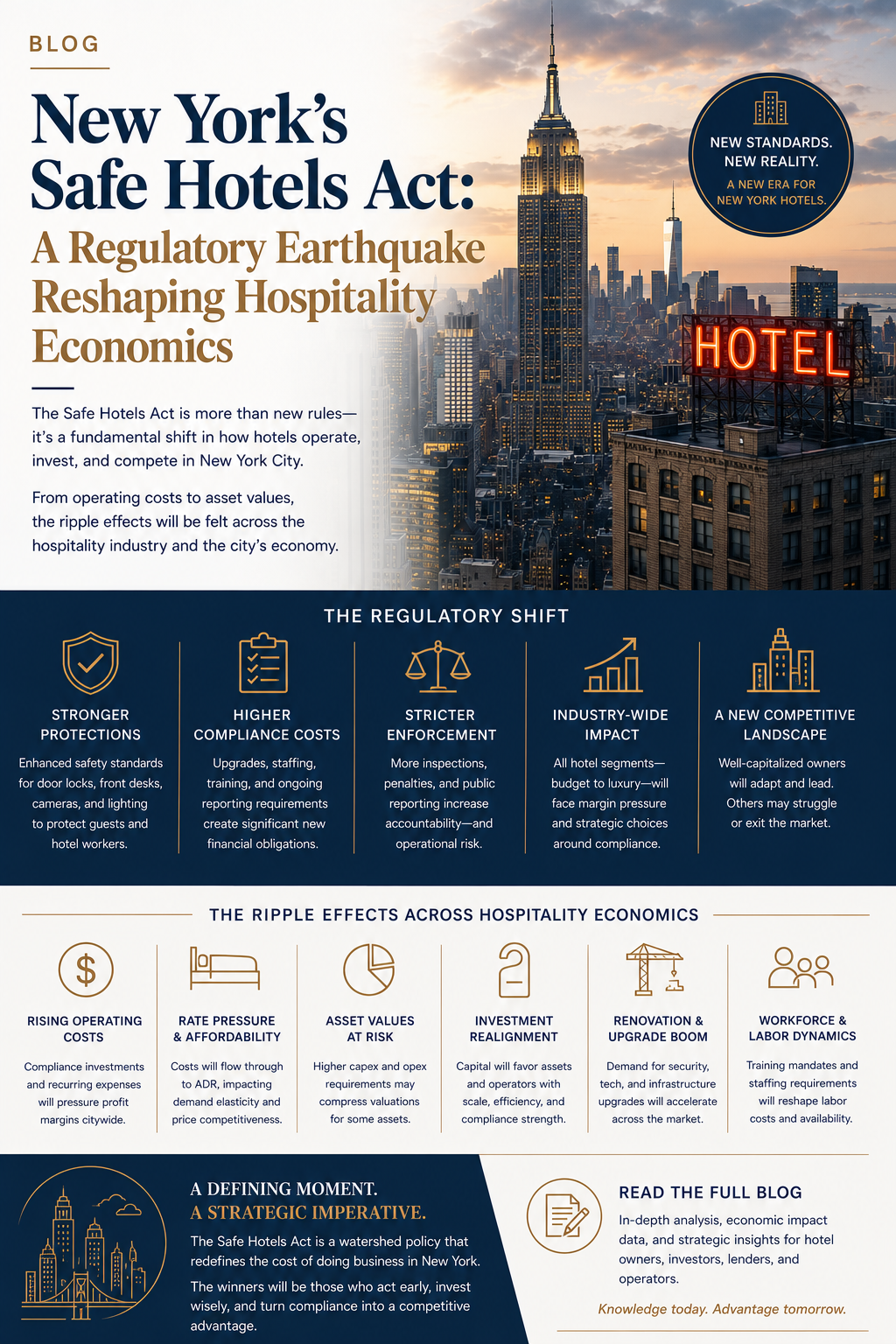
The Dawn of a New Regulatory Era
New York City has implemented legislation that fundamentally transforms the operational landscape for its hotel industry, and the reverberations are being felt far beyond the five boroughs. The Safe Hotels Act, while ostensibly focused on worker safety and guest protection, contains provisions that industry executives are characterizing as both “devastating” and “onerous” — language that reflects genuine alarm about the law’s implications for business viability, investment attractiveness, and the broader competitive position of one of the world’s most important hospitality markets.
The law’s requirement that nonunion hotels with more than 100 rooms directly hire their “core employees” — including housekeeping staff and front desk personnel — effectively prohibits the use of subcontractors and staffing agencies that have become integral to hotel operations in major urban centers. This provision, which represents the first known legislative ban on subcontractor utilization in the hotel sector, has triggered immediate concerns about cost structures, operational flexibility, and the long-term viability of nonunion properties.
What makes this legislation particularly significant is its potential to serve as a template for other jurisdictions. Industry observers note that San Francisco, Los Angeles, and other blue cities have already considered similar measures, suggesting that New York’s action may represent the leading edge of a broader regulatory wave. For an industry still recovering from pandemic disruptions, the prospect of cascading labor mandates across multiple markets creates a challenging environment for strategic planning and investment.
The Law’s Architecture: Safety Framing, Labor Substance
The Dual Structure of the Legislation
The Safe Hotels Act combines provisions that are genuinely focused on safety with labor requirements that fundamentally restructure hotel employment relationships. The safety elements — including mandated panic buttons for employees and mandatory human trafficking recognition training — have generated relatively little controversy. These provisions align with broader industry trends toward enhanced worker protection and are consistent with the law’s stated purpose.
The labor provisions, however, represent a significant departure from established practice. By requiring direct employment of core personnel and prohibiting subcontractor utilization, the law effectively mandates a particular employment model that had previously been a matter of business choice. This intervention in operational decision-making has generated the most significant pushback from industry stakeholders.
The distinction between safety and labor provisions is important for understanding both the law’s political appeal and its practical impact. The safety framing helps justify the legislation and may make it more difficult to challenge in court. However, the labor provisions are where the law’s most significant economic consequences reside, and these are the elements that industry executives are highlighting in their opposition.
The Nonunion Hotel Impact
The law’s provisions affect nonunion hotels disproportionately, as unionized properties generally already employ core workers directly. According to analysis by the New York City Independent Budget Office, the direct employment requirement is “expected to have a larger impact on nonunion hotels, potentially increasing their operating costs.” This differential impact reflects the structural differences between union and nonunion employment models.
The numbers illustrate the scale of the affected sector. New York has 785 hotels, of which 581 are nonunion — approximately 74% of the total. These properties, which range from boutique establishments to major branded hotels, now face the challenge of restructuring their employment models to comply with the new requirements. The magnitude of this transition should not be underestimated; it represents a fundamental change in how a substantial portion of the city’s hotel industry operates.
For nonunion hotels that have relied on subcontractors for housekeeping and front desk staffing, the transition to direct employment involves significant operational challenges. These include establishing new hiring and management systems, assuming responsibility for benefits and workers’ compensation, and developing the administrative capacity to manage a larger direct workforce. The costs of this transition are likely to be substantial and may affect the competitive positioning of nonunion properties relative to their unionized competitors.
The Operational Challenges: Beyond Simple Cost Increases
The Subcontractor Rationale
The industry’s reliance on subcontractors is not merely a cost-saving measure but reflects genuine operational necessities in a challenging urban environment. Hotel operators have emphasized that subcontractors provide critical services that enhance operational flexibility and workforce reliability.
One often-cited challenge is workforce accessibility. In a city where many housekeepers commute from distant neighborhoods — sometimes traveling an hour and a half or more to reach centrally located properties — subcontractors can help source workers, arrange transportation, and ensure reliable attendance. These services are particularly valuable during off-peak seasons when fluctuating occupancy creates variable staffing needs.
Subcontractors also provide a buffer against demand volatility. Hotels can adjust staffing levels more flexibly when using subcontractors, scaling up during peak periods and reducing hours during slower seasons without the complications associated with direct employment. This flexibility is essential for maintaining profitability in a cyclical industry where demand can vary dramatically.
The prohibition on subcontractor utilization eliminates this flexibility, potentially forcing hotels to maintain larger permanent staffing levels than they would otherwise need. This may lead to higher costs during off-peak periods and reduced ability to scale up during peak periods, both of which could affect profitability and service quality.
The Administrative Burden
Beyond the direct cost implications, the law imposes a substantial administrative burden on affected hotels. Direct employment requires compliance with a host of regulations, including wage and hour requirements, worker safety standards, unemployment insurance, workers’ compensation, and various tax obligations. Hotels that previously relied on subcontractors must now develop the administrative capacity to manage these responsibilities.
This burden falls disproportionately on smaller nonunion hotels that may lack the administrative infrastructure of larger chains or unionized properties. For these hotels, the transition to direct employment may require significant investment in human resources systems, legal compliance expertise, and administrative staffing. The fixed costs of this transition may be particularly challenging for properties with limited financial resources.
The administrative burden extends beyond initial compliance to ongoing management. Direct employment requires ongoing attention to labor relations, performance management, and workforce development. Hotels that previously delegated these responsibilities to subcontractors must now develop internal capabilities in these areas, adding to the operational complexity of managing a hotel.
The Financial Implications: Cost Structures and Investment Decisions
The Cost Impact Assessment
The precise cost impact of the Safe Hotels Act remains the subject of ongoing analysis, but the available evidence suggests it will be substantial. The New York City Independent Budget Office has confirmed that the direct employment requirement will increase operating costs for nonunion hotels, though the magnitude of the increase depends on how hotels restructure their operations in response.
The cost increase arises from multiple sources. Direct employment typically involves higher labor costs than subcontracting, as hotels must provide benefits, pay payroll taxes, and assume workers’ compensation obligations. The administrative costs of managing a direct workforce also add to expenses. Additionally, the loss of staffing flexibility may force hotels to maintain higher staffing levels during off-peak periods, further increasing costs.
Industry estimates of the cost impact vary, but all suggest significant increases. Some operators have indicated that the law could add 10-20% to their labor costs, a margin that could make the difference between profitability and loss for many nonunion properties. For an industry operating on thin margins, these increases are consequential.
The Financing Dimension
The law’s impact extends beyond operations to affect the financing environment for hotel properties. Lenders are increasingly factoring the Safe Hotels Act into their underwriting decisions, making refinancing more challenging for affected properties. This development is particularly concerning given the significant debt maturities facing the hotel sector in the coming years.
Some lenders have become more cautious about providing financing for nonunion hotels in New York, recognizing that the law introduces new operational risks that could affect repayment capacity. This caution may lead to higher borrowing costs, lower loan-to-value ratios, or outright denials of credit for properties that appear vulnerable to the law’s impact.
The financing implications compound the operational challenges created by the law. Hotels that face higher operating costs may struggle to service debt, potentially leading to distress, foreclosure, or forced sales. The cascade of effects — from operational costs to financing availability to property values — could reshape the economic landscape for New York’s hotel industry.
The Investment Impact
The most significant long-term implication of the Safe Hotels Act may be its effect on investment decisions. Industry leaders have warned that New York has become “a lot less attractive” as an investment destination due to the regulatory environment, and there is evidence that some investors are shifting their focus to other markets.
The investment impact operates through multiple channels. The higher operating costs associated with the law reduce the potential returns on hotel investments, making New York less competitive relative to other cities. The regulatory uncertainty surrounding the law’s implementation and potential expansion adds risk to investment decisions. And the prospect that other cities may adopt similar measures creates a broader concern about the future trajectory of hotel regulation.
For an industry that relies on substantial capital investment, these considerations are consequential. New York has historically been among the most attractive hotel investment markets in the world, but its competitive position may be eroding as the regulatory environment becomes more challenging. The long-term effect on property values, new development, and the quality of the city’s hotel stock remains to be determined.
The Template Concern: A National Movement in the Making
The Blue City Trend
The concern that New York’s legislation may serve as a template for other jurisdictions reflects a broader pattern in urban governance. Progressive cities across the country have been pursuing labor mandates that affect various industries, and the hotel sector has been a particular focus of these efforts.
Industry observers note that San Francisco and Los Angeles have already considered similar legislation, suggesting that the New York model may gain traction in other markets. The political dynamics that produced the Safe Hotels Act — including strong labor advocacy, progressive city councils, and a mayoral administration sympathetic to worker protections — are present in many other cities.
The prospect of cascading mandates across multiple markets is particularly concerning for hotel operators and investors. If major cities adopt similar requirements, the industry would face a patchwork of regulations that could complicate national operating strategies and reduce economies of scale. The possibility that the New York model becomes the industry standard — or at least a common feature in major markets — is a significant risk factor for hotel investment and operations.
The Labor Mandate Evolution
The Safe Hotels Act represents the latest phase in the evolution of labor mandates affecting the hotel industry. Previous efforts focused on wage increases, benefits requirements, and scheduling protections. The New York law goes further by intervening in the fundamental structure of employment relationships, effectively mandating a particular employment model.
This evolution reflects the increasing ambition of labor advocates and their allies in city government. Having achieved success on wage and benefit issues, they are now seeking to reshape the structure of employment itself. The prohibition on subcontracting is a particularly significant innovation because it directly addresses the employment relationships that have enabled nonunion hotels to operate with different cost structures than unionized properties.
The potential for further evolution is real. If the New York model proves politically successful, advocates may seek to extend similar requirements to other industries or to expand the scope of hotel mandates. The hotel industry is likely to remain a focus of labor advocacy, given its visibility, its concentration in major cities, and the presence of a significant unionized sector that provides a model for nonunion properties.
The Policy Rationale: Worker Protection or Union Strategy?
The Safety Framing
The Safe Hotels Act’s proponents have emphasized its safety objectives, noting that panic buttons and human trafficking training provide important protections for hotel workers. These provisions have broad appeal and are difficult to oppose, as they address genuine concerns about worker safety in a service industry where employees often work in isolated environments.
The safety framing has been politically effective, helping to build support for the legislation and making it more difficult to challenge in court. However, industry critics argue that the safety provisions could have been implemented without the labor mandates, suggesting that the safety framing serves as a cover for the more controversial labor provisions.
The relationship between safety and labor provisions is complex. Advocates argue that direct employment enhances safety by ensuring that workers have clear reporting lines, access to benefits, and a stable employment relationship that encourages reporting of safety concerns. Critics counter that these benefits could have been achieved through more targeted measures, and that the labor provisions go beyond what is necessary for worker safety.
The Union Impact
The law’s differential impact on union and nonunion hotels has led to speculation about its underlying purpose. By increasing costs for nonunion properties, the law may reduce the competitive advantage that nonunion hotels have enjoyed, potentially making unionization more attractive or reducing the competitive pressure on unionized properties.
This dynamic has led some industry observers to characterize the law as a union strategy rather than a worker protection measure. While this characterization is disputed, the evidence suggests that the law does create advantages for unionized properties relative to their nonunion competitors. The effect may be to strengthen the unionized sector’s competitive position, potentially leading to increased unionization or reduced competition.
The union impact is not necessarily an unintended consequence; it may be an explicit goal of some advocates. However, the law’s proponents would likely argue that any union impact is incidental to the primary purpose of protecting workers and ensuring stable employment relationships.
The Industry Response: Adaptation and Advocacy
Operational Adaptation Strategies
Faced with the new regulatory environment, hotel operators are developing strategies to manage the law’s impact. These strategies range from operational adjustments to legal challenges, and their success will determine the ultimate consequences of the legislation.
Operational adaptation begins with compliance. Hotels affected by the direct employment requirement must transition their workforce from subcontractor to direct employment, a process that involves hiring, training, and establishing new administrative systems. The timing and execution of this transition will be critical to minimizing disruption and controlling costs.
Some operators are exploring technology solutions to offset the increased costs associated with direct employment. Automation of front desk functions, robotic cleaning systems, and other innovations may help reduce labor requirements and improve efficiency. However, these solutions are not yet widely deployed and may not be suitable for all property types.
Others are considering changes in their business models, including repositioning properties to serve different market segments or adjusting pricing strategies to maintain profitability. The viability of these strategies depends on market conditions and the specific characteristics of each property.
Advocacy and Legal Challenges
Beyond operational adaptation, the industry is pursuing advocacy and legal strategies to address the law’s impact. Industry associations are lobbying for amendments or modifications to the legislation, seeking to reduce its burden on affected properties. These efforts may yield some relief, though the political dynamics that produced the law make substantial changes unlikely.
Legal challenges are also being considered. The industry may argue that the law exceeds the city’s authority, violates constitutional protections, or conflicts with federal or state law. The outcome of any litigation is uncertain, but legal challenges could delay implementation or result in modifications to the law’s provisions.
The industry’s advocacy efforts also extend to other jurisdictions. By highlighting the negative consequences of the New York law, industry leaders hope to discourage other cities from adopting similar measures. The message is that the law increases costs, reduces investment, and ultimately harms the workers it is intended to protect.
The Broader Implications for the Hospitality Sector
The Competitive Landscape
The Safe Hotels Act reshapes the competitive dynamics of New York’s hotel industry. By increasing costs for nonunion properties, the law creates advantages for unionized hotels that already employed core workers directly. This shift may lead to changes in market shares, pricing, and service offerings.
Nonunion hotels that successfully adapt to the new requirements may maintain their competitive position, while those that struggle may lose market share or be forced to exit the market. The long-term effect on the industry’s structure will depend on how operators respond and whether the law’s impact is sustained over time.
The competitive implications extend beyond New York. If other cities adopt similar laws, the industry’s national competitive landscape could be reshaped. Hotels in jurisdictions with less restrictive regulations may gain advantages over those in regulated markets, potentially affecting investment decisions and corporate strategies.
The Labor Market Impact
The law’s effect on the labor market is likely to be complex. Direct employment may provide workers with greater stability and access to benefits, consistent with the law’s stated objectives. However, it may also reduce flexibility for workers who value the varied opportunities available through subcontracting arrangements.
The impact on wages and working conditions is uncertain. Direct employment may lead to higher wages and better benefits, but it could also reduce employment levels as hotels adjust their staffing models in response to higher costs. The net effect on workers will depend on the balance between these competing forces.
The law may also affect the structure of the hotel workforce. If direct employment leads to more stable employment relationships, it could reduce turnover and improve service quality. However, it could also reduce the availability of part-time and flexible arrangements that some workers prefer.
Conclusion: A Defining Moment for Urban Hospitality
The Safe Hotels Act represents a defining moment for New York’s hotel industry and potentially for the broader hospitality sector. By intervening in the fundamental structure of employment relationships, the law goes beyond traditional labor regulation to reshape how hotels organize their operations. The consequences will be measured in costs, competitiveness, and the long-term attractiveness of New York as a hotel investment destination.
The law’s impact extends beyond the immediate operational challenges it creates. It signals a new phase in the evolution of labor mandates, one in which advocates seek not just to improve wages and conditions but to restructure employment relationships themselves. The potential that this model will spread to other cities makes the New York experiment consequential for the industry nationwide.
The industry’s response to this challenge will shape its long-term trajectory. Operators who adapt successfully may find new efficiencies and opportunities in the changed regulatory environment. Those who resist may find themselves at a competitive disadvantage. The choices made in the coming months and years will determine whether the Safe Hotels Act is a temporary disruption or a permanent transformation of the industry’s operating model.
For city policymakers, the law presents a test of their regulatory approach. If the law achieves its stated objectives without causing significant economic disruption, it may become a model for other jurisdictions. If it leads to reduced investment, property deterioration, or unintended consequences for workers, it may generate calls for reform or repeal. The evidence will accumulate over time, and the policy debate will continue.
What is clear is that the hotel industry will never be the same. The Safe Hotels Act has changed the rules of the game, and all stakeholders must adapt to the new reality. The ultimate outcome will depend on the creativity of operators, the advocacy of industry associations, the responsiveness of policymakers, and the choices of workers and consumers who will ultimately determine the industry’s fate in the nation’s largest city.