 by InRealEstate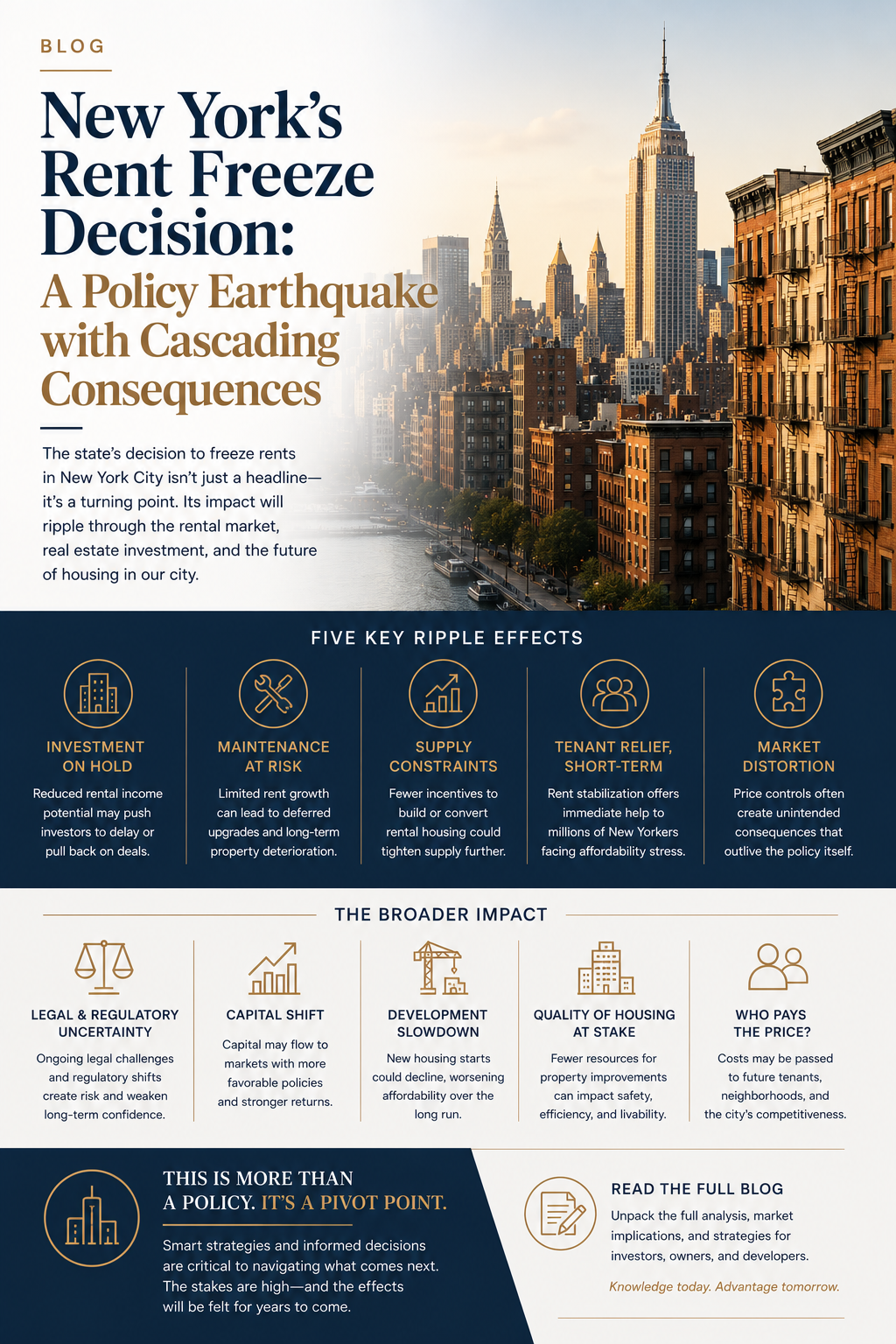
The Vote That Changed Everything
In a decision that will reverberate through New York’s housing market for years, the Rent Guidelines Board has approved a comprehensive rent freeze affecting approximately one million rent-stabilized apartments across the city. The 7-1 vote, which came after a dramatic last-minute resignation by a landlord representative, represents the most aggressive rent regulation action in recent memory and marks the first time the board has frozen rents for two-year leases.
The significance of this decision extends far beyond the immediate financial relief it provides to tenants. It represents a fundamental reorientation of housing policy priorities, signaling that the political calculus around rent regulation has shifted decisively in favor of tenant protections. This shift carries profound implications for property owners, housing advocates, financial institutions, and the broader New York economy.
The vote’s timing, occurring against the backdrop of a record-low rental vacancy rate of 1.4% and rising operational costs for building owners, makes the decision particularly consequential. The board effectively chose to prioritize tenant affordability over owner financial viability, setting the stage for what will likely be an extended period of uncertainty and potential conflict in the city’s housing market.
The Mechanics of the Decision
The Board’s Composition and Dynamics
The Rent Guidelines Board’s composition has been transformed by a series of mayoral appointments that have fundamentally altered its decision-making dynamics. With six of the eight voting members appointed by the current administration, the board now reflects a political philosophy that views rent regulation as a primary tool for addressing housing affordability rather than a necessary evil to be managed with restraint.
The eleventh-hour resignation of a landlord representative hours before the vote adds a layer of procedural drama to the decision. While the resignation technically reduced the board’s size, it effectively eliminated a dissenting voice that might have moderated the outcome or at least provided a more robust counterargument during deliberations. The 7-1 vote suggests near-unanimity among remaining members, indicating that the board has achieved a level of consensus that previous iterations lacked.
This transformation reflects broader political shifts in New York City governance. The electorate has demonstrated increasing support for aggressive tenant protections, and the board’s composition now mirrors this political reality. Whether this represents a durable realignment or a temporary pendulum swing remains to be determined by future elections and the tangible outcomes of current policies.
The Two-Year Lease Precedent
The decision to freeze rents on two-year leases marks an unprecedented departure from historical practice. The board last froze rents on one-year leases in 2020, but two-year leases have traditionally received more generous increases to account for the additional uncertainty and risk tenants assume by committing to a longer term.
By extending the freeze to two-year leases, the board has signaled that it views tenants as needing protection not just in the immediate term but over a more extended horizon. This decision is particularly significant because two-year leases have typically been viewed as a mechanism for owners to secure reliable tenancy and reduce turnover costs. The freeze eliminates this incentive, potentially reducing the availability of two-year lease options for tenants who might prefer the stability they offer.
The precedent established by this decision may have lasting effects on the rental market beyond the freeze’s duration. If future boards continue to treat one-year and two-year leases identically, the premium that two-year leases have historically commanded may permanently evaporate, fundamentally altering the economics of lease negotiation in the rent-stabilized sector.
The Economic Realities Behind the Vote
The Financial Pressure on Building Owners
The decision comes at a moment when rent-stabilized properties face mounting financial pressure that threatens the viability of the entire sector. According to comprehensive data compiled by the nonprofit lender Community Preservation Corporation, operating expenses for these properties have grown more than twice as fast as rent increases since 2020, a disparity that has eroded owner margins and raised concerns about the sustainability of the business model.
The Rent Guidelines Board’s own Price Index of Operating Costs found that expenses for buildings with rent-stabilized apartments rose 5.3% in 2026, outstripping inflation and representing a significant increase in the cost of maintaining these properties. This cost growth reflects broader economic trends, including rising insurance premiums, increased property taxes, higher labor costs, and the escalating expense of building materials and repairs.
Despite this cost pressure, the board chose to freeze rents, requiring owners to absorb these cost increases without the ability to pass them along to tenants. For properties with modest operating margins, this decision could push them into negative cash flow territory, potentially leading to deferred maintenance, reduced services, and in the worst cases, property distress and eventual transfer to new ownership.
The Variation in Owner Financial Capacity
Research presented to the board revealed significant variation in owners’ ability to absorb the cost increases that the rent freeze imposes. Some buildings, particularly those with limited debt and well-managed expense profiles, may weather the freeze without substantial difficulty. Others, particularly those acquired recently at high capitalization rates with significant debt burdens, face a far more precarious financial position.
This variation complicates the policy analysis. While the freeze will impose hardship on some owners, others have the financial capacity to absorb the cost without operational disruption. The challenge for policymakers is that the regulatory framework cannot easily distinguish between owners who can absorb the freeze and those who cannot, applying the same rule across all rent-stabilized properties regardless of their financial condition.
The board’s decision effectively chooses tenant affordability over property preservation, accepting that some owners may exit the market or reduce investment in their properties. Whether this trade-off is justified depends on one’s assessment of the relative importance of tenant protection versus property maintenance in the city’s housing ecosystem.
The Tenant Perspective: A Much-Needed Relief
The Affordability Crisis Context
The rent freeze comes against the backdrop of a housing affordability crisis that has reached crisis proportions. The 2023 New York City Housing and Vacancy Survey documented a rental vacancy rate of just 1.4%, a historic low that signals the extreme tightness of the city’s housing market. In this environment, tenants have virtually no leverage, and market-rate rents have soared beyond the reach of many working-class and middle-class households.
The rent-stabilized sector represents the primary source of affordable housing for these households. With roughly 996,600 units, representing approximately 27% of the city’s housing stock and 41% of its rental units, rent stabilization provides a critical buffer against the full force of market pressures. The median rent in rent-stabilized units of $1,500 compares favorably to the $2,000 median for market-rate units, demonstrating the significant benefit that stabilization provides to its tenants.
However, this benefit has been eroding over time as rent increases have outpaced wage growth for many tenants. The freeze effectively halts this erosion, at least temporarily, providing a measure of stability to hundreds of thousands of households that have struggled to keep pace with rising housing costs.
The Tenant Impact Analysis
For the average rent-stabilized tenant, the freeze translates into immediate and tangible financial relief. A tenant paying the median rent of $1,500 would avoid an increase of perhaps 3-5% that would have been allowed under a more typical board decision. This savings, amounting to $540-$900 annually, may represent a meaningful improvement in financial circumstances for households already stretched thin by other rising costs.
The impact extends beyond the direct financial benefit. The freeze provides psychological relief, allowing tenants to plan their household budgets with greater certainty and reducing the anxiety associated with potential rent increases. For families on fixed incomes, including many elderly New Yorkers, this certainty is particularly valuable.
The freeze also has important equity implications. Rent-stabilized tenants are disproportionately lower-income and minority households, and the freeze provides targeted relief to precisely those groups most in need of housing assistance. While the freeze does not address the underlying shortage of affordable housing, it does prevent the existing stock of rent-stabilized housing from becoming less affordable, a significant achievement in its own right.
The Owner Response: A Looming Confrontation
The Real Estate Industry Reaction
The response from the real estate industry has been swift and vehement. Industry leaders have characterized the freeze as a devastating blow to the already struggling rent-stabilized sector, warning of cascading consequences for property maintenance, investment, and the city’s broader housing market.
The Real Estate Board of New York’s president captured the industry’s perspective: the board ignored its own data and made a terrible decision that will mean less investment in maintenance and repairs, accelerating the deterioration of the housing stock and making the housing crisis worse. This assessment reflects genuine concern that the freeze will undermine the financial foundation of the rent-stabilized sector, reducing the quality of housing available to millions of New Yorkers.
The New York Apartment Association has been even more explicit in its warnings, suggesting that “all options are on the table” in response to the decision. This veiled threat of litigation signals that the industry may challenge the freeze in court, arguing that it exceeds the board’s authority or violates property owners’ constitutional rights.
The Litigation Threat
A potential lawsuit against the rent freeze would follow a pattern established in previous controversies over rent regulation. Legal challenges have typically centered on claims that the board’s decisions constitute a regulatory taking, improperly depriving property owners of the economic value of their investments, or that the board failed to properly consider the evidence before it.
The “all options are on the table” response suggests the industry is seriously considering litigation as a strategy. A successful lawsuit could overturn the freeze, generate substantial legal fees, and create a chilling effect on future board decisions. Even an unsuccessful lawsuit could create uncertainty that damages the market for rent-stabilized properties.
However, the legal landscape for rent regulation challenges has shifted in recent years. Courts have generally upheld the constitutionality of rent regulation, deferring to legislative bodies on the appropriate balance between tenant protection and owner rights. The board’s decision, based on substantial evidence including its own cost index, may be difficult to overturn under the deferential standard of review typically applied to administrative agency decisions.
The Financial Market Implications
The freeze carries significant implications for the financial markets that support the rent-stabilized housing sector. Lenders that finance these properties may reassess their risk tolerance, demanding higher interest rates or more conservative loan-to-value ratios to compensate for the increased uncertainty.
The community preservation corporation survey documenting rising delinquent loans suggests that financial distress is already building in the sector. The freeze may accelerate this trend, pushing properties with thin margins toward default and potentially triggering a wave of distressed sales or foreclosures.
Investors in rent-stabilized properties will face a more challenging environment. The freeze reduces the revenue growth that many financial models assumed, potentially requiring downward revisions to property valuations. This could create opportunities for investors with strong balance sheets and patient capital, while squeezing out investors who relied on more aggressive financial projections.
The Broader Policy Implications
The Balancing Act Between Affordability and Preservation
The rent freeze highlights the fundamental tension at the heart of housing policy: the need to balance affordability for current tenants with the preservation and improvement of the housing stock for future residents. By choosing affordability over preservation, the board has made a clear policy choice that will have both immediate benefits and potential long-term costs.
The immediate benefit is the relief provided to hundreds of thousands of households that otherwise would face higher rents. This is a tangible accomplishment that will be appreciated by tenants and their advocates. The potential long-term cost is the deterioration of the rent-stabilized housing stock, as owners reduce investment in maintenance and repairs in response to the freeze.
Whether the benefits outweigh the costs depends on several uncertain factors, including the duration of the freeze, the extent to which owners respond by reducing investment, and the availability of alternative funding sources for property improvements. If the freeze is followed by more balanced decisions in future years, and if owners respond constructively rather than defensively, the negative impacts may be manageable. If the freeze becomes a pattern, and if owners disinvest in response, the consequences could be severe.
The Political Calculus
The rent freeze represents a significant political victory for the administration that championed it. Delivering on a central campaign promise, the administration has demonstrated its commitment to tenant interests and its willingness to use the tools of government to address housing affordability.
However, the political calculus is not without risks. If the freeze results in noticeable deterioration of housing conditions or accelerates financial distress in the rent-stabilized sector, the administration could face political backlash from both property owners and the tenants they serve. The responsibility for the consequences of the freeze rests with the administration, and those consequences will be closely scrutinized by voters and political opponents alike.
The decision also sets a precedent for future Rent Guidelines Board decisions. If future boards follow this year’s aggressive approach, the rent-stabilized sector could face an extended period of restrictive regulation. If they revert to more moderate approaches, the freeze may be viewed as an isolated departure from historical norms.
The Unintended Consequences
The freeze may produce unintended consequences that complicate its evaluation. One potential consequence is the reduction in the availability of two-year leases, as owners find them less attractive without the premium they once commanded. This could reduce the stability available to tenants who preferred longer-term arrangements.
Another potential consequence is the acceleration of efforts to deregulate rent-stabilized apartments through legal mechanisms. Owners who can afford to challenge their apartments’ status may do so, reducing the stock of rent-stabilized units over time. While the number of units lost through such mechanisms is limited, the cumulative effect could be significant.
The freeze may also affect new construction, as developers factor the uncertain regulatory environment into their investment decisions. If the rent freeze signals a broader shift toward more restrictive regulation, developers may shift their investments to other markets, reducing the supply of new housing in New York at a time of severe shortage.
The Data and Research Context
The Rent Guidelines Board’s Own Research
The board’s decision appears to have been influenced by a complex body of research that offered support for competing interpretations. The Price Index of Operating Costs documenting a 5.3% expense increase provided evidence that owners face genuine cost pressure. However, other research showed variation in owners’ ability to absorb these increases, with some properties having significant financial capacity.
The board’s research also highlighted broader economic trends that informed its decision. The record-low vacancy rate suggests that tenants face extreme pressure in the housing market, with limited alternatives if their rents increase. This context makes the freeze more defensible as a response to an extreme market situation rather than a normal adjustment.
Critics of the freeze argue that the board selectively interpreted its own research, emphasizing data that supported the freeze while discounting data that suggested a more balanced approach. The industry statement that the board “ignored its own data” captures this critique, suggesting that the outcome was predetermined by political considerations rather than derived from a neutral analysis of the evidence.
The Comparative Perspective
New York’s rent regulation approach differs from that of other major cities, and the freeze may have been influenced by comparative analysis. Some cities have embraced aggressive rent control measures, while others have moved toward deregulation. The Rent Guidelines Board’s decision places New York squarely in the aggressive regulation camp, at least for the current year.
The consequences of similar decisions in other jurisdictions provide a cautionary tale for New York. In some cities, aggressive rent regulation has been associated with deteriorating housing stock, reduced investment, and declining property conditions. In other contexts, regulation has been successfully balanced with preservation through complementary policies and investment.
The unique characteristics of New York’s housing market, including its age and density, its regulatory complexity, and its financial market structure, mean that lessons from other jurisdictions must be applied with caution. However, the comparative evidence suggests that the freeze is likely to produce some negative consequences even if its benefits are also substantial.
What Happens Next
The Implementation Phase
The freeze takes effect on October 1, 2026, and extends through September 30, 2027. In the intervening period, owners and tenants will adjust to the new regulatory environment. Owners will assess their financial positions, tenants will plan their budgets, and both sides will prepare for the negotiations and potential disputes that the freeze will generate.
The implementation phase will also reveal the practical effects of the freeze. Buildings that experience financial difficulty may reduce services or delay maintenance, with consequences that become apparent over time. Tenants who benefit from the freeze may find their buildings in need of repair, creating a tension between immediate savings and long-term housing quality.
The board’s decision to freeze both one-year and two-year leases will affect lease negotiation dynamics. The freeze may actually increase demand for two-year leases, as tenants seeking to lock in the frozen rent for an extended period may prefer the longer term. This could create an unintended effect in which the freeze benefits tenants who can make a longer commitment while providing less benefit to those who prefer or require shorter terms.
The Longer-Term Outlook
Beyond the freeze’s current one-year term, the rent-stabilized sector faces continued uncertainty. The Rent Guidelines Board will revisit rent policy annually, and the direction of future decisions will depend on economic conditions, political considerations, and the observed effects of the freeze.
If the freeze produces negative consequences, future boards may moderate their approach. If the freeze is absorbed without substantial disruption, the precedent for more aggressive regulation may be reinforced. The cyclical nature of the board’s decision-making suggests that the freeze is likely to be followed by at least some adjustment, perhaps a more moderate increase in subsequent years.
The longer-term trajectory of rent regulation in New York will also be shaped by factors outside the board’s control. State legislative action, federal policy, economic trends, and demographic patterns will all influence the environment in which rent regulation operates. The freeze represents a single decision within a complex and evolving policy landscape.
Conclusion: A Watershed Moment with Unclear Consequences
The rent freeze approved by New York City’s Rent Guidelines Board represents a watershed moment in the city’s housing policy. By choosing to freeze rents on both one-year and two-year leases despite mounting cost pressures on property owners, the board has made a clear statement about its priorities: tenant affordability must be protected even at the expense of property owner financial viability.
This decision carries both immediate benefits and potential long-term costs. The immediate benefits are substantial: approximately one million rent-stabilized households will avoid rent increases, saving hundreds of dollars annually at a time when housing costs are a primary source of financial stress. The potential long-term costs include reduced investment in the rent-stabilized housing stock, financial distress for property owners, and a deterioration of housing conditions that could harm the very tenants the freeze was designed to protect.
The full consequences of the freeze will take years to manifest. Whether this decision is remembered as a triumph of tenant advocacy or a costly policy error will depend on how owners respond, how the housing market adjusts, and whether the freeze is followed by more balanced decisions in future years. What is clear is that the board has set a new precedent that will shape rent regulation debates for years to come.
The political dynamics that produced this decision are also evolving. The freeze reflects a shifting political calculus that prioritizes tenant interests over property owner concerns, a shift that may prove durable or may be reversed in future election cycles. The legal and political challenges that the freeze will face may determine its ultimate impact, as litigation and legislative action shape the regulatory environment.
For New Yorkers, the freeze offers a moment of relief in a housing market that has become increasingly unaffordable. For policymakers, it presents a test case of aggressive rent regulation in a complex, high-cost urban environment. The outcomes of this experiment will influence housing policy not just in New York but in cities across the country that face similar challenges of affordability, preservation, and the difficult balance between competing interests.
The rent freeze is not the end of the story, but the beginning of a new chapter in New York’s long-running debate over how to provide housing that is both affordable and well-maintained. The choices made in response to this decision will determine whether the city can achieve both objectives or whether it must accept trade-offs between them. The path forward requires careful attention to outcomes, willingness to adjust course as evidence accumulates, and a recognition that housing policy is ultimately about the lives of millions of New Yorkers who deserve both affordable rents and decent places to live.