 by
by 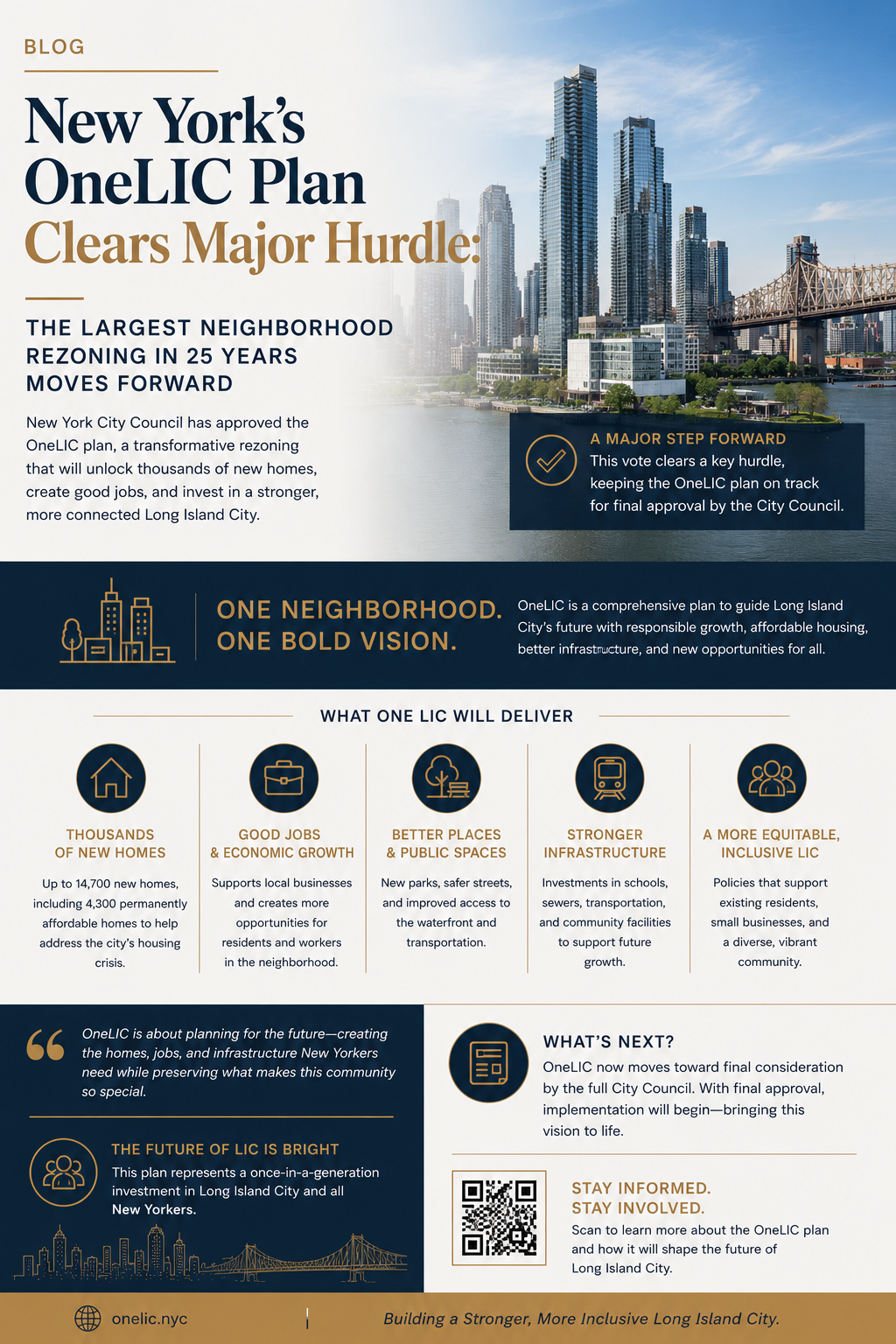
A Landmark Vote for Long Island City’s Future
Two City Council committees voted in favor of the OneLIC plan to revamp local zoning in a 54-block Queens area that would add about 14,700 new apartments, including as many as 4,350 permanently affordable units . The plan, which New York Mayor Eric Adams called the city’s largest neighborhood-specific rezoning in at least a quarter century, now heads to the full City Council for a final vote expected November 12 .
The full City Council is expected to vote on OneLIC November 12, according to a council spokesperson.
What the OneLIC Plan Will Bring to Long Island City
Housing Production at Scale
The proposal would create approximately 14,700 new apartments in a 54-block area of Long Island City, Queens. The area stretches from the East River to Crescent Street and Queens Plaza North to 47th Avenue, with one segment reaching up to 39th Avenue between 21st Street and 23rd Street. Under current zoning, much of this area remains restricted from new housing due to outdated rules, while significant sections of the waterfront have remained inaccessible to the public .
The plan would also create over 3.5 million square feet of commercial and industrial space while making the waterfront publicly accessible. This represents a comprehensive approach to revitalization that goes beyond housing alone, potentially creating new jobs and economic activity in the area.
Affordable Housing Component
OneLIC would include as many as 4,350 permanently affordable units, representing approximately 30% of the total new housing stock. This aligns with the city’s broader commitment to addressing the affordability crisis while leveraging private development to produce mixed-income communities.
The plan comes as New York contends with what the city has found to be a historic record low rental vacancy rate of 1.4% . This figure, the lowest since 1968, has made apartment hunting in the city increasingly difficult, with bidding wars and strict income requirements becoming common . With more than 85,000 people currently sleeping in city-run homeless shelters, the need for new housing supply has never been more acute .
Public Space and Waterfront Access
Beyond housing, OneLIC includes significant commitments to public space. The plan calls for the creation of approximately four acres of new open space under the Queensboro Bridge, a publicly accessible waterfront connection between Gantry Park and Queensbridge Park, and affordable housing . This builds on recent investments in the neighborhood, including the $2.6 million renovation of Queensbridge Baby Park, which reopened in June 2026 .
The plan’s focus on public space reflects the city’s recognition that residential development must be accompanied by amenities that support quality of life and community cohesion.
Long Island City’s Transformation: A Neighborhood in Demand
Record-High Rents
Long Island City has already proven to be a highly popular residential neighborhood just across the East River from Manhattan. The waterfront neighborhoods just across the river from Manhattan, including Long Island City and Brooklyn’s Williamsburg and Dumbo, have seen a slew of developments that command rents above the city’s already record-high average.
The average market asking apartment rent in Long Island City has risen to a record high of $4,285 a month, above the New York metro average of $3,353, according to CoStar data . More recent data from RentCafe shows the average rent for an apartment in Long Island City at $4,621, a 2.76% increase compared to the previous year . Studios average $3,547, one-bedrooms average $4,545, and two-bedroom units average $6,130 .
According to M.N.S. Real Estate’s May 2026 report, Long Island City had the most expensive units across all three categories among Queens neighborhoods, with studios averaging $3,770, one-bedrooms averaging $4,410, and two-bedrooms averaging $6,487 .
New Luxury Development
The neighborhood’s appeal continues to attract significant investment. The Italic, a 49-story, 363-unit mixed-use rental building at 26-32 Jackson Ave., recently secured $224.3 million in bridge financing from Wells Fargo . Developed by a joint venture between The Carlyle Group, Fetner Properties, and Lions Group, the building features 109 affordable units and amenities including a gym, indoor basketball court, golf simulator, coworking space, and a rooftop terrace with panoramic city views .
The asking rents for the Italic’s 254 market-rate units range from $3,739 for a studio to $9,067 for a three-bedroom apartment . The building was “developed to appeal to modern renters migrating from Manhattan,” according to JLL, reflecting the neighborhood’s growing appeal as a more affordable alternative to Manhattan living .
Additionally, Paragon LIC, a 186-unit luxury condominium tower on the waterfront at 45-40 Vernon Blvd., has launched sales as the first new waterfront condo development in Long Island City in more than a decade . Pricing ranges from $655,000 to $4.65 million, and developer ZD Jasper expects rapid sellout . According to Ryan Serhant, founder and CEO of Serhant, the brokerage handling sales: “We’re working through a backlist of locals who would never leave LIC and are eager to level up” .
The Need for Speed: Leasing Bottlenecks and Implementation Challenges
Affordable Housing Leasing Delays
While OneLIC promises to add thousands of housing units, the city faces a significant challenge in getting new affordable units occupied quickly. A new report from the New York Housing Conference found that “excessive oversight” is slowing down leasing in city-subsidized buildings, keeping brand new, low-rent apartments vacant for months despite enormous demand .
One Bronx affordable housing project tracked by the report took 27 months to lease just 180 apartments, highlighting the inefficiencies in the current system . “It’s really frustrating when you see vacant affordable units. Taxpayers should be angry about that,” said Rachel Fee, executive director of the housing conference. “There has to be a better way to do this. It feels really antiquated, inefficient and clunky, and also really ripe for improvement now that we have a new mayor” .
A Growing Neighborhood Continues to Attract Investment
Long Island City is one of New York’s fastest-growing neighborhoods, featuring over 30,000 existing residential units and 13.5 million square feet of office space . The OneLIC plan is projected to add 14,700 new residential units, further amplifying foot traffic and consumer spending power in the area .
The neighborhood’s continued growth, combined with the citywide rental vacancy crisis, suggests strong demand for the new units OneLIC will enable. With the city’s rental vacancy rate at just 1.4%—well below the 5% threshold that typically signals a housing emergency—the pressure to deliver new supply quickly is intense .
Key Takeaways for Real Estate Professionals
Massive Supply Injection: OneLIC represents the largest neighborhood-specific rezoning in 25 years, adding approximately 14,700 units to a neighborhood already experiencing significant growth. This scale of new supply could have meaningful implications for Long Island City’s rental market dynamics.
Affordability Mandates: The plan’s requirement of up to 4,350 permanently affordable units (approximately 30% of total units) reflects the city’s continued emphasis on affordable housing production, a priority for Mayor Eric Adams and likely future administrations.
Continued Investment Momentum: The neighborhood’s record-high rents and recent luxury developments—including The Italic and Paragon LIC—demonstrate that investor confidence in Long Island City remains strong, even as broader office market challenges persist elsewhere in the city .
Implementation Risks: The 27-month leasing delay for affordable units in a Bronx project highlights the importance of addressing the “antiquated, inefficient and clunky” oversight process . Without reform, some of OneLIC’s affordable units could face similar delays, undermining the plan’s effectiveness.
The Mayor Matters: The November 12 City Council vote will be a key test of Mayor Adams’ commitment to housing production, and the implementation of OneLIC will be closely watched by the real estate industry as a bellwether for the city’s broader housing strategy . The plan’s success could demonstrate the city’s ability to deliver major neighborhood rezoning projects, potentially paving the way for similar efforts elsewhere.