 by
by 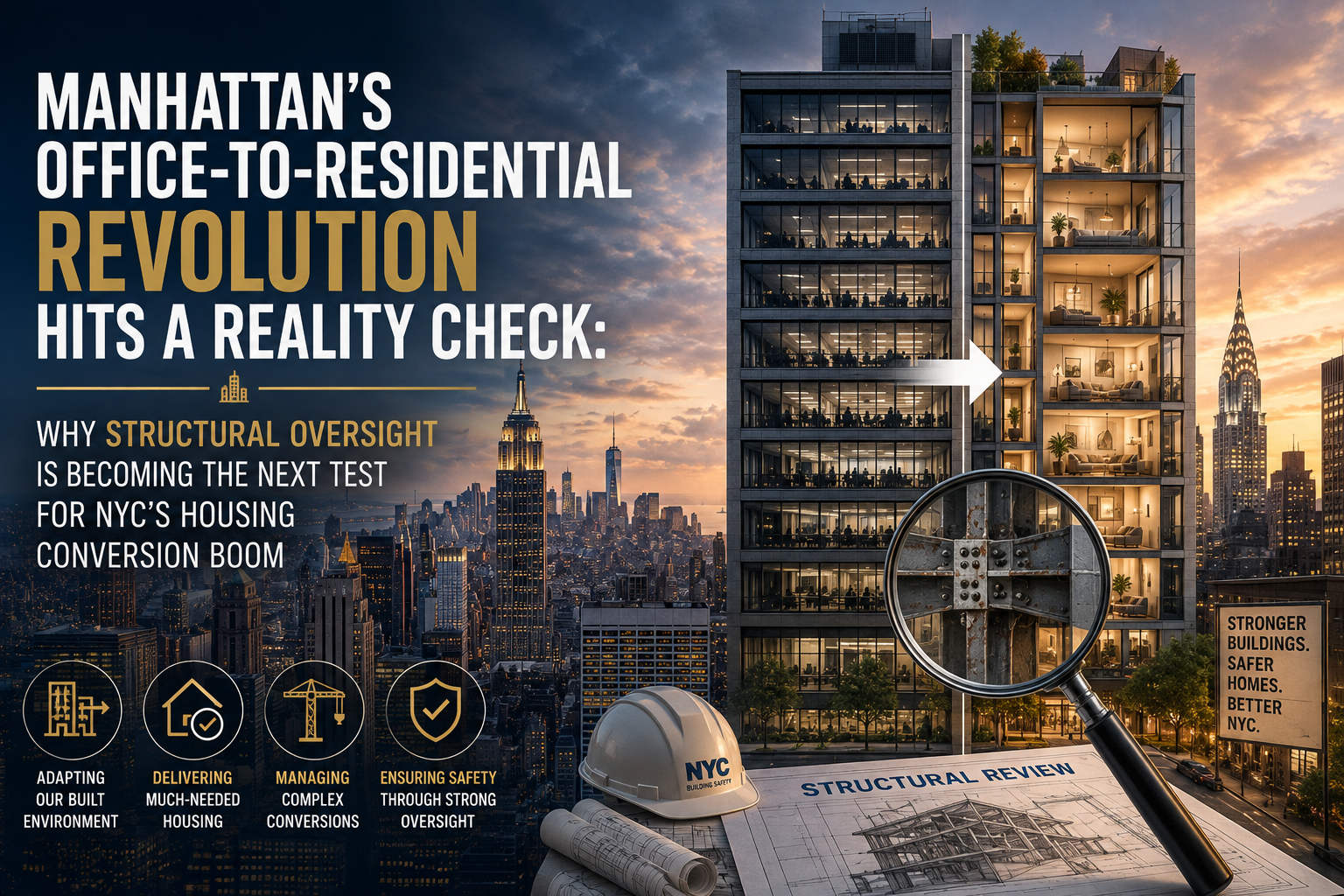
Manhattan’s Office-to-Residential Revolution Faces a New Test: Safety, Engineering, and Regulatory Oversight
New York’s office-to-residential conversion boom faces increased regulatory scrutiny after a stop-work order at 222 Broadway. Learn how engineering oversight, construction safety, and compliance are reshaping Manhattan’s redevelopment market.
Table of Contents
Introduction: The Office Conversion Era Meets a New Regulatory Reality
New York City’s push to convert outdated office towers into residential buildings has become one of the most important strategies for tackling two challenges at once: a struggling Manhattan office market and a severe NYC housing shortage.
But as developers pour billions of dollars into office-to-residential conversion projects across Manhattan, a new challenge is emerging — construction safety, engineering oversight, and regulatory compliance.
The recent stop-work order at 222 Broadway, a Lower Manhattan office tower being converted into the luxury residential project Wrey, underscores a broader issue facing the city: turning aging commercial buildings into modern housing requires complex structural work, and every engineering decision carries real consequences.
The incident doesn’t signal a failure of the office conversion strategy itself. Rather, it shows that New York’s transformation of its aging building stock will require tighter coordination between developers, engineers, and city regulators.
222 Broadway: A Flagship Office Conversion Faces Unexpected Delays
Flagship conversion projects like Wrey at 222 Broadway sit at the center of a citywide debate over how aggressively New York can pursue office-to-residential conversions without compromising construction safety and engineering oversight standards across the borough.
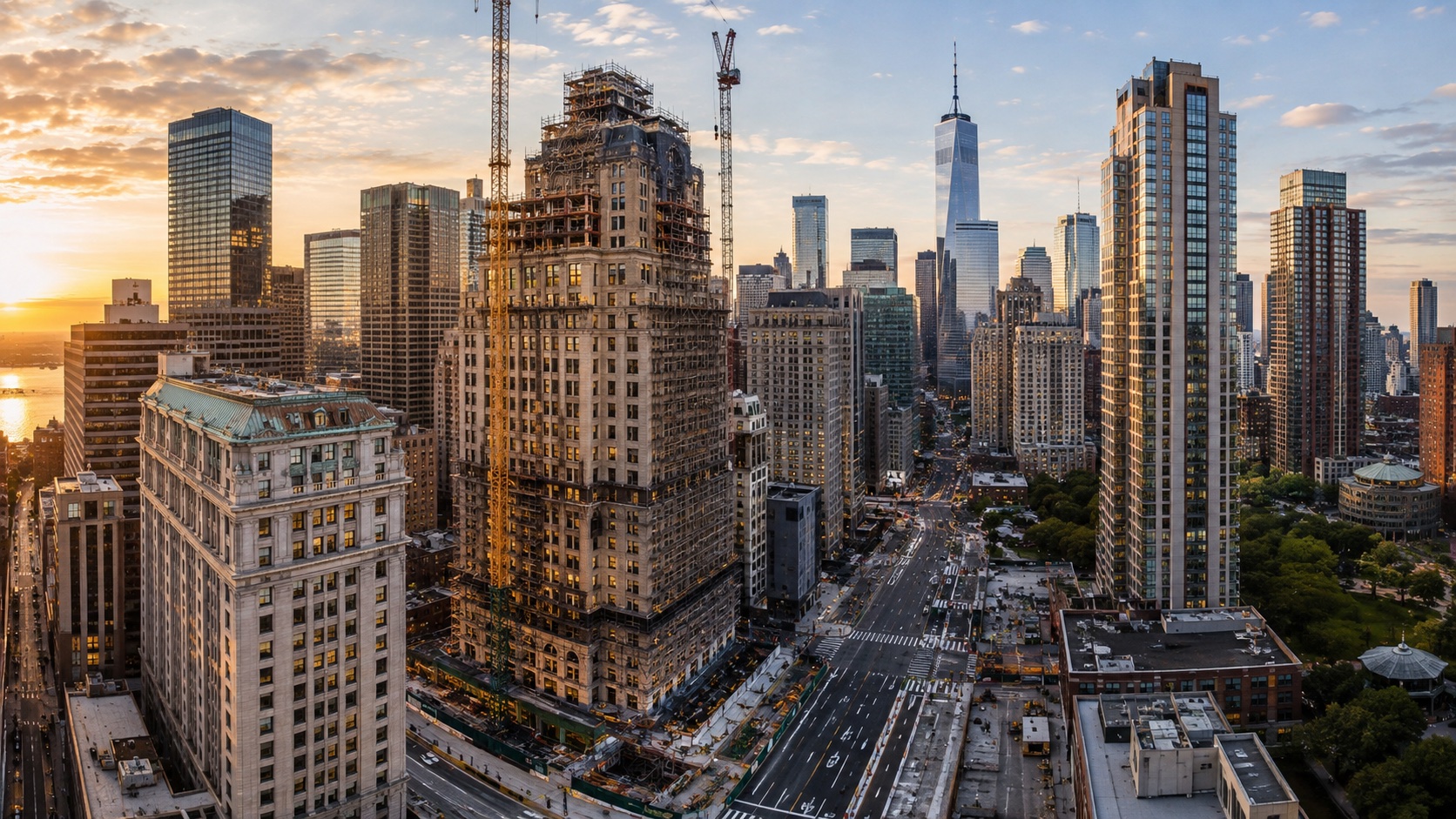
The photograph above captures the scale of Manhattan’s office conversion movement, where aging commercial towers in the Financial District are being repositioned as luxury residential communities amid rising Manhattan office market vacancy and sustained demand for NYC housing in transit-rich downtown neighborhoods.
Located between Fulton Street and Ann Street in the Financial District, 222 Broadway is exactly the type of property New York hopes to transform as demand for traditional office space continues to shift.
The former office tower, once home to tenants including Bank of America and WeWork, was acquired by a partnership between GFP Development and private equity firm TPG with plans to reposition the building as Wrey, a luxury residential destination.
Key Features of the Wrey Redevelopment Project
- Approximately 788 residential apartments
- Studio, one-bedroom, two-bedroom, and three-bedroom units
- Luxury penthouses
- A rooftop pool overlooking One World Trade Center
- High-end residential amenities
With rents starting around $4,500 per month, the project reflects a broader trend: developers are targeting older Class B office buildings and repositioning them for higher-value residential demand.
That momentum hit a snag, however, when the New York City Department of Buildings issued a full stop-work order.
Engineering Issues Trigger City Review
The Department of Buildings halted construction after reviewing reports of cracks discovered in two concrete beams on the 32nd floor.
Officials say the structural issue had already been repaired, and ownership maintained that the building remained safe throughout.
Key Regulatory Issues Under Review
- The timing of reporting the issue
- Required notification procedures
- Documentation of repair changes
- Compliance with Department of Buildings regulations
The developer says engineers identified and repaired the issue immediately, and that an independent review confirmed the repairs were completed safely.
That distinction matters. It points to a growing reality in New York construction: regulatory compliance now carries as much weight as physical construction quality.
The Pfizer Conversion Collapse Changed the Industry Conversation
The heightened scrutiny at 222 Broadway comes shortly after a major construction failure at another Manhattan office-to-residential conversion project.
The partial collapse at the former Pfizer headquarters conversion at 219 and 235 East 42nd Street dramatically changed how the industry views redevelopment risk.
How the Incident Reshaped Regulatory Oversight
- Structural column failures
- Evacuations of nearby buildings
- Street closures
- Increased Department of Buildings inspections citywide
In its aftermath, regulators began conducting broader safety reviews of conversion projects across the city.
The message from city officials is clear: office-to-residential conversions are necessary for New York’s future, but they must be executed with extraordinary attention to structural integrity.
Why Office-to-Residential Conversions Are Technically Challenging
Converting an office building into apartments involves far more than redesigning interior layouts. This type of adaptive reuse demands extensive structural and systems engineering that goes well beyond cosmetic renovation.
Many older office towers were originally built for:
- Large open floor plates
- Higher floor loads
- Centralized mechanical systems
- Limited plumbing infrastructure
Major Infrastructure Upgrades Required
Before any residential floor plan can take shape, developers must address the deep building-system constraints shown in conversion work across the Manhattan office market, where adaptive reuse projects demand coordinated upgrades to plumbing, mechanical, and structural components under strict engineering oversight.
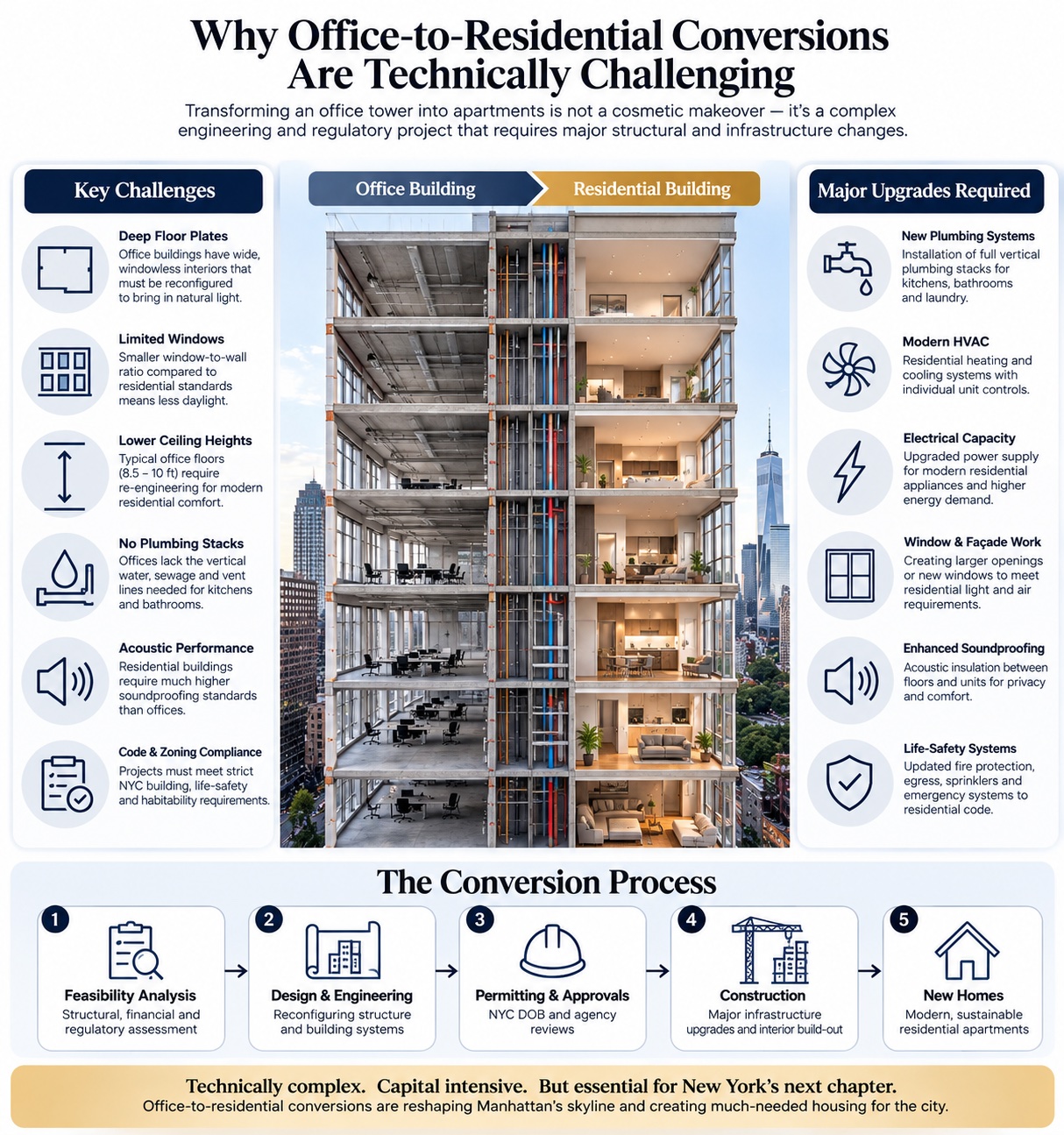
As the image above illustrates, successful office-to-residential conversions depend on re-engineering entire building cores — a reality that connects directly to rising construction safety standards and the tighter compliance environment shaping commercial real estate redevelopment across New York City today.
- New plumbing infrastructure — Apartments need individual kitchens, bathrooms, and water systems, often requiring major changes to building cores.
- Different structural loads — Residential use creates weight distribution patterns that differ from commercial office environments.
- New mechanical systems — Developers must redesign ventilation, heating, cooling, electrical systems, and elevators.
- Updated safety requirements — Projects must meet modern fire protection, accessibility, and emergency regulations.
These demands explain why city officials are ramping up oversight as more conversions move forward.
Manhattan’s Office Market Is Being Redefined
The situation at 222 Broadway comes at a pivotal moment for Manhattan commercial real estate.
The traditional office model has changed for good, driven by:
- Hybrid work adoption
- Reduced corporate footprints
- Higher office vacancy rates
- Growing demand for newer, amenity-rich buildings
Older office towers, especially those built decades ago, face mounting pressure because many simply can’t compete with newer Class A properties.
Office conversion has emerged as one solution. Buildings that once represented Manhattan’s commercial dominance are now becoming opportunities for:
- Housing creation
- Neighborhood revitalization
- Increased property values
- New residential communities
Lower Manhattan Becomes the Center of the Conversion Movement
Lower Manhattan has become one of the strongest markets for office-to-residential redevelopment, thanks to its large inventory of aging office buildings.
Projects such as:
- 25 Water Street
- 222 Broadway (Wrey)
- Other Lower Manhattan redevelopment initiatives
are reshaping the neighborhood from a traditional business district into a mixed-use community.
The shift is significant: the Financial District is no longer just a place where people work — it’s becoming a place where people live. That transition could reshape retail demand, restaurant activity, public transportation patterns, and evening and weekend foot traffic throughout the area.
The Developer Challenge: Balancing Speed, Cost, and Safety
For developers, the current environment demands a difficult balancing act. They must manage rising construction costs, financing challenges, interest rates, regulatory requirements, and uncertain market demand — all at once.
At the same time, delays can significantly hurt a project’s economics. A stop-work order can drive up construction expenses, add financing pressure, push back leasing timelines, and rattle investors.
As a result, engineering planning and regulatory communication have become just as critical to a project’s success as the construction itself.
A New Era of Construction Oversight in New York
The Department of Buildings’ increased enforcement signals a broader shift in how New York approaches redevelopment.
Historically, the city focused heavily on encouraging new housing supply. Now, as thousands of apartments emerge through conversions, officials are placing greater emphasis on structural reviews, engineering documentation, construction transparency, and real-time reporting.
The goal: prevent isolated incidents from undermining confidence in the entire conversion market.
Frequently Asked Questions
What is an office-to-residential conversion?
An office-to-residential conversion transforms a commercial office building into apartments or condominiums. In Manhattan, this process typically involves rezoning approvals, structural engineering assessments, and major upgrades to plumbing, mechanical systems, and life-safety infrastructure. Conversions allow developers to repurpose underutilized office towers while adding housing supply in neighborhoods where new construction is limited. New York City has actively encouraged these projects to address both rising office vacancy and housing shortages.
What happened at 222 Broadway in Lower Manhattan?
At 222 Broadway, the New York City Department of Buildings issued a stop-work order during construction of the Wrey residential conversion project. Officials cited concerns related to cracks found in concrete beams on the 32nd floor, along with questions about reporting timelines and repair documentation. The developer reported that engineers identified and repaired the structural issue promptly. The incident highlights the heightened scrutiny facing flagship conversion projects in the Financial District.
How is the Manhattan office market affecting conversion demand?
Hybrid work, corporate downsizing, and preference for newer Class A buildings have pushed vacancy rates higher across the Manhattan office market. Older Class B and Class C towers face the greatest pressure to find alternative uses. Office-to-residential conversions offer owners a path to reposition aging assets, unlock residential rents, and contribute to NYC housing supply. Market conditions increasingly favor buildings in transit-rich districts like Lower Manhattan where residential demand remains strong.
What are the main challenges of adaptive reuse in NYC?
Adaptive reuse of office buildings in New York City requires navigating complex zoning rules, floor plate layouts designed for open offices, and outdated building systems. Developers must install individual plumbing for hundreds of units, upgrade elevators and ventilation, and verify that structural elements can support residential loads. Fire protection, accessibility, and egress requirements often exceed original commercial standards. These technical hurdles make engineering expertise and early regulatory coordination essential to project success.
What engineering challenges do office conversions face?
Engineering challenges in office conversions include assessing load-bearing capacity, reinforcing columns and floor slabs, and redesigning building cores to accommodate residential plumbing stacks. Mechanical systems built for centralized office use must be replaced or substantially upgraded. Seismic and wind considerations, facade integrity, and connection details between old and new structural elements require careful analysis. Events like the 222 Broadway beam issue demonstrate why continuous engineering oversight is critical throughout construction.
What role does the NYC Department of Buildings play in conversions?
The New York City Department of Buildings oversees permits, inspections, and compliance for all conversion projects. Following high-profile incidents including the Pfizer headquarters partial collapse, the agency has intensified structural reviews and enforcement across Manhattan. Developers must submit engineering reports, notify officials of structural changes, and maintain documentation demonstrating code compliance. Stop-work orders can halt projects when reporting procedures or safety standards are not met, regardless of whether physical repairs have been completed.
Why is construction safety especially important for conversion projects?
Conversion projects involve invasive structural work inside occupied urban environments, increasing risks to workers, neighbors, and adjacent buildings. Partial demolitions, column modifications, and temporary shoring create conditions unlike ground-up construction. High-profile failures have prompted citywide safety reviews and stricter reporting requirements. Maintaining construction safety protects public confidence in the conversion strategy itself, ensuring that New York can expand housing supply without compromising the integrity of its aging building stock.
Why is Lower Manhattan leading office-to-residential redevelopment?
Lower Manhattan holds a large inventory of mid-century and pre-war office towers that struggle to compete with modern commercial properties. Strong transit access, waterfront amenities, and growing residential demand make the Financial District attractive for housing. Projects like 25 Water Street and 222 Broadway (Wrey) signal a broader shift toward mixed-use neighborhoods. Lower Manhattan redevelopment is transforming a historically commercial district into a 24-hour community with new retail, dining, and residential opportunities.
Conclusion: Office Conversions Remain the Future—But Safety Will Define Success
The stop-work order at 222 Broadway isn’t just a story about one construction project. It reflects a larger moment for New York’s real estate industry.
The city is entering a new phase in which aging office towers are being reinvented as residential communities — a transformation that could become one of the largest real estate shifts in Manhattan’s history.
Its success will hinge on one essential factor: New York must convert buildings faster, but never at the expense of safety, engineering quality, and public confidence.
The future of Manhattan’s skyline may no longer be defined only by office towers. Increasingly, it will be shaped by how successfully those towers become homes.