
 by
by 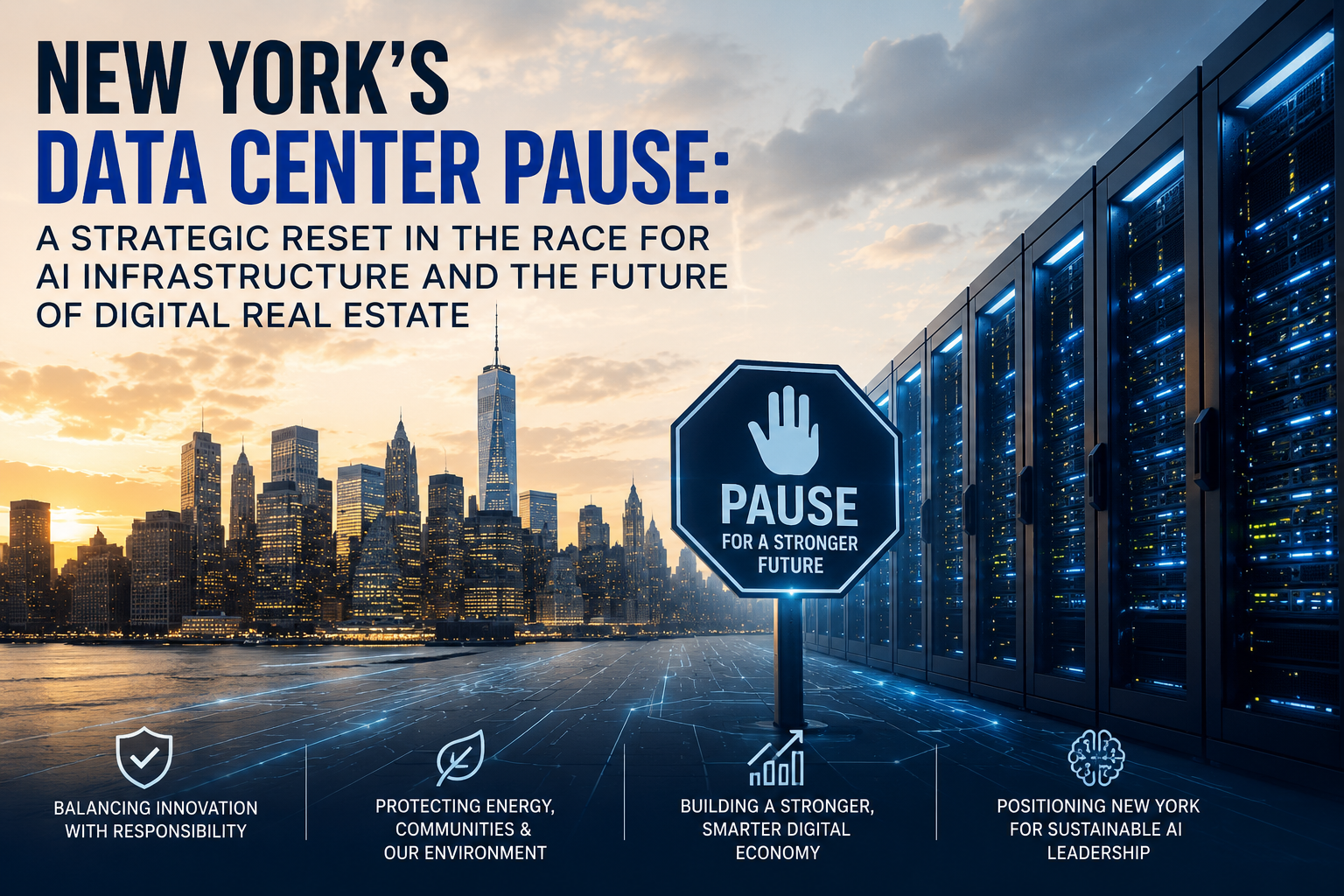
New York’s Data Center Pause: A Strategic Reset in the Race for AI Infrastructure
As states race to host artificial intelligence workloads, New York has taken the unprecedented step of pausing large-scale data center approvals while it develops new standards. The hero image below frames the stakes—server capacity, grid pressure, and the skyline itself—ahead of our analysis of the one-year moratorium, key policy concerns, and the national regulatory response.

This hero illustration visualizes the core tension behind New York’s first statewide data center moratorium. On the left, rows of illuminated server racks represent the massive computing capacity demanded by artificial intelligence, cloud platforms, and enterprise digital services. Glowing power transmission towers connect those servers to the New York City skyline on the right, including One World Trade Center, underscoring how large-scale data center development depends on grid infrastructure that also serves millions of residents and businesses. A professional reviewing data on a tablet in the foreground suggests the policy, planning, and investment decisions shaping this market. Wind turbines and solar panels in the lower right highlight renewable energy integration—a priority as states weigh environmental impacts against economic growth. The composition captures why Governor Kathy Hochul’s pause on facilities requiring 50 megawatts or more has national significance: data centers are no longer isolated industrial projects but urban infrastructure with direct consequences for electricity costs, land use, and community benefit. For readers exploring New York’s regulatory reset, this image anchors the article’s central question—how to pursue AI infrastructure responsibly without passing long-term costs to the public.
The illustration above connects digital infrastructure to the urban landscape that New York policymakers must protect. From energy and environmental challenges to the jobs-versus-costs debate, every section of this guide explains how the statewide pause could reshape investment well beyond the Empire State.
New York has become the first state in the nation to pause the development of large-scale data centers, marking a significant turning point in the rapid expansion of artificial intelligence infrastructure across the United States.
As demand for computing power accelerates, driven by artificial intelligence, cloud services, and other advanced technologies, data centers have become one of the fastest-growing segments of commercial real estate. But the massive energy requirements, infrastructure demands, and community impacts tied to these facilities have fueled growing political and economic debate.
Governor Kathy Hochul’s decision to establish a one-year moratorium on large data center developments marks a shift in how states are approaching the AI boom. Rather than competing solely to attract technology investment, New York is attempting to build a new framework, one that balances economic growth against energy reliability, environmental concerns, and public benefit.
The decision could have major implications not just for New York, but for the entire U.S. data center market.
New York’s First Statewide Data Center Pause Signals a New Regulatory Era
Why the State Introduced the Moratorium
Governor Hochul signed an executive order creating a temporary pause on new data centers requiring 50 megawatts or more of electricity capacity. To put that in perspective, a facility of that size can consume enough electricity to power roughly 50,000 homes continuously.
Key Concerns Driving the Decision
↑ Back to Statewide Data Center Pause
The state’s concerns center on several major issues:
- Potential increases in electricity costs
- Pressure on energy infrastructure
- Environmental impacts
- Community concerns about land use
- Whether residents are seeing sufficient economic benefit in return
Hochul has said New York needs stronger standards to ensure companies benefiting from the state’s resources are also contributing to local communities.
That marks a real shift in framing. The question is no longer simply how quickly New York can attract data centers. It’s how the state can develop AI infrastructure without saddling residents and businesses with long-term costs.
The AI Boom Creates Unprecedented Demand for Digital Infrastructure
↑ Contents · FAQ · Top
Why AI Requires Massive Computing Capacity
↑ Back to AI Boom & Digital Infrastructure
The rapid expansion of artificial intelligence has turned data centers into one of the most strategically important real estate sectors in the world.
AI systems require enormous computing capacity, which in turn drives demand for:
- High-powered servers
- Specialized cooling systems
- Advanced electrical infrastructure
- Large-scale industrial properties
- Reliable energy sources
What Makes Data Centers Different from Traditional Real Estate
↑ Back to AI Boom & Digital Infrastructure
Unlike traditional office or retail development, data centers live and die by access to electricity capacity, fiber connectivity, land availability, water resources, and government approvals. That has set off a new kind of competition among states, all chasing billions of dollars in technology investment.
Why New York Is Taking a Different Approach
Energy, Environmental, and Community Challenges
↑ Back to New York’s Different Approach
For decades, economic development competition centered on tax incentives, land availability, workforce strength, and business-friendly regulation. The rise of AI infrastructure has introduced a new variable: energy consumption. Large data centers can draw as much electricity as entire communities, and that’s raised a distinct set of concerns.
Higher utility costs. As demand climbs, utilities may need costly upgrades to expand grid capacity.
Infrastructure pressure. Electric grids built for traditional demand now have to absorb new industrial-scale users.
Environmental concerns. Communities are asking harder questions about water usage, emissions, and land impact.
Limited community benefits. Some residents argue data centers generate fewer local jobs than traditional industries do.
New York’s approach is designed to work through these concerns before approving further large-scale development.
A National Trend: States Begin Reevaluating Data Center Expansion
Growing Regulatory Momentum Across the United States
New York isn’t alone. Other states and municipalities are reconsidering how aggressively to pursue data center growth. Georgia, New Hampshire, Oklahoma, Pennsylvania, South Carolina, South Dakota, and Vermont are all weighing similar restrictions.
Local governments have started acting too, extending temporary pauses into longer-term restrictions, tightening review requirements, adding community impact studies, and reconsidering tax incentives altogether. Data center regulation is quickly becoming a national issue rather than a local one.
The Economic Development Debate: Jobs vs. Infrastructure Costs
Balancing Economic Growth with Public Investment
↑ Back to Economic Development Debate
Data centers are a complicated proposition for economic development. Supporters point to billions of dollars in investment, construction jobs, tax revenue, technology infrastructure, and long-term economic benefit. Critics counter that data centers typically create fewer permanent jobs than industries like manufacturing, healthcare, or logistics.
At the heart of the debate is a simple question: do the economic benefits justify the increased energy demand, infrastructure investment, potential tax impacts, and community disruption? Going forward, projects will likely need stronger agreements between developers and the communities they operate in.
The Future of Data Center Incentives
Will Traditional Tax Incentives Continue?
↑ Back to Future of Data Center Incentives
One of the biggest potential effects of New York’s policy shift concerns tax incentives. States have long competed for data centers by offering sales tax exemptions, property tax benefits, and other development incentives, tools that have made these projects financially attractive to build.
But as residents apply more pressure, those incentives are becoming harder for governments to justify. Developers could soon be facing higher development costs, longer approval timelines, and tighter regulatory requirements, all of which could reshape where companies choose to build.
Which States Could Benefit from New York’s Decision?
Texas and Virginia Remain Leading Alternatives
↑ Back to States Benefiting from NY Pause
Demand for AI infrastructure isn’t going away. Companies still need data centers, and developers may simply redirect their attention to markets offering available energy capacity, faster approvals, lower regulatory uncertainty, and strong infrastructure networks.
Texas and Virginia stand to benefit here, given their already-established data center ecosystems. Increasingly, the competition between states may come down to energy strategy: whoever offers reliable power, affordable electricity, fast permitting, and strong digital connectivity is likely to come out ahead.
Adaptive Reuse Could Become the Next Data Center Trend
Repurposing Existing Buildings for Digital Infrastructure
↑ Back to Adaptive Reuse Trend
The next wave of data center development may not be limited to massive campuses built on undeveloped land. Adaptive reuse, converting existing buildings into technology infrastructure, could become a meaningful trend, echoing New York’s own office-to-residential conversion movement.
The advantages are clear: less community disruption, faster development timelines, existing power connections, and lower environmental impact. Vacant industrial buildings, outdated commercial facilities, and former office properties could all become candidates for smaller-scale computing facilities.
Implications for Commercial Real Estate
Power Infrastructure Becomes a Strategic Asset
↑ Back to Commercial Real Estate Implications
The data center debate marks a real evolution in commercial real estate. Traditional property value has long been driven by location, tenant demand, accessibility, and amenities. Data centers operate under a different model, one where value depends on energy availability, infrastructure capacity, network connectivity, and regulatory environment.
That’s creating an entirely new category of strategic real estate asset. Land with access to power infrastructure may soon rank among the most valuable resources in the digital economy.
The Future of AI Infrastructure
Responsible AI growth will depend on how developers, utilities, and governments align power, connectivity, and community expectations. Before exploring growth with greater accountability, the infographic below summarizes how commercial real estate is evolving around power infrastructure and adaptive reuse opportunities.
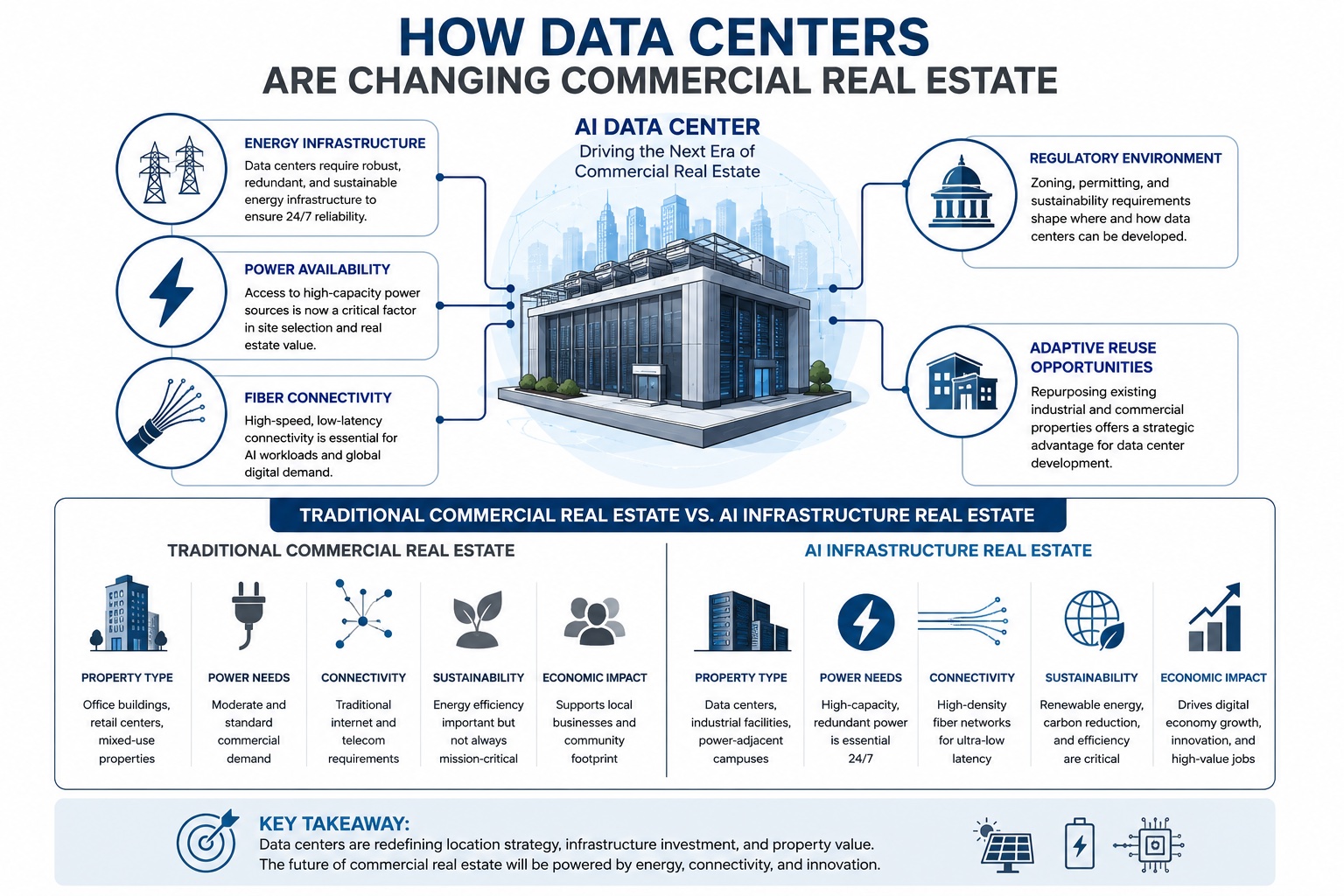
This infographic titled “How Data Centers Are Changing Commercial Real Estate” maps the structural shift AI infrastructure is forcing across property markets. At the center, a modern data center building sits beneath a digital globe, surrounded by five drivers—energy infrastructure, power availability, fiber connectivity, regulatory environment, and adaptive reuse opportunities—that define site selection today. The comparison table contrasts traditional commercial real estate (offices, retail, mixed-use) with AI infrastructure assets (data centers, industrial campuses, power-adjacent land) across power needs, connectivity, sustainability, and economic impact. Traditional properties rely on moderate commercial electricity and standard telecom, while AI facilities require high-capacity redundant power, ultra-low-latency fiber networks, and aggressive carbon-reduction strategies around the clock. The key takeaway reinforces that location strategy, infrastructure investment, and property value are being redefined by energy and innovation rather than foot traffic alone. For New York and other states reevaluating large-scale development, the graphic explains why commercial real estate professionals now treat grid access and regulatory clarity as strategic assets. It directly supports the article’s discussion of accountable growth, adaptive reuse, and the future of AI infrastructure.
The comparison chart above shows why AI data centers differ sharply from traditional office and retail assets in electricity demand, fiber requirements, and sustainability expectations. Readers weighing incentive changes, regional competition, and New York’s long-term strategy should keep this framework in mind as they review the conclusion and FAQ.
Growth with Greater Accountability
↑ Back to Future of AI Infrastructure
New York’s decision isn’t a rejection of artificial intelligence development. It’s an attempt to figure out how AI infrastructure should be built responsibly. The next generation of data centers will likely need to address energy efficiency, renewable power integration, community investment, infrastructure upgrades, and environmental responsibility.
The industry’s long-term success may hinge on building stronger partnerships between technology companies, governments, utilities, and the communities they operate in.
Conclusion
New York’s Pause Could Redefine the Future of Digital Development
New York’s first-in-the-nation data center pause is a major moment in the evolution of AI infrastructure. The state is challenging the assumption that attracting technology investment requires unlimited expansion without further review.
As artificial intelligence continues to reshape the global economy, competition for data center development will only grow more complex. The eventual winners won’t simply be the places offering the biggest incentives—they’ll be the ones capable of balancing innovation, infrastructure, affordability, and community support.
New York’s decision may well become a blueprint for how cities and states manage the next phase of the AI revolution. See the FAQ section for quick answers to common questions.
Frequently Asked Questions
Why did New York pause large data center development?
Governor Hochul signed an executive order creating a temporary pause to reassess how large data centers affect electricity costs, grid capacity, the environment, and local communities. The state wants stronger standards before approving further development. See why the moratorium was introduced and the key concerns driving the decision.
What size data centers are affected by the moratorium?
The pause applies to new data centers requiring 50 megawatts or more of electricity capacity—roughly enough to power about 50,000 homes continuously. Learn more in Why the State Introduced the Moratorium.
How does AI drive demand for data centers?
AI systems require enormous computing capacity, which drives demand for high-powered servers, specialized cooling, advanced electrical infrastructure, large industrial properties, and reliable energy. Read Why AI Requires Massive Computing Capacity for details.
Are other states considering similar restrictions?
Yes. Georgia, New Hampshire, Oklahoma, Pennsylvania, South Carolina, South Dakota, and Vermont are among those weighing similar restrictions, alongside local governments tightening reviews and reconsidering incentives. See Growing Regulatory Momentum Across the United States.
Do data centers create as many jobs as traditional industries?
Critics argue data centers typically create fewer permanent jobs than sectors like manufacturing, healthcare, or logistics, even though they attract large capital investment. The core debate is covered in Balancing Economic Growth with Public Investment.
Which states might attract projects redirected from New York?
Texas and Virginia are well positioned because of their established data center ecosystems, available energy capacity, and faster approval environments. See Texas and Virginia Remain Leading Alternatives.
Is New York rejecting AI development entirely?
No. The pause is an attempt to build AI infrastructure responsibly, with greater attention to energy efficiency, renewable power, community investment, and environmental responsibility. Read Growth with Greater Accountability and the Conclusion.
Join The Discussion