 by
by 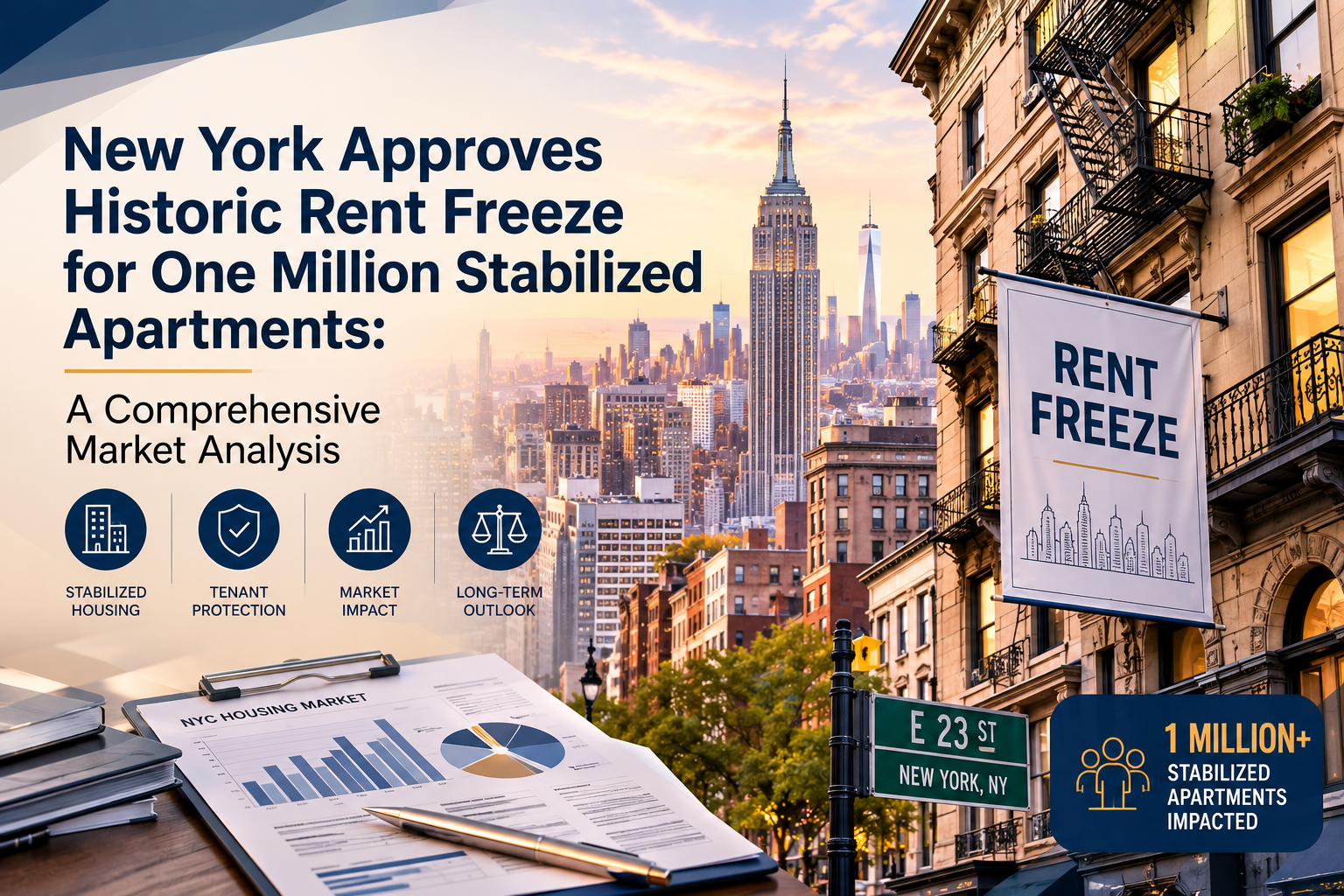
Understanding the Policy Decision and Its Far-Reaching Implications
In a landmark decision that delivers on a central campaign promise, the New York City Rent Guidelines Board voted 7-1 on June 25, 2026, to freeze rents on both one-year and two-year leases for approximately one million rent-stabilized apartments across the five boroughs. The freeze takes effect October 1, 2026, and extends through September 30, 2027, marking the first time in the board’s history that rents have been frozen for two-year leases. This comprehensive analysis examines the policy’s origins, the vote’s contentious dynamics, and the profound implications for tenants, landlords, real estate investors, and the broader New York City housing market.
The Vote: Political Victory Amid Controversy
Board Composition and the Resignation Controversy
The vote’s outcome was heavily influenced by Mayor Zohran Mamdani’s appointments to the nine-member board. Six of the eight voting members were appointed by Mamdani after he took office, creating a clear majority aligned with his affordability agenda. The ninth seat remained vacant following the dramatic resignation of Christina Smyth, a landlord representative, just hours before the vote. In her resignation letter, Smyth accused the board of bias and “knowingly disregarding its own evidence” that landlords face spiking operating costs. She stated that “this year’s RGB order was decided last year on the campaign trail” and that “everything since has been theater.” The remaining landlord representative, Maksim Wynn, ultimately voted in favor of the freeze, arguing that raising costs on tenants could “counterintuitively decrease income” by spurring vacancies or non-payment.
The Decision’s Historic Nature
The 7-1 vote, with Public Representative Arpit Gupta casting the only dissenting vote, represents the most aggressive rent regulation action in recent New York City history. While the board has frozen one-year leases three times previously, most recently in 2020 under former Mayor Bill de Blasio, this marks the first-ever freeze on two-year leases. Mayor Mamdani hailed the decision as “a historic victory for New York City tenants” and “the relief that working people across our city deserve.”
The Policy in Context: New York’s Rent-Stabilization System
The Scale of Rent Stabilization
Rent-stabilized apartments represent a significant portion of New York City’s housing stock. According to the 2023 New York City Housing and Vacancy Survey, there are approximately 996,600 rent-stabilized units across the city. These units represent roughly 27% of all housing units and approximately 41% of rental housing, serving around 2 million New Yorkers. The median stabilized rent stands at $1,500, compared with $2,000 for market-rate units. These units are generally found in buildings constructed before 1974 with six or more apartments, though properties receiving certain tax benefits or subsidies may also be subject to stabilization.
The 2023 Housing and Vacancy Survey Context
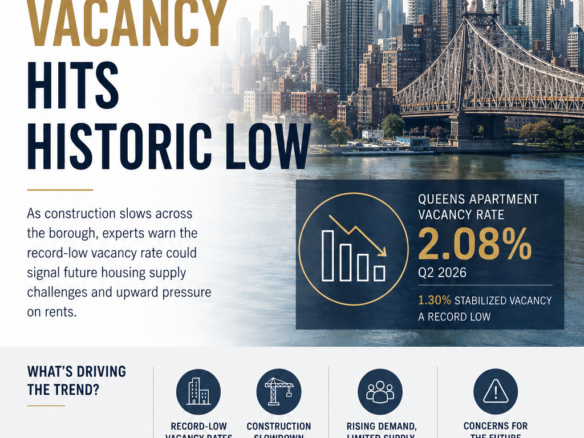
The rent freeze arrives against the backdrop of a historically tight rental market. The 2023 survey found the citywide rental vacancy rate had dropped to a record low of 1.4%, the lowest since 1968. This figure represents a dramatic decline from the 4.54% vacancy rate recorded in 2021. The housing crunch is most acute for low-income renters, with fewer than 0.5% of apartments renting below $1,100 per month vacant and available.
The Financial Reality for Rent-Stabilized Buildings
Rising Operating Costs
The board’s decision has drawn fierce criticism from landlord groups, who argue that freezing rents ignores the mounting financial pressures facing rent-stabilized properties. The board’s own 2026 Price Index of Operating Costs found that expenses for buildings with rent-stabilized apartments rose 5.3% overall. This increase breaks down into several critical components, with insurance costs surging 10.5% over the past year and 29.2% cumulatively over two years. Maintenance costs have risen 6.0%, utilities have increased 5.6%, and real estate taxes have climbed 2.6%. Since 2020, expenses for rent-stabilized buildings have grown more than twice as fast as rent increases. A Community Preservation Corp. analysis of nearly 15,000 rent-stabilized units found expenses up 27% since 2020, while rents have grown only 11% during that period. Insurance costs alone have increased 75% since 2020.
Debt Service Coverage Ratio Concerns
The financial strain on rent-stabilized properties is quantifiable through Debt Service Coverage Ratio (DSCR) analysis. DSCR lenders typically require a minimum ratio of 1.20 to 1.25 on qualifying investment properties. Industry default analysis projects DSCR on properties with significant stabilized exposure declining by an average of 0.11x under a sustained freeze, enough to push borderline deals below required thresholds. According to Community Preservation Corp. data, 36% of the rent-stabilized loans in their servicing portfolio already have a DSCR below 1.0, meaning the buildings securing those mortgages lose money every month. The organization estimates that if rents remain frozen for all four years of Mamdani’s term, Net Operating Income for stabilized apartments citywide would drop from an average of $4,508 to $2,929 before accounting for debt service. In the Bronx, which has the largest concentration of stabilized units, NOI would fall from $266 to negative $1,313.
The 2019 Legislative Framework
The 2026 rent freeze compounds revenue constraints already imposed by the 2019 Housing Stability and Tenant Protection Act (HSTPA). That legislation eliminated vacancy bonuses, vacancy decontrol, and luxury decontrol provisions while capping Individual Apartment Improvement recoveries at $30,000 spread over 15 years. These changes removed the primary mechanisms owners historically used to offset rising costs, making the current freeze particularly challenging for small landlords.
Industry Response and Market Implications
Landlord Opposition
Real estate industry groups have reacted with alarm to the board’s decision. James Whelan, president of the Real Estate Board of New York, warned that the freeze “will mean less investment in maintenance and repairs, accelerating the deterioration of the housing stock that millions of New Yorkers call home.” Kenny Burgos, CEO of the New York Apartment Association, issued an even more dire warning, stating that “this freeze will destroy the living conditions for hundreds of thousands of New Yorkers.” Burgos added that “all options are on the table,” including a potential lawsuit challenging the board’s decision. He argued that the vote proceeded without full landlord representation after Smyth’s resignation and that the board has been “ignoring data for years.”
The Small Landlord Perspective
The financial strain is most acutely felt by small landlords who own buildings with fewer than 11 units. Unlike large institutional owners who can absorb losses across diversified portfolios, small landlords operate on narrower margins with less capital reserve to sustain operating losses. Testimony at board hearings consistently described negative cash flow and pressure to sell among this cohort. A letter to the New York Post from a single mother who invested everything into one small rent-stabilized building captured this sentiment poignantly, asking why compassion for one group must come at the expense of another and questioning why small property owners are expected to absorb rising costs.
Rental Market Distortions
Critics argue that stricter rent regulation distorts the housing market in predictable ways. Since the 2019 HSTPA, turnover has become more likely in market-rate units than in rent-stabilized ones, and available units skew toward higher rent ranges affordable only to households earning over $100,000. The 2023 Housing and Vacancy Survey also found that rent-stabilized units are more likely to have multiple maintenance deficiencies than market-rate apartments, with 24% of stabilized units having deficiencies compared with fewer than 20% in 2017, suggesting that reduced investment is already taking a toll.
The Path Forward: Policy Solutions and Market Adjustments
Immediate Mitigation Strategies
Rafael Cestero, CEO of the Community Preservation Corporation and former head of the city’s Department of Housing Preservation and Development, has called for immediate policy interventions to address the financial challenges facing rent-stabilized buildings. His proposed solutions include the creation of a public insurance vehicle to help stabilize costs, given that insurance costs have been a huge driver of rising expenses and have increased 75% since 2020. He also advocates for property tax relief specifically targeting rent-stabilized buildings, noting that these properties pay an average of $4,000 per unit per year in property taxes. Additionally, Cestero calls for tort reform to address the legal environment that drives high liability insurance costs in New York and reform of rental assistance programs to streamline the “byzantine and archaic bureaucracy” governing them, helping tenants who fall behind on rent avoid eviction while ensuring landlords receive payment.
Long-Term Structural Reform
Cestero has argued that the Rent Guidelines Board has “run its useful life” and should be eliminated in favor of a formula-based system similar to California’s, where rents are tied to the Consumer Price Index plus a spread. This approach would remove politics from the process and provide a rational mechanism for rent increases that protect tenants while allowing private capital to flow into the system. As Cestero stated, “We’ve achieved such a crisis that I think it’s time that we really completely rethink the system and try to take politics out of it.”
The Private Capital Conundrum
Perhaps the most significant long-term risk is the potential withdrawal of private capital from the rent-stabilized market. As Cestero explained, if lenders start underwriting at zero percent rent growth and five percent expense increases, that will dramatically shrink the available private capital in the marketplace for repairs, acquisitions, and refinancing, ultimately strangling the system. Former Rent Guidelines Board Chair David Reiss has described the situation as “a slow-moving train wreck,” while Cestero noted that a political process is unlikely to create a good outcome for tenants and buildings over the long run.
Key Takeaways for Real Estate Professionals
Selective Investment Risk: Rent-stabilized buildings face significant financial headwinds, particularly those with 90% or more stabilized units. Investors should underwrite with zero rent growth and five percent expense increases to stress-test acquisition assumptions.
The DSCR Squeeze: Properties with stabilized exposure are facing declining Debt Service Coverage Ratios as frozen income meets rising expenses. Lenders are likely to tighten underwriting standards for these properties.
Market Distortions: Continued political intervention in rental markets may accelerate the deterioration of aging housing stock while pushing more demand into market-rate units.
Policy Uncertainty: The political pendulum in New York housing policy continues to swing between tenant and landlord interests, creating an unpredictable regulatory environment.
Conclusion: A Critical Juncture for New York’s Housing Stock The rent freeze represents a watershed moment in New York City housing policy, delivering a historic victory for tenant advocates while potentially presenting an existential challenge for the owners of rent-stabilized properties. With the city’s rental vacancy rate at a 50-year low and operating costs continuing to rise, the freeze’s long-term impact will depend largely on whether policymakers implement complementary measures to address the underlying cost drivers that threaten the viability of rent-stabilized housing. The convergence of frozen revenue, rising expenses, and constrained capital access creates a dynamic environment that will test the resilience of both tenants and property owners. Real estate professionals who understand these interconnected trends and adapt their investment strategies accordingly will be best positioned to navigate the challenges ahead. The coming years will reveal whether the city can achieve the “return to balance and predictability” that both landlord and tenant advocates identify as the goal for rent-stabilized housing, or whether the current trajectory of political overcorrection will continue to produce unintended consequences for the housing stock that millions of New Yorkers call home