
 by
by 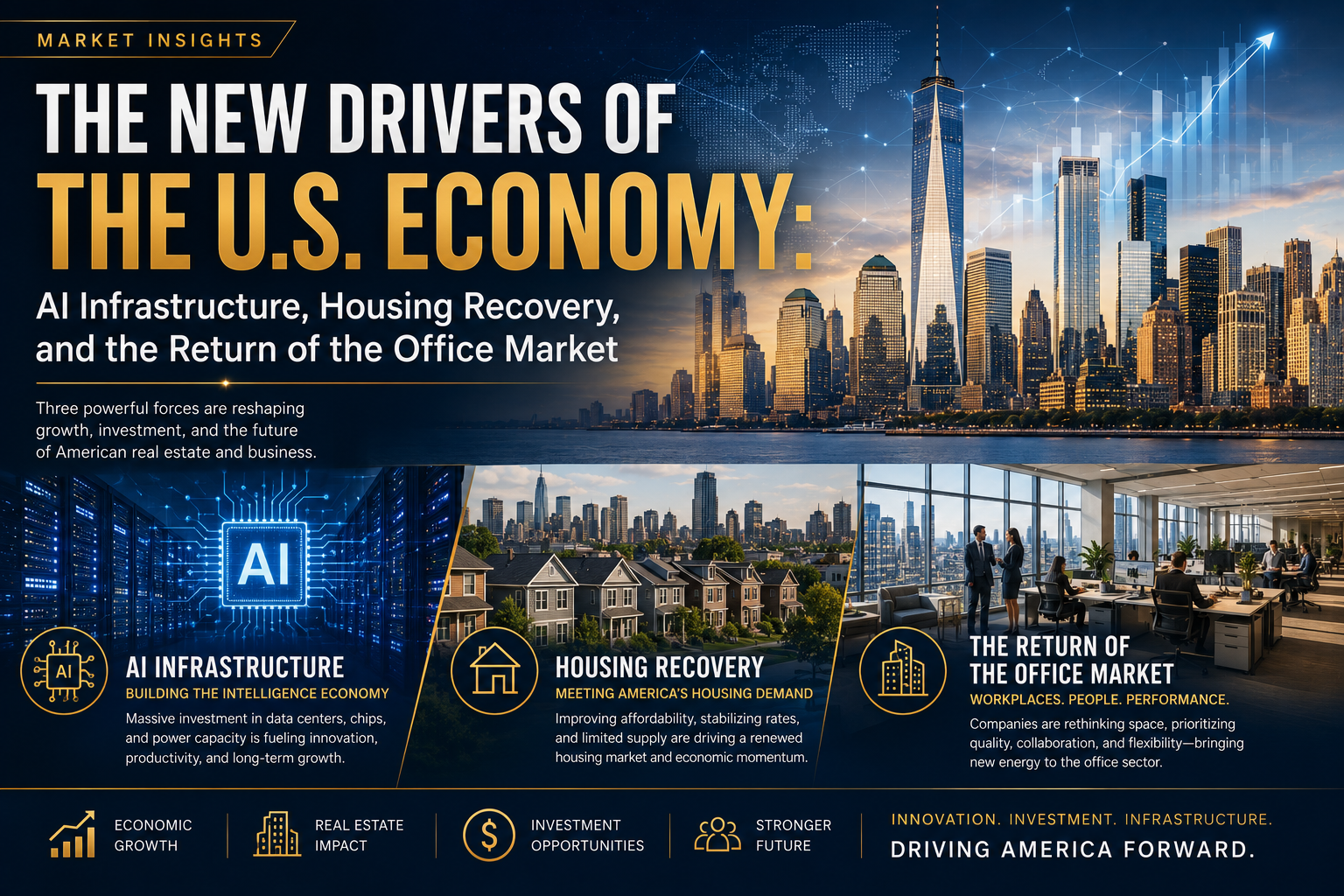
A market analysis of how artificial intelligence investment, residential activity, and workplace transformation are reshaping economic growth and real estate strategy.
Introduction: The U.S. Economy Enters a New Cycle of Transformation
The U.S. economy is entering a period of significant structural change. Three major trends are emerging simultaneously: unprecedented investment in artificial intelligence infrastructure, improving conditions in the residential housing market, and a gradual recovery in office occupancy.
These developments represent more than short-term market movements. Together, they reflect a broader transformation in how businesses invest, where people live, and how cities evolve.
Artificial intelligence is creating demand for a new generation of digital infrastructure. The housing market is showing signs of stabilization after years of affordability challenges. Meanwhile, office markets are adapting to a post-pandemic environment as companies redefine the role of physical workplaces.
For investors, developers, and businesses, these trends provide important insight into the next phase of economic growth.
Artificial Intelligence Infrastructure Becomes a Major Investment Opportunity
The rapid expansion of artificial intelligence is creating one of the largest infrastructure investment cycles in modern history.
Technology companies require enormous computing capacity to support advanced AI applications, cloud services, and large-scale data processing. As demand increases, the need for specialized infrastructure has expanded beyond traditional technology sectors and into real estate, energy, and finance.
Major investment firms are now entering the AI infrastructure market by providing capital for the development of data centers and related systems.
This shift demonstrates that artificial intelligence is no longer viewed only as a software innovation. It is becoming a physical infrastructure industry requiring:
- Large-scale facilities
- Advanced electrical systems
- High-capacity networks
- Specialized construction
- Long-term energy solutions
The future of AI growth will depend not only on technological innovation but also on the ability to build the physical foundation supporting that technology.
The Rise of Data Centers as Strategic Real Estate Assets
Data centers have become one of the most important emerging sectors within commercial real estate.
Unlike traditional office or industrial properties, data centers require highly specialized locations with:
- Reliable power availability
- Strong connectivity infrastructure
- Large development sites
- Advanced cooling capabilities
As artificial intelligence adoption accelerates, demand for these facilities is expected to continue increasing.
This trend is creating new opportunities for:
- Real estate developers
- Infrastructure investors
- Energy companies
- Municipalities seeking economic growth
However, the expansion of data centers also introduces challenges, including energy consumption, infrastructure costs, and community impact.
The next generation of projects will likely require stronger partnerships between technology companies, governments, utilities, and local communities.
Housing Market Shows Early Signs of Recovery
While technology investment accelerates, the residential market is showing signs of improvement.
Existing home sales have increased, indicating that buyers and sellers are gradually adjusting to a higher interest-rate environment.
Several factors are supporting this improvement:
- Stabilizing mortgage conditions
- Strong employment levels
- Household income growth
- Increased buyer confidence
The improvement represents an important development for the broader economy because housing activity influences many industries, including construction, finance, retail, and professional services.
Affordability Remains the Key Challenge
Despite positive momentum, the housing market continues to face significant obstacles.
High home prices and elevated borrowing costs remain barriers for many buyers.
The current market environment is defined by a balance between:
Positive Factors
- Improving economic conditions
- Strong labor markets
- Increased buyer activity
Challenges
- Limited housing inventory
- Mortgage affordability concerns
- High construction costs
The future direction of residential real estate will largely depend on interest rates and whether additional supply becomes available.
Office Market Recovery Signals Changing Workplace Patterns
The office sector continues to undergo a major transformation.
Following several years of uncertainty, office attendance has shown gradual improvement as more companies strengthen in-person workplace expectations.
Recent trends indicate that employees are returning to offices at higher levels, particularly in major business markets.
This recovery is important because office activity supports entire urban ecosystems, including:
- Restaurants
- Retail businesses
- Transportation networks
- Hospitality
- Local services
A stronger office presence can contribute to the revitalization of central business districts.
Regional Markets Compete for Business Growth
Office recovery is not occurring equally across all markets.
Several cities have benefited from corporate expansion due to:
- Business-friendly environments
- Strong workforce availability
- Lower operating costs
- Population growth
Markets such as Texas business centers and major coastal cities continue competing for companies, investment, and talent.
The future of corporate America may not be concentrated in one location. Instead, companies are increasingly building multi-market strategies that combine different regional advantages.
The Connection Between Technology, Real Estate, and Economic Growth
Although artificial intelligence, housing, and office recovery appear to represent separate trends, they are closely connected.
Economic growth depends on the relationship between:
- Companies investing in infrastructure
- Workers choosing where to live
- Businesses selecting locations
- Developers responding to demand
AI facilities require land and energy.
Technology companies require skilled workers.
Workers require housing.
Businesses require functional office environments.
Together, these factors create a new economic ecosystem where technology and real estate are increasingly interconnected.
Implications for Commercial Real Estate Investors
The changing economic landscape creates both opportunities and risks.
Emerging Opportunities
Investors may find potential growth in:
- Data center development
- Technology-related infrastructure
- Residential projects in expanding markets
- Mixed-use developments
- Modern office properties in strong locations
Market Challenges
However, investors must also consider:
- Rising construction costs
- Changing tenant expectations
- Energy availability
- Regulatory requirements
- Differences between regional markets
Successful investment strategies will require flexibility and a strong understanding of long-term economic trends.
Conclusion: The Future Economy Will Be Built on Adaptation
The latest market indicators suggest that the U.S. economy is entering a new phase defined by adaptation and innovation.
Artificial intelligence is creating demand for a new infrastructure network.
The housing market is moving toward greater stability.
The office sector is redefining its purpose in a changing workplace environment.
These trends demonstrate that economic growth is no longer driven by a single industry or location. Instead, it is shaped by the interaction between technology, real estate, and human behavior.
For investors, businesses, and cities, the ability to adapt to these changes will determine success in the next economic cycle.
The future of the U.S. economy will be built where technology, capital, and real estate come together.
Join The Discussion