 by
by 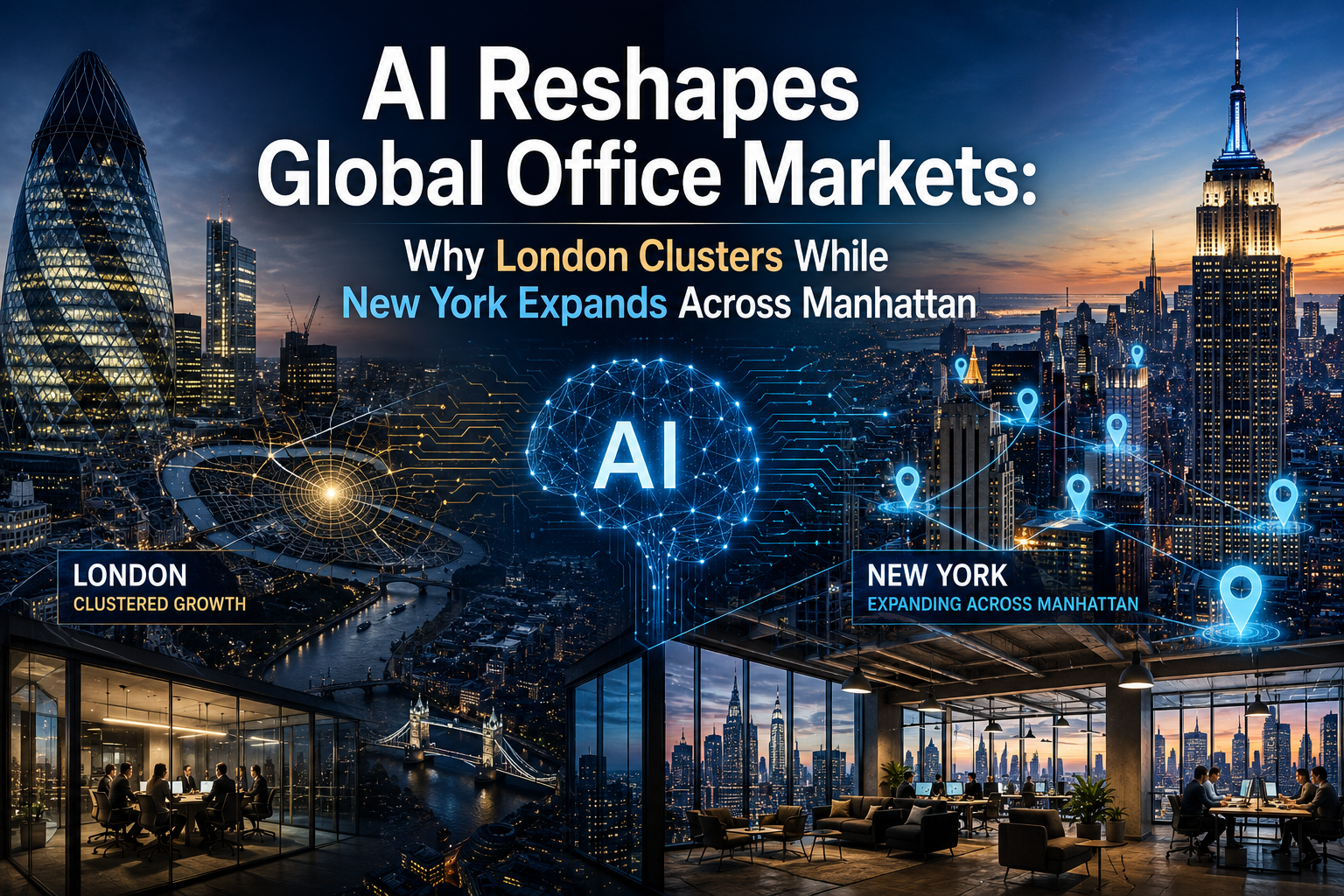
AI Reshapes Global Office Markets: Why London Clusters While New York Expands Across Manhattan
Discover how artificial intelligence is transforming office demand in London and New York. Compare AI office clusters, commercial real estate trends, talent strategies, and the future of innovation ecosystems.
How artificial intelligence companies are redefining office demand, talent strategies, and the future geography of innovation in two of the world’s leading business centers.
Introduction: The New Geography of Artificial Intelligence
The infographic below introduces how artificial intelligence is driving office demand in two global hubs. It visualizes why London’s AI market clusters around innovation districts such as King’s Cross, while New York’s AI expansion spreads across Manhattan near finance, healthcare, and enterprise clients.
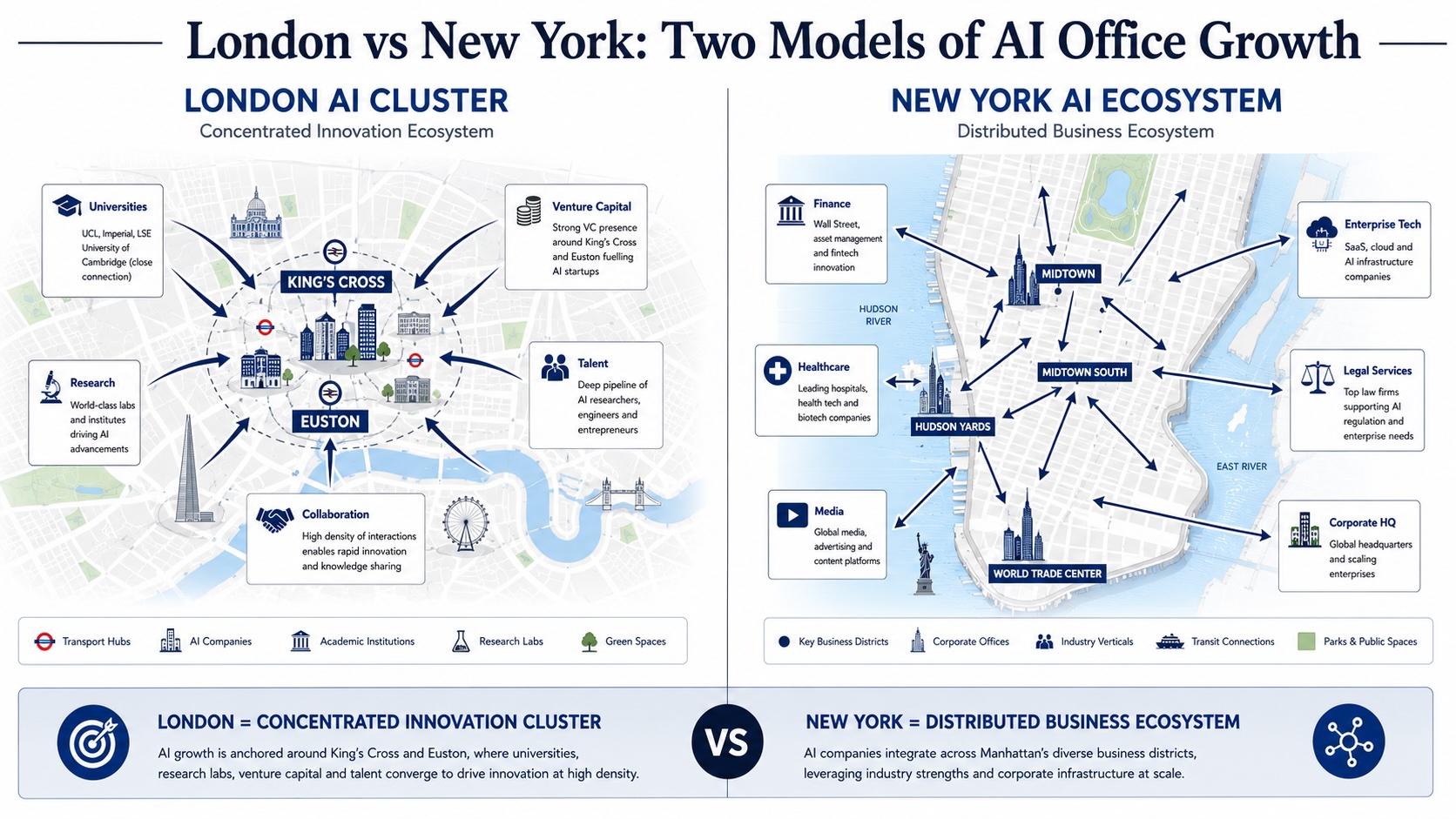
As the chart shows, AI office strategies diverge by city: concentration supports research collaboration and talent density in London, while distribution in New York places firms closer to industry customers. Explore commercial real estate impacts, Manhattan as an AI business platform, and the FAQ section for deeper analysis of both models.
Artificial intelligence has become one of the most powerful forces shaping global business decisions, investment patterns, and commercial real estate demand. As AI companies scale rapidly, their office strategies are revealing an important trend: location still matters in the digital economy.
London and New York have emerged as two of the world’s leading AI hubs, benefiting from strong talent pools, financial ecosystems, and access to major corporate clients. But the way AI companies are expanding in these markets looks very different from one city to the next.
London has developed a concentrated AI cluster centered around a few key innovation districts, while New York’s AI expansion is spreading across a wider range of Manhattan neighborhoods. This difference points to two distinct models of technology growth:
- London: a concentrated innovation ecosystem built around proximity and collaboration
- New York: a diversified business ecosystem integrated into a broader commercial market
AI Becomes a Major Driver of Office Demand
The rapid growth of artificial intelligence has created a new source of demand for premium office space. Unlike previous technology cycles, many AI companies are expanding their office footprints earlier in their growth process. Several factors are driving this trend:
- Significant venture capital investment
- Rapid employee growth
- Increasing enterprise adoption of AI solutions
- Demand for specialized technical talent
- The need for collaboration-focused workplaces
Although AI companies remain smaller office occupiers compared with traditional industries such as finance and law, their growth trajectory makes them increasingly important players in major office markets.
Why London Has Become a Global AI Cluster
London’s AI ecosystem has developed around a strong combination of talent, research institutions, and investment capital. The city offers several advantages:
- World-class universities
- Strong venture capital networks
- International business connections
- Access to financial institutions
- A deep technology workforce
These factors have encouraged AI companies to locate near existing innovation communities rather than spread evenly across the city.
King’s Cross: The Center of London’s AI Ecosystem
One of the clearest examples of London’s AI concentration is the King’s Cross and Euston area. The district has attracted major technology companies because it offers:
- High-quality office space
- Strong transportation connections
- Proximity to universities
- Access to research talent
The presence of major technology companies has created an ecosystem effect, where new AI firms benefit from being close to established players, investors, and skilled workers. The area demonstrates a classic technology cluster model: companies attract talent, talent attracts companies, and the ecosystem continues to strengthen.
Transportation and Talent: London’s Competitive Advantage
London’s public transportation network plays an important role in supporting AI growth. Unlike many global cities where talent pools are limited by commuting challenges, London gives companies access to a large workforce across the metropolitan region, drawing from:
- Leading universities
- Research institutions
- Technology communities
- Financial and professional services industries
For AI companies, access to talent is often more important than access to inexpensive real estate.
See also: New York’s AI Growth Takes a Different Path and The Commercial Real Estate Impact
New York’s AI Growth Takes a Different Path
While London’s AI expansion has concentrated around specific districts, New York’s growth has been more distributed. The reason is largely tied to the city’s unique economic structure. New York isn’t just a technology center—it’s also the headquarters of:
- Global financial institutions
- Healthcare companies
- Law firms
- Media organizations
- Enterprise businesses
This creates a powerful environment for AI companies developing solutions for major industries.
Manhattan Becomes an AI Business Platform
AI companies in New York are increasingly choosing locations throughout Manhattan rather than clustering in one neighborhood. Demand has expanded across multiple office markets, including:
- Midtown South
- Midtown
- Hudson Yards
- World Trade Center area
- Other premium office districts
This reflects a broader shift in what technology companies are prioritizing. Instead of seeking out only traditional tech neighborhoods, AI firms are increasingly choosing locations that provide:
- Access to customers
- Visibility
- High-quality office environments
- Proximity to business decision-makers
Why New York’s AI Market Is More Distributed
New York’s AI ecosystem is shaped by the city’s economic diversity. Different AI companies serve different industries.
Enterprise AI
Companies developing workplace and business applications benefit from proximity to large corporate customers.
Financial AI
New York’s financial sector creates demand for AI solutions related to investment analysis, risk management, trading systems, and compliance.
Healthcare AI
The city’s medical institutions and healthcare companies support AI development in diagnostics, patient management, and medical research.
Legal and Professional Services AI
New York’s concentration of law firms and professional services companies creates demand for AI tools designed for knowledge-intensive industries.
See also: Why London Has Become a Global AI Cluster and AI Becomes a Major Driver of Office Demand
The Commercial Real Estate Impact
The expansion of AI companies is creating new opportunities for office landlords and developers. AI firms often seek:
- Modern office buildings
- Flexible workplace designs
- Collaboration spaces
- High-quality amenities
- Locations attractive to specialized employees
This trend benefits premium office properties, particularly buildings that offer modern infrastructure and strong locations.
AI Companies Are Changing Tenant Expectations
The growth of AI firms is also reshaping what companies expect from office space. Traditional technology companies often prioritized large open spaces, creative environments, and campus-style workplaces. AI companies, by contrast, are increasingly focused on:
- Research collaboration
- Advanced technology infrastructure
- Employee interaction
- Access to specialized talent
The office is becoming a tool for innovation rather than simply a workplace.
See also: Why London Has Become a Global AI Cluster and New York’s AI Growth Takes a Different Path
The Future: AI Will Continue Strengthening Global Innovation Centers
The expansion of AI companies in London and New York points to an important reality: even in a highly digital economy, physical location remains critical. AI companies continue to value cities that provide talent, capital, customers, research institutions, and professional networks. The future of AI development will likely favor major global cities with strong ecosystems rather than isolated technology campuses.
Frequently Asked Questions
| # | Topic | Question |
|---|---|---|
| 1 | Office Demand | Why are AI companies leasing more office space? |
| 2 | London Market | Why is London’s AI market concentrated? |
| 3 | Manhattan Market | Why is Manhattan more distributed? |
| 4 | Commercial Real Estate | How does AI affect commercial real estate? |
| 5 | Talent Strategy | Why do AI firms prioritize talent? |
| 6 | Industry Demand | What industries drive AI office demand? |
| 7 | Premium Buildings | What makes premium office buildings attractive? |
| 8 | Workplace Design | How are AI workplaces different? |
| 9 | Future of Offices | Will AI replace traditional offices? |
| 10 | Investment | What does this mean for investors? |
| 11 | City Comparison | Which city has the stronger AI ecosystem? |
| 12 | Office Trends | What are future office trends? |
Why are AI companies leasing more office space?
AI companies are leasing more office space because rapid scaling, venture capital inflows, and enterprise adoption require physical hubs for collaboration, recruitment, and client engagement. Unlike earlier remote-first technology cycles, many AI firms expand their footprints early to attract specialized engineers, data scientists, and research talent who benefit from in-person problem-solving. Premium offices also signal credibility to enterprise customers evaluating AI partnerships. Collaboration-focused layouts support model development, product iteration, and cross-functional teams that struggle to replicate the same velocity entirely remotely. As AI moves from experimentation to production, companies need secure infrastructure, meeting space for investors and clients, and environments where interdisciplinary teams can iterate quickly—making office space a strategic asset rather than a legacy cost. See also: AI Becomes a Major Driver of Office Demand.
Why is London’s AI market concentrated?
London’s AI market is concentrated because the city rewards proximity to universities, venture capital, research institutions, and established technology employers. Districts such as King’s Cross demonstrate how cluster effects accelerate growth: companies attract talent, talent attracts investors, and the ecosystem compounds over time. London’s transportation network further supports concentration by giving firms access to a metropolitan talent pool without requiring dispersed office locations. For early-stage and scaling AI companies, being inside an innovation corridor reduces hiring friction, increases networking opportunities, and improves access to partners across finance and professional services. Concentration also helps landlords and developers invest in infrastructure tailored to technology tenants. See also: King’s Cross: The Center of London’s AI Ecosystem.
Why is Manhattan more distributed?
Manhattan’s AI market is more distributed because New York’s economy is deeply integrated across finance, healthcare, law, media, and enterprise services. AI companies often locate near the customers they serve rather than in a single technology neighborhood. A financial AI firm may prioritize Midtown proximity to banks, while a healthcare AI company may value access to major medical institutions. This customer-driven geography produces demand across Midtown South, Hudson Yards, the World Trade Center area, and other premium districts. New York’s scale and industry diversity encourage AI growth that mirrors the city’s broader commercial map rather than a single innovation corridor. See also: Manhattan Becomes an AI Business Platform.
How does AI affect commercial real estate?
AI affects commercial real estate by introducing a fast-growing tenant category that prioritizes modern buildings, flexible layouts, collaboration space, and locations that help recruit specialized employees. While AI firms may still occupy smaller footprints than legacy financial tenants, their growth rates and premium preferences influence leasing strategy across major markets. Landlords benefit when properties offer advanced infrastructure, amenity-rich environments, and access to transit and talent. AI demand also reshapes tenant improvement expectations, with more emphasis on research collaboration zones and technology-ready infrastructure. Over time, AI expansion supports premium assets in global cities where innovation, capital, and customers converge. See also: The Commercial Real Estate Impact.
Why do AI firms prioritize talent?
AI firms prioritize talent because competitive advantage depends on scarce technical expertise in machine learning, data engineering, product development, and applied research. In AI, small teams can create disproportionate value, making recruitment and retention central to corporate strategy. Office location becomes a talent tool: the right address improves visibility, supports hybrid collaboration, and places companies near universities, investors, and peer firms. AI organizations also compete globally for specialists who expect high-quality workplaces and access to vibrant professional communities. As a result, real estate decisions are often secondary to talent access, which is why both London and New York remain attractive despite higher occupancy costs. See also: Transportation and Talent: London’s Competitive Advantage.
What industries drive AI office demand?
Industries driving AI office demand include finance, healthcare, legal and professional services, enterprise software, and media—particularly in New York, where AI products are often built close to end users. Financial institutions create demand for AI tools in trading, risk, compliance, and analytics. Healthcare systems support diagnostic, research, and operational AI applications. Law and professional services firms need knowledge-intensive automation and document intelligence solutions. Enterprise AI companies benefit from proximity to corporate buyers adopting workplace and productivity tools. These industry linkages explain why AI office growth aligns with major business districts rather than technology-only submarkets. See also: Enterprise AI, Financial AI, and Healthcare AI.
How are AI workplaces different?
AI workplaces differ from traditional tech offices by emphasizing research collaboration, advanced infrastructure, and environments designed for interdisciplinary teams rather than purely open creative layouts. AI companies often need spaces that support model experimentation, privacy-sensitive workflows, client demonstrations, and rapid iteration between engineering, product, and business functions. Meeting space for enterprise buyers and investors is also more important as AI products move into production. Hybrid work remains common, but the office becomes a coordination hub where complex problems are solved faster in person. This shift is changing how landlords and tenants design space, with greater focus on flexibility and technical readiness. See also: AI Companies Are Changing Tenant Expectations.
Will AI replace traditional offices?
AI is unlikely to replace traditional offices in major innovation centers, even as automation changes how work is performed. Instead, AI appears to be reshaping office demand by increasing the value of locations that aggregate talent, capital, customers, and research networks. Remote tools reduce some routine coordination costs, but AI development still benefits from in-person collaboration, secure infrastructure, and proximity to industry partners. In London and New York, AI expansion suggests that leading cities remain essential for scaling advanced technology businesses. The office is evolving from a default workplace into a strategic platform for innovation, recruitment, and enterprise sales. See also: The Future: AI Will Continue Strengthening Global Innovation Centers.
What does this mean for investors?
For investors, AI office trends highlight opportunities in premium assets located in global cities with durable innovation ecosystems. AI tenants may start small but grow quickly, making early relationships with scaling companies valuable for long-term leasing pipelines. Properties that support flexible configurations, strong transit access, and modern amenities are better positioned to attract technology occupiers paying for quality rather than volume. Investors should also monitor how industry-specific AI demand maps onto submarkets—finance-linked firms in New York and cluster-oriented firms in London may pursue different location strategies. Understanding these patterns can improve underwriting, tenant mix planning, and capital allocation across office portfolios. See also: The Commercial Real Estate Impact.
Which city has the stronger AI ecosystem?
Neither London nor New York holds a universal advantage; each leads through a different growth model. London’s strength is concentration—tight innovation corridors such as King’s Cross create powerful cluster effects among startups, universities, investors, and established technology employers. New York’s strength is diversification—AI companies can sit near customers across finance, healthcare, law, and enterprise industries throughout Manhattan. London excels when proximity and research collaboration drive value; New York excels when customer access and industry integration drive adoption. For global AI strategy, both cities remain top-tier hubs, and the stronger ecosystem depends on a company’s product focus and go-to-market model. See also: Conclusion: Two Cities, Two Models of AI Growth.
What are future office trends?
Future office trends point toward flexible, technology-ready spaces in global cities where AI firms can access talent, capital, and customers simultaneously. Expect continued demand for premium buildings with collaboration zones, scalable infrastructure, and locations aligned to industry ecosystems rather than generic tech districts. Hybrid work will persist, but offices will function as innovation hubs for recruitment, research coordination, and enterprise engagement. Landlords will increasingly compete on adaptability, amenities, and proximity to transit and universities. AI growth is likely to reinforce major innovation centers such as London and New York rather than disperse activity evenly, confirming that place still matters in the digital economy. See also: The Future: AI Will Continue Strengthening Global Innovation Centers.
Conclusion: Two Cities, Two Models of AI Growth
The comparison table below summarizes the two AI office growth models discussed throughout this article. It contrasts London’s concentrated innovation cluster with New York’s distributed Manhattan strategy, linking each approach to enterprise, financial, and healthcare AI demand.
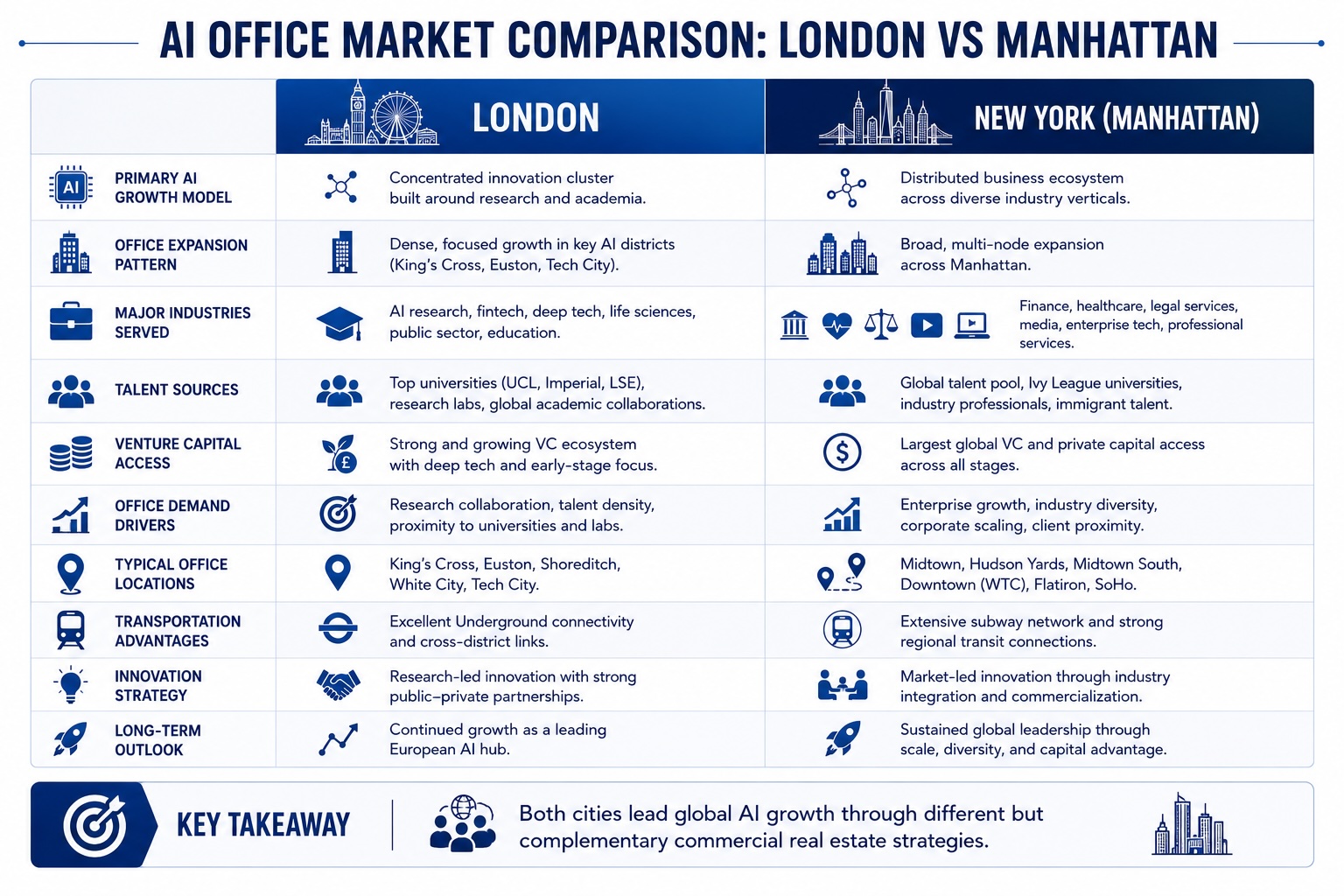
Use this table alongside sections on changing tenant expectations, future innovation centers, and which city has the stronger AI ecosystem to evaluate location strategy for AI firms and real estate investors.
London and New York are both benefiting from the AI revolution, but their growth patterns reveal different strategies. London’s strength comes from concentration—a tightly connected innovation corridor where companies benefit from proximity to research and technology communities. New York’s advantage comes from diversity—a global business ecosystem where AI companies can connect directly with customers across finance, healthcare, law, and enterprise industries.
Both models point to the same underlying principle: artificial intelligence may be built on digital technology, but its growth depends on human talent, business relationships, and the cities that bring them together. As AI continues expanding, London and New York are positioned to remain among the world’s most important centers for innovation, investment, and commercial growth.