 by InRealEstate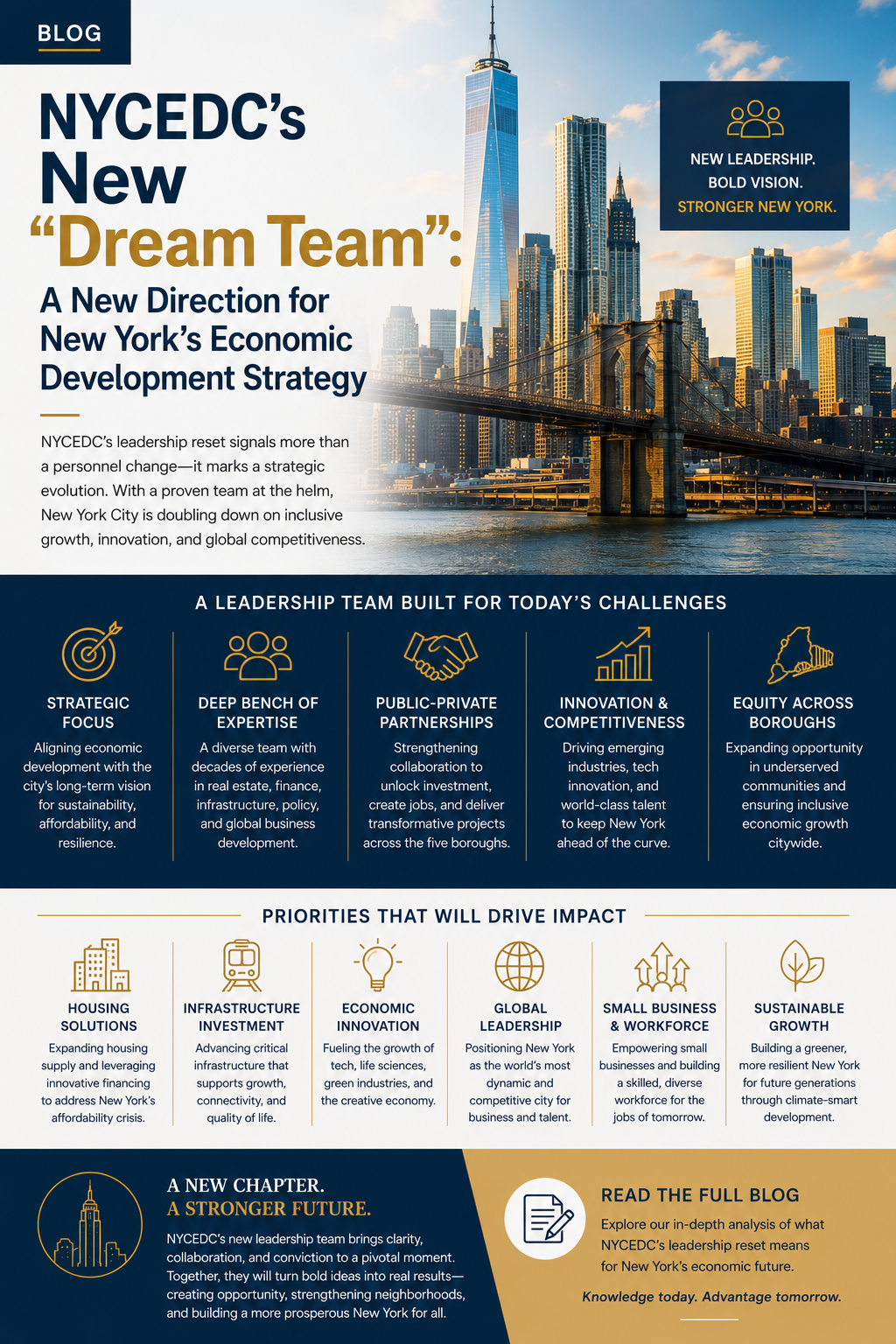
The New NYCEDC: What a Leadership Shift Could Mean for New York’s Economic Future
An analysis of the changing leadership approach at NYCEDC and what it could mean for investment, real estate, housing, and the long-term economic future of New York City.
Introduction: A Defining Moment for New York’s Economic Development
New York City is entering a new chapter in its economic development strategy. After a period of leadership uncertainty and interim management, the New York City Economic Development Corporation (NYCEDC) is moving toward a new operating model built around government expertise, economic competitiveness, and a stronger emphasis on public impact.
The shift echoes a broader national conversation about the future of cities: how to attract investment while addressing affordability, workforce challenges, and community needs. For decades, economic development was measured largely by traditional indicators — total investment attracted, jobs created, new construction activity, corporate expansion. That definition is evolving. Increasingly, cities are asking whether development creates lasting benefits for residents, businesses, and neighborhoods, not just headline growth numbers.
The central challenge for NYCEDC will be balancing two objectives often treated as competing priorities: maintaining New York’s position as a global economic leader while building a more inclusive and resilient economy.
NYCEDC: The Institution Shaping New York’s Economic Future
Although NYCEDC operates outside the traditional structure of city government, its influence on New York’s growth strategy is substantial. Through public-private partnerships, real estate initiatives, and strategic investments, the organization plays a central role in shaping commercial real estate development across office, retail, industrial, and mixed-use markets; expanding affordable housing through public resources and partnerships; strengthening industrial and innovation growth in manufacturing, life sciences, technology, and emerging sectors; transforming waterfront areas and infrastructure by redeveloping underutilized land; and driving neighborhood revitalization across all five boroughs.
Because of this broad mandate, any shift in NYCEDC’s strategy carries direct consequences for developers, investors, businesses, workers, and local communities alike.
A New Economic Philosophy: Growth With Greater Public Impact
The new direction at NYCEDC marks a shift from traditional economic development toward a broader model that weighs both economic performance and social outcomes. At its core, the approach is trying to answer a difficult question: can New York keep growing while ensuring that growth benefits more of its residents?
On one side is the need for continued economic growth. New York must keep attracting private investment, global companies, entrepreneurs, new development, and high-quality jobs — competitiveness isn’t optional when other cities are aggressively courting the same businesses, talent, and capital.
On the other side is the need for economic responsibility. The city is contending with real housing affordability pressure, rising operating costs, strain on small businesses, income inequality, and limited access to quality employment. The future of economic development in New York will hinge on whether the city can generate growth that strengthens communities rather than adding to the pressure they’re already under.
Experience Meets Reform: A New Leadership Model
The new NYCEDC approach combines operational experience with policy transformation, built around two complementary functions.
The first is operational expertise — the ability to turn vision into results. Successful economic development depends on executing complex projects: managing large-scale developments, coordinating across multiple government agencies, improving project delivery, building confidence with investors and developers, and maintaining long-term partnerships. New York’s development environment is notoriously complex, and navigating its regulations, financing structures, and stakeholder relationships takes real experience.
The second is policy evolution — redefining what counts as an economic benefit. The broader policy direction focuses on increasing economic opportunity, supporting competitiveness, strengthening community outcomes, and improving accountability. In practice, that suggests future projects may be judged not only by their financial returns but by their broader contribution to the city.
The Impact on New York’s Real Estate Market
The real estate industry will be watching closely to see how NYCEDC’s priorities shape future development decisions. A stronger focus on public benefit could reshape what’s expected of a project from the outset.
Community benefits are likely to matter more, with projects expected to show a stronger connection to the neighborhoods around them. Affordable housing integration may become a standard expectation rather than an add-on, with more residential developments including affordability requirements or mixed-income components. Workforce commitments — local hiring, job quality, career opportunities — may carry greater weight in project approvals. And long-term economic value, not just short-term returns, may become a bigger part of how projects are evaluated.
For developers, success may increasingly depend on how well a project aligns with the city’s broader objectives, not just its own bottom line.
Housing: The Ultimate Test of NYC’s Economic Strategy
Housing will likely become the clearest measure of whether NYCEDC’s new strategy is working. New York’s housing challenge remains severe: limited supply, high rental costs, persistent development barriers, and mounting affordability concerns in neighborhoods across the city.
NYCEDC will play a central role in addressing it, through public land development, partnerships with private developers, mixed-income housing initiatives, and investment in emerging neighborhoods. The real test will be producing more housing while still maintaining economic growth and neighborhood stability — two goals that don’t always pull in the same direction.
Major Development Initiatives Entering a New Phase
The new strategy will be tested across several major categories of development.
Life sciences and innovation. New York continues to compete with global innovation hubs, and investment in biotechnology, research, and technology can strengthen its position as a leader in these industries. That kind of growth depends on research infrastructure, a skilled workforce, academic partnerships, and modern facilities.
Waterfront redevelopment. New York’s waterfront remains one of its greatest untapped economic opportunities. Large-scale redevelopment there can create new commercial districts, housing, public space, and much-needed infrastructure improvements.
Mixed-use neighborhood transformation. Development is increasingly oriented toward building complete communities — combining residential, commercial, retail, public amenities, and employment in the same footprint. It’s a shift toward neighborhoods designed for living and working, not just one or the other.
Business Community Response: Confidence and Concern
The business community’s reaction reflects two distinct perspectives.
Supporters see real opportunity in the new approach, arguing it could bring more effective project management, stronger coordination across government, greater long-term stability, and more predictable economic planning — and that responsible development, done right, strengthens investor confidence rather than undermining it.
Critics point to real risks: increased regulatory requirements, longer approval processes, higher development costs, and the uncertainty that comes with any shift in the rules. The challenge for NYCEDC will be raising standards without eroding the competitiveness that makes New York attractive in the first place.
NYCEDC as a National Model for Urban Development
The changes underway at NYCEDC reflect a larger shift playing out in major cities worldwide. Urban leaders everywhere are asking similar questions: How can cities attract investment while improving quality of life? How can development address affordability rather than worsen it? How can growth become more inclusive without slowing down?
New York’s approach is likely to become an important case study for other global cities wrestling with the same pressures.
Conclusion: A New Definition of Economic Success
The transformation of NYCEDC is more than a leadership change — it reflects a broader shift in how New York City defines economic progress. Whether the strategy succeeds will depend on balancing three fundamental priorities: attracting investment and maintaining New York’s position as a global business center; creating opportunity so that growth produces real benefits for workers and communities; and building a more resilient city through expanded housing, infrastructure, and long-term economic stability.
If it works, this approach could redefine urban economic development and offer a model for cities around the world. But striking that balance will require careful coordination between government, businesses, developers, and communities. The next chapter of New York’s economic story will come down to a simple question: can growth and public benefit finally become partners instead of competing forces?