
 by
by 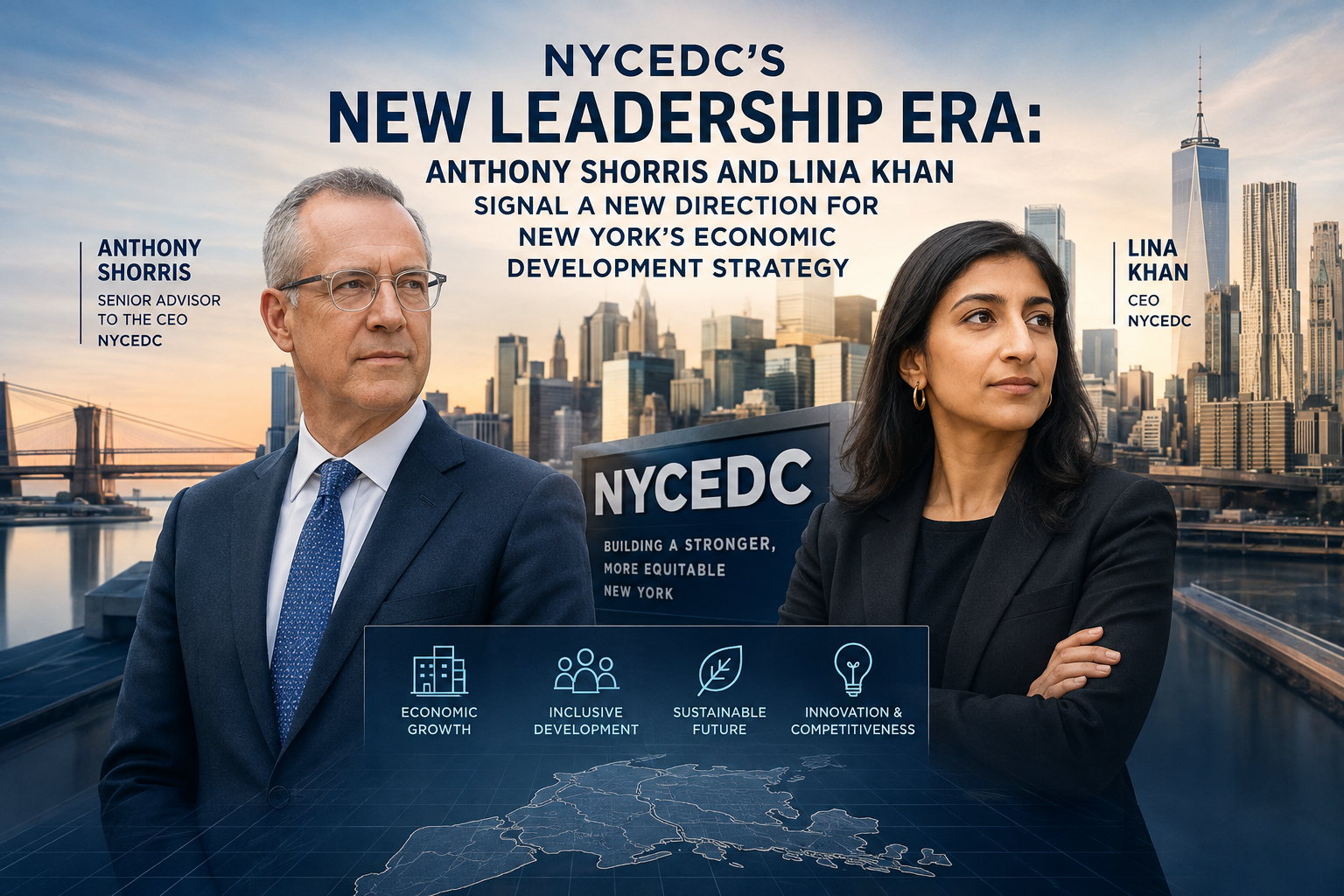
NYCEDC’s New Leadership Era: Anthony Shorris and Lina Khan Signal a New Direction for New York’s Economic Development Strategy
As Anthony Shorris and Lina Khan take the helm at the New York City Economic Development Corporation (NYCEDC), the agency enters a defining period for economic development across all five boroughs. The leadership portrait below captures the scale of that mandate—linking public stewardship of city assets to the private investment, housing production, and infrastructure growth that will shape New York’s next chapter.

This hero image presents Anthony Shorris and Lina Khan as the new faces of NYCEDC leadership, positioned against a panoramic view of Lower and Midtown Manhattan. One World Trade Center anchors the left side of the skyline, while construction cranes rise above glass towers on the right—visual shorthand for the redevelopment pipeline the agency oversees. An elevated subway train and the Brooklyn Bridge in the foreground underscore the infrastructure dimension of NYCEDC’s work, connecting transportation, housing, and commercial real estate into a single urban growth agenda. The golden-hour lighting and forward-looking gazes reinforce the article’s central theme: a leadership transition at a moment when New York must rebuild its office market, expand affordable housing, attract emerging industries, and maintain its global competitiveness. For readers tracking how public-private investment, zoning policy, and major capital projects intersect, this image frames the stakes clearly—NYCEDC is not merely facilitating deals but steering the physical and economic future of the nation’s largest city.
The visual above underscores why this leadership change matters for commercial real estate stakeholders, developers, and policymakers alike. From affordable housing production on city-owned land to major projects such as SPARC Kips Bay, NYCEDC’s next phase will touch nearly every sector of the New York market.
The appointment of Anthony Shorris as NYCEDC CEO and Lina Khan as Board Chair marks a new era for New York City’s economic development. Explore how their leadership could reshape housing, commercial real estate, infrastructure, innovation, and public-private investment.
Introduction: A Critical Leadership Shift at the Center of New York’s Growth Agenda
New York City has entered a new phase in its economic development strategy with the appointment of Anthony Shorris as President and Chief Executive Officer of the New York City Economic Development Corporation (NYCEDC) and Lina Khan as Chair of the NYCEDC Board. The transition arrives at a pivotal moment for the city, as it confronts major economic challenges: the transformation of the office market, a severe housing shortage, rising competition from other U.S. cities, and the need to attract emerging industries.
As the organization responsible for managing city-owned assets, supporting major redevelopment initiatives, and coordinating public-private investment, NYCEDC plays a central role in shaping how New York grows. The appointments of Shorris, a longtime government executive, and Khan, a prominent competition policy advocate, point to a broader shift toward a development model focused on investment, housing creation, economic competitiveness, and public accountability.
Anthony Shorris Brings Four Decades of Government and Institutional Leadership
Experience Across Government, Infrastructure, and Healthcare
Anthony Shorris arrives at NYCEDC with extensive experience across government, infrastructure, healthcare, and private-sector consulting. His career includes serving as First Deputy Mayor under Mayor Bill de Blasio, where he managed the operations of a city government with approximately 350,000 employees, a multibillion-dollar annual budget, and dozens of agencies.
He has also served as Executive Director of the Port Authority of New York and New Jersey, Deputy Chancellor for Operations at the New York City Department of Education, and in senior roles at major healthcare institutions. He was a partner at McKinsey & Company and currently teaches at Princeton University while serving as Vice Chair of the Regional Plan Association.
Unlike a traditional real estate-focused executive, Shorris brings experience managing complex public systems and large-scale organizations. That background suggests NYCEDC’s next phase may emphasize operational efficiency, strategic planning, and tighter coordination between government agencies and private-sector partners.
NYCEDC’s Expanding Role in New York’s Economic Future
Driving Redevelopment, Infrastructure, and Innovation
NYCEDC has become one of the most influential organizations shaping New York’s economic landscape. The agency manages public assets, supports infrastructure investment, and partners with developers and businesses on transformational projects throughout the five boroughs.
Major initiatives under NYCEDC’s involvement include the SPARC Kips Bay life sciences and healthcare campus, the redevelopment of the Brooklyn Marine Terminal, and the transformation of Willets Point into a mixed-use neighborhood featuring New York City’s first soccer-specific stadium.
Together, these projects reflect a broader strategy: moving beyond New York’s traditional dependence on finance and expanding into life sciences, technology, healthcare, advanced manufacturing, and innovation.
Affordable Housing Becomes a Central Economic Priority
Expanding Housing Through Public-Private Partnerships
One of the biggest challenges facing the new leadership team will be addressing New York’s housing crisis. Mayor Zohran Mamdani’s administration has emphasized using city-owned land, financing tools, and public-private partnerships to increase affordable housing production.
Under Shorris’ leadership, NYCEDC could take on a larger role in identifying underutilized public properties, supporting residential development, and unlocking new housing opportunities.
Still, increasing housing supply will require overcoming significant obstacles: high construction costs, financing challenges, zoning limitations, and market uncertainty. The test will be creating projects that are financially viable while meeting the city’s affordability goals.
Lina Khan’s Appointment Signals Greater Competition and Accountability
How Competition Policy Could Influence NYCEDC
The appointment of Lina Khan as NYCEDC Board Chair introduces a new perspective on how economic development should operate. Khan gained national recognition during her tenure as Chair of the Federal Trade Commission for her aggressive approach to antitrust enforcement and corporate competition.
Her role at NYCEDC may shape how the city approaches major agreements with private companies and developers. Future economic development initiatives could face greater scrutiny around transparency, competition, and public benefit.
For the real estate industry, that could mean closer examination of public-private partnerships, development incentives, and agreements involving valuable city resources.
New York’s Commercial Real Estate Market Faces Historic Transformation
Office Conversions and Urban Redevelopment
The leadership change coincides with one of the most challenging periods for New York’s commercial real estate market. The traditional office model has been disrupted by hybrid work, changing corporate strategies, and declining demand for older office buildings.
At the same time, New York faces a significant opportunity: converting outdated office properties into housing, innovation spaces, and mixed-use communities.
NYCEDC will likely play a major role in supporting that transformation by helping facilitate:
- Office-to-residential conversions
- New housing development
- Innovation districts
- Neighborhood revitalization projects
- Infrastructure improvements
The decisions NYCEDC makes in the coming years could redefine the physical and economic landscape of Manhattan and the outer boroughs.
Competing in a New National Economic Landscape
New York’s ability to retain employers and talent depends on how well NYCEDC coordinates housing, infrastructure, and business growth against rising Sun Belt competition. The strategic infographic below maps the six pillars—affordable housing, commercial real estate, public-private partnerships, innovation, and transit-oriented development—that define the city’s response to cities such as Miami, Dallas, Austin, and Nashville.
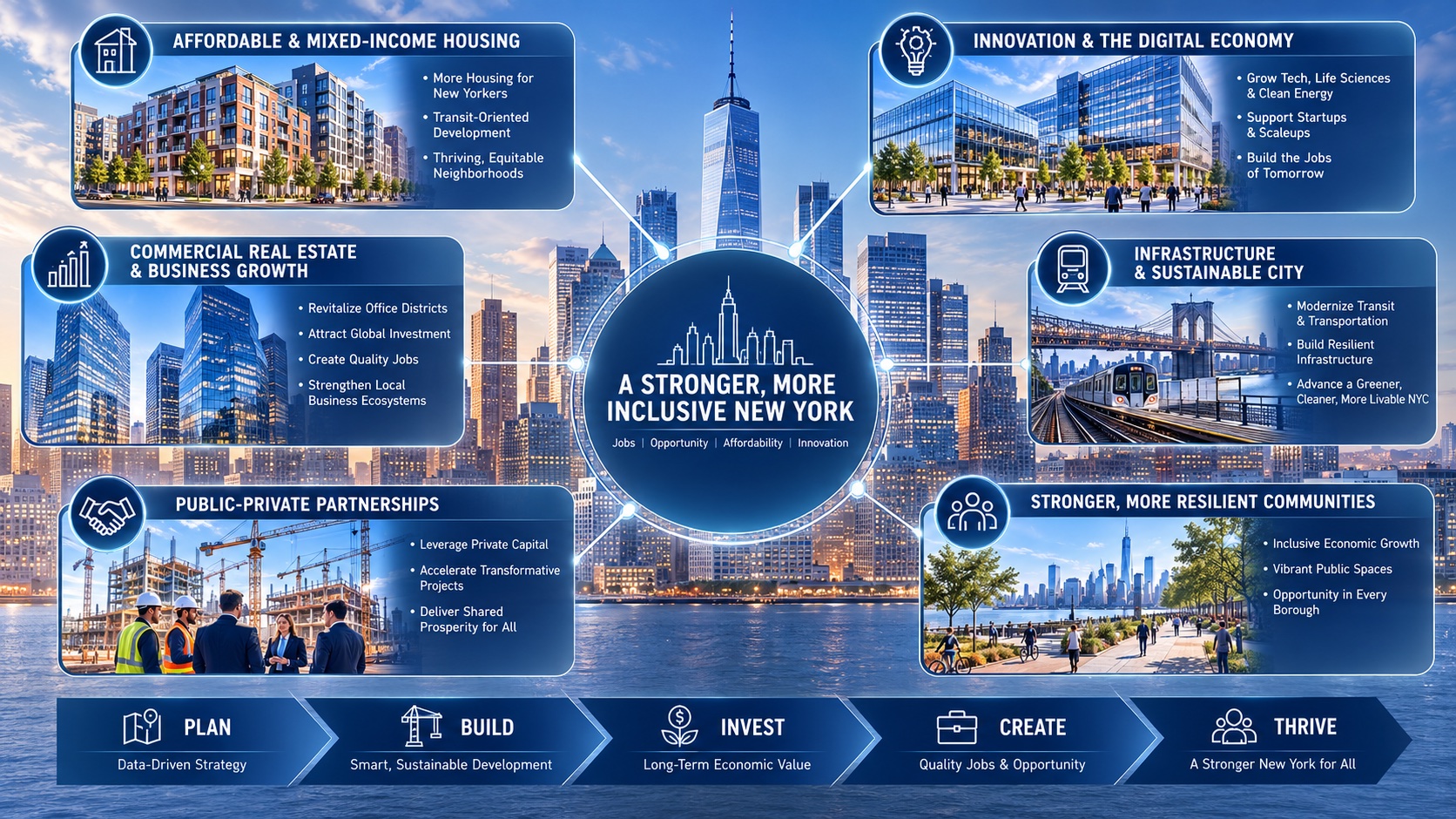
Set against a twilight Manhattan skyline with One World Trade Center at center, this infographic titled “A Stronger, More Inclusive New York” outlines NYCEDC’s integrated approach to national economic competition. Six radiating panels address affordable and mixed-income housing, commercial real estate and business growth, public-private partnerships, innovation and the digital economy, infrastructure and sustainable city-building, and stronger, more resilient communities. Each pillar includes specific policy goals—from transit-oriented development and office district revitalization to startup support and waterfront public spaces—reflecting the priorities Shorris and Khan are expected to advance. A five-step process bar at the bottom (Plan, Build, Invest, Create, Thrive) ties individual initiatives to a long-term value chain. For readers evaluating how New York competes with lower-cost markets, the graphic makes the tradeoffs explicit: the city cannot win on land price alone but can differentiate through density, talent, infrastructure, and inclusive growth. It directly supports this article’s analysis of NYCEDC’s expanding mandate and the competitive pressures reshaping U.S. metro economies.
The roadmap illustrated above aligns with NYCEDC priorities explored throughout this article—from AI and digital infrastructure to Brooklyn Marine Terminal redevelopment. As the section below details, maintaining New York’s global economic center status requires executing each pillar while cities across the country offer lower costs and aggressive incentive packages.
Keeping New York Competitive in a Changing Economy
New York is facing stronger competition from cities such as Miami, Dallas, Austin, and Nashville, which have attracted businesses with lower costs, available land, and aggressive economic incentives.
For NYCEDC, the challenge will be maintaining New York’s position as a global economic center while addressing concerns about affordability, regulation, and quality of life.
To remain competitive, the city must continue attracting companies in high-growth sectors, supporting existing industries, and creating opportunities for small businesses.
The Future of Public-Private Development in New York
Balancing Economic Growth and Public Accountability
The success of the new NYCEDC leadership team will depend heavily on its ability to balance competing priorities. The agency must:
- Encourage private investment while protecting public interests
- Accelerate development while maintaining strong oversight
- Create affordable housing while ensuring financial feasibility
- Support large corporations while strengthening small businesses
The relationship between city government and the real estate industry will be one of the most important factors shaping New York’s economic future.
Conclusion: A New Chapter for NYCEDC and New York’s Growth Strategy
What This Leadership Transition Means for New York’s Future
The appointments of Anthony Shorris and Lina Khan mark a significant moment for New York City’s economic development strategy. Their combined backgrounds—Shorris’ operational government experience and Khan’s focus on competition and accountability—reflect a new approach to how the city manages growth.
NYCEDC now faces the challenge of guiding New York through a period of major transformation: rebuilding the office market, expanding housing opportunities, attracting new industries, and maintaining the city’s global economic leadership.
The next decade will determine whether New York can build a more balanced development model—one that attracts investment, supports innovation, expands housing, and delivers economic opportunity across all five boroughs.
Frequently Asked Questions
What is NYCEDC?
The New York City Economic Development Corporation (NYCEDC) is the city’s primary economic development organization. It manages city-owned assets, supports major redevelopment initiatives, and coordinates public-private investment to shape how New York grows across all five boroughs.
Who is Anthony Shorris?
Anthony Shorris is the President and Chief Executive Officer of NYCEDC. He previously served as First Deputy Mayor under Mayor Bill de Blasio, Executive Director of the Port Authority of New York and New Jersey, and Deputy Chancellor for Operations at the New York City Department of Education, among other senior government and consulting roles.
Who is Lina Khan?
Lina Khan is the Chair of the NYCEDC Board. She gained national recognition as Chair of the Federal Trade Commission for her aggressive approach to antitrust enforcement and corporate competition, and her appointment signals a greater focus on transparency and accountability in New York’s economic development agreements.
Why does NYCEDC matter for New York’s economy?
NYCEDC plays a central role in managing public assets, supporting infrastructure investment, and partnering with developers and businesses on transformational projects. Its decisions influence housing production, commercial real estate adaptation, industry diversification, and the city’s ability to compete nationally and globally.
How does NYCEDC influence commercial real estate?
NYCEDC supports major redevelopment projects, facilitates office-to-residential conversions, and helps unlock new housing and innovation districts. As New York’s commercial real estate market adapts to hybrid work and declining demand for older office buildings, the agency’s role in guiding that transformation has become increasingly important.
What are office-to-residential conversions?
Office-to-residential conversions involve repurposing outdated or underutilized office buildings into housing units. In New York, this strategy addresses both the surplus of older office space and the severe housing shortage, creating mixed-use communities and innovation spaces in the process.
How will affordable housing affect NYC’s economic development?
Affordable housing has become a central economic priority under Mayor Zohran Mamdani’s administration. NYCEDC is expected to identify underutilized public properties and support residential development, though success depends on overcoming high construction costs, financing challenges, zoning limitations, and market uncertainty.
How does NYC compete with cities like Miami and Dallas?
New York faces growing competition from cities such as Miami, Dallas, Austin, and Nashville, which offer lower costs, available land, and aggressive economic incentives. NYCEDC must help maintain New York’s position as a global economic center while addressing affordability, regulation, and quality-of-life concerns that influence business location decisions.
What role do public-private partnerships play in NYC economic development?
Public-private partnerships are a core tool for NYCEDC, enabling the city to leverage private investment while advancing public goals such as affordable housing, infrastructure improvements, and neighborhood revitalization. Under new leadership, these agreements may face increased scrutiny around transparency, competition, and public benefit.



Join The Discussion