 by InRealEstate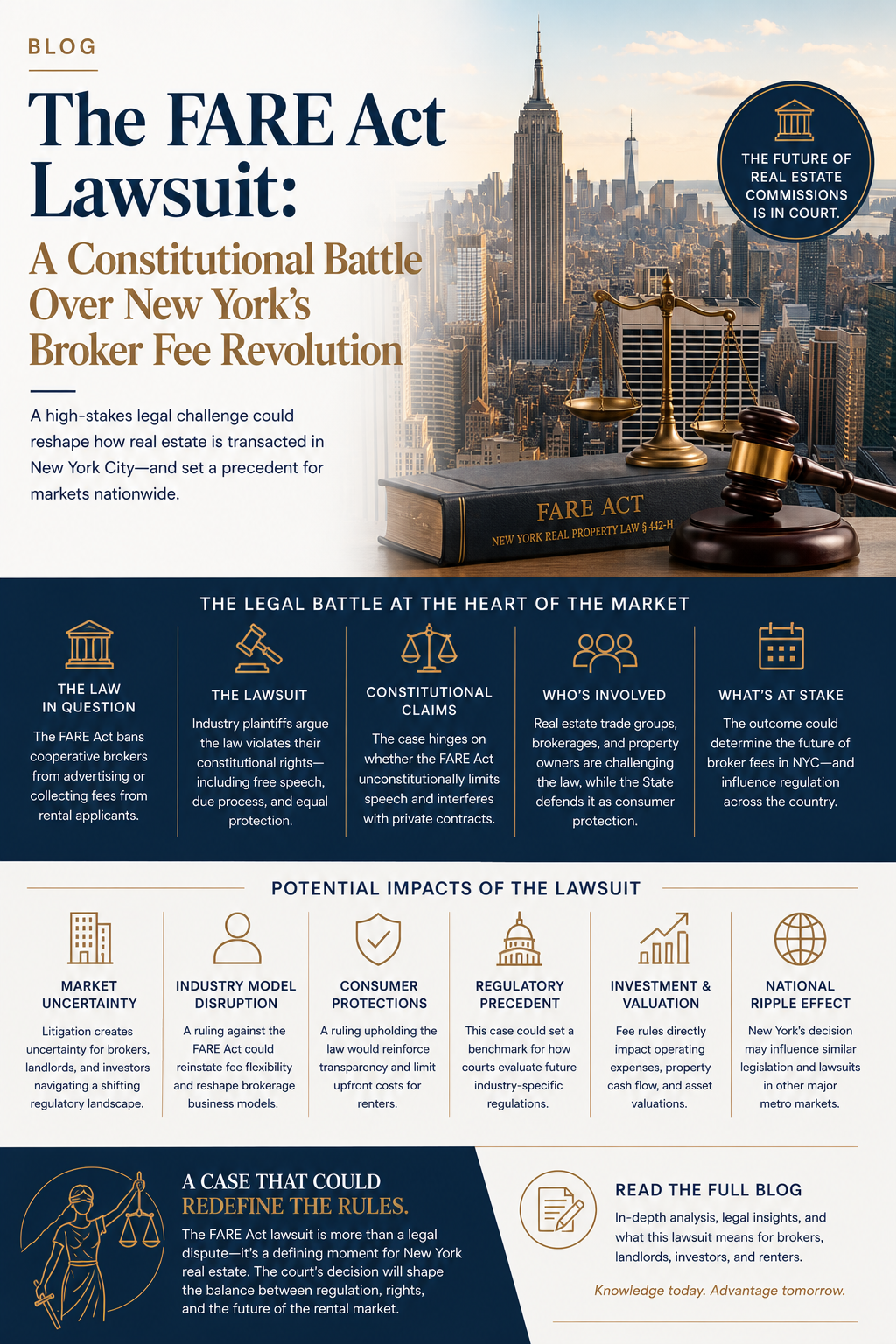
A Legal Challenge with Far-Reaching Implications
The Real Estate Board of New York has launched a comprehensive legal assault on one of the most significant tenant protection measures in recent memory. The lawsuit, filed against New York City’s Fairness in Apartment Rental Expenses Act, challenges the legislation on constitutional grounds and seeks to preserve a decades-old system that has required tenants to pay broker fees even when they never hired the broker who showed them an apartment.
The FARE Act, which became law after the mayor took no action within the required 30-day period, represents a fundamental restructuring of how rental transactions are conducted in one of the nation’s most expensive housing markets. By shifting the obligation to pay broker fees from tenants to the landlords who actually hire brokers, the law aims to reduce the daunting upfront costs that have made moving in New York City financially prohibitive for countless households.
For the real estate industry, however, the stakes could not be higher. The lawsuit argues that the law infringes upon constitutional guarantees of free speech and contract rights, while also violating state law. The outcome of this legal battle will determine not only the future of broker fee arrangements in New York but may also influence housing policy in other cities considering similar reforms.
The Law at the Center of the Controversy
What the FARE Act Actually Does
The FARE Act, which took effect in June 2025, fundamentally alters the economics of renting an apartment in New York City . Under the new framework, when a landlord hires a broker to market and show a rental property, that broker cannot charge a fee to the tenant who ultimately rents the apartment. The law also prohibits landlords from conditioning a rental on a tenant retaining a particular agent or broker.
The legislation addresses a practice that has long been a source of frustration for tenants: paying thousands of dollars in broker fees to professionals who were representing the landlord’s interests, not the tenant’s. Prior to the law, tenants routinely paid broker commissions equal to one month’s rent or as much as 15% of annual rent, even when the broker’s primary obligation was to secure the best deal for the property owner .
The law creates a rebuttable presumption that any broker who publishes a listing for an apartment does so with the landlord’s permission . This presumption is significant because it places the burden on landlords and brokers to demonstrate that a listing was published without the landlord’s authorization—a potentially difficult evidentiary hurdle.
Importantly, the FARE Act does not eliminate broker fees entirely. Tenants who choose to hire their own broker to represent them in finding an apartment can still pay that broker directly. The law simply prohibits landlords from passing along the cost of their own hired brokers to tenants .
The Enforcement Mechanisms
The law is backed by a structure of civil penalties designed to ensure compliance. First-time violations can result in fines of up to $1,000, with subsequent violations within a two-year period carrying fines of up to $2,000 . The Department of Consumer and Worker Protection is responsible for enforcing the law and has established a penalty schedule to implement these provisions.
In addition to administrative enforcement, the FARE Act creates a private cause of action, allowing tenants to sue directly for violations . This provision gives tenants a powerful tool to challenge improper broker fee charges without relying solely on government enforcement.
The law also requires itemized written disclosure of all fees that tenants must pay to rent an apartment . This transparency requirement aims to eliminate surprise charges and ensure that tenants understand the full cost of their rental transaction before signing a lease.
The Industry Lawsuit: REBNY’s Constitutional Challenge
The First Amendment Argument
At the heart of REBNY’s legal challenge is the claim that the FARE Act violates brokers’ First Amendment rights to free commercial speech . The trade group argues that by making it illegal for brokers to publish apartment listings and then seek compensation from tenants, the law effectively restricts the publication of rental advertisements.
The argument proceeds as follows: Under the FARE Act, when a broker publishes a listing for an apartment, the law presumes that broker has been hired by the landlord. Consequently, that broker cannot charge a fee to the tenant who rents the apartment. Brokers who wish to continue charging tenant fees must therefore either avoid publishing listings or find other ways to connect with potential tenants. This, REBNY contends, constitutes an unconstitutional burden on commercial speech.
The lawsuit also argues that the law will have the practical effect of reducing the advertising of rental apartments, making it harder for tenants to find available housing . This reduction in listings, REBNY claims, harms both the brokers who rely on advertising to generate business and the tenants who depend on public listings to find apartments.
However, legal analysis suggests that this First Amendment argument faces significant hurdles. The Second Circuit Court of Appeals has upheld the FARE Act against First Amendment challenges, treating the law as a content-neutral commercial speech regulation subject to intermediate scrutiny rather than strict scrutiny . The court found that the law does not ban publication of listings but simply changes who pays for the broker’s services when a listing leads to a rental.
The Contracts Clause Argument
REBNY’s second major constitutional argument invokes the Contracts Clause of the U.S. Constitution, which prohibits states from passing laws that impair existing contractual obligations . The trade group argues that the FARE Act retroactively impairs existing listing agreements that require brokers to seek compensation from tenants.
Under the old system, brokers and landlords could enter into listing agreements that explicitly contemplated tenant payment of broker fees. These contracts formed the basis of the rental transaction structure that had prevailed in New York for decades. The FARE Act, REBNY argues, effectively renders these agreements void and unenforceable, impairing the contractual rights of both brokers and landlords.
While the Second Circuit has acknowledged that the law may substantially impair some existing contracts, it concluded that this impairment is reasonable and appropriate given the law’s significant public purpose . The court emphasized the strong record evidence linking the FARE Act to its stated goals of reducing upfront moving costs, increasing housing mobility, and promoting fairness and transparency in the rental market.
The State Law Preemption Argument
REBNY’s third major argument is that the FARE Act is preempted by New York State’s comprehensive regulatory regime governing real estate brokers . The state has established detailed rules for broker conduct, compensation, and procedures, and REBNY argues that the city’s law conflicts with this broader framework.
The preemption argument is significant because it addresses the question of which level of government has authority to regulate broker compensation in rental transactions. If the state’s regulatory scheme is deemed to occupy the field, the city’s law could be invalidated regardless of its constitutional merits.
However, the Second Circuit has been skeptical of this argument, noting that the state regulatory framework does not explicitly address the allocation of broker fees between landlords and tenants . The court found that the FARE Act fills a gap in the state regulatory scheme rather than conflicting with it.
The Tenant Perspective: Why Reform Was Needed
The Cost Burden of Moving
The FARE Act emerged from a recognition that the cost of moving in New York City had become prohibitive for many households. Prior to the law, tenants moving to a new apartment faced upfront costs that could exceed $13,000 on average, including first month’s rent, security deposit, and broker fees .
For a tenant renting a $4,000-per-month apartment, a 15% broker commission on the annual rent would amount to $7,200 . Combined with first month’s rent and a security deposit, the upfront cost to move in could exceed $15,000—a sum far beyond the reach of many working-class and middle-class households.
These upfront costs had significant implications for tenant mobility. Households that might have preferred to move were effectively trapped in their existing apartments, unable to afford the transaction costs of relocation. This reduced turnover in the rental market, potentially contributing to the tight supply that has driven rents upward.
The Principal-Agent Problem
The FARE Act also addressed a fundamental principal-agent problem in the rental market. When a tenant pays a fee to a broker who was hired by the landlord, the incentive structure is inherently misaligned. The broker has a financial obligation to the landlord, who wants to maximize rent, not to the tenant, who wants to secure a fair deal.
This misalignment was particularly problematic in New York, where tenants were often required to pay broker fees even when they had no choice in the selection of the broker. Landlords could hire a broker, publish a listing, and effectively force prospective tenants to pay for the privilege of viewing and applying for an apartment.
The FARE Act addresses this misalignment by ensuring that the party who benefits from the broker’s services—the landlord—bears the cost. This creates a more straightforward principal-agent relationship and eliminates the perverse incentives that existed under the old system.
The Affordability Implications
For housing advocates, the FARE Act represented a critical step toward making New York more affordable for renters. The law reduces the upfront financial barrier to moving, potentially increasing tenant mobility and allowing households to relocate to apartments that better suit their needs.
The law also has implications for housing voucher programs. Prior to the FARE Act, the city’s housing voucher programs were often required to cover broker fees for voucher recipients, adding to the cost of providing housing assistance. By shifting this cost to landlords, the law reduces the burden on the city’s housing programs.
The Industry Perspective: Concerns and Criticisms
The Pass-Through Problem
One of the industry’s most persistent criticisms of the FARE Act is that it will simply result in landlords incorporating the cost of broker fees into higher rents . Under this view, tenants will not actually save money but will instead pay the broker fee over time through increased monthly rent payments.
For tenants who stay in an apartment for multiple years, this pass-through could result in paying far more than the one-time broker fee they would have paid under the old system. A broker fee of $4,000, when amortized over a lease term and factored into base rent for subsequent increases, could ultimately cost a tenant significantly more than the original fee.
However, supporters of the law argue that the pass-through argument assumes a perfectly competitive market in which landlords have pricing power. In practice, they contend, market forces will limit the ability of landlords to fully pass through the cost of broker fees, particularly in a market with vacancy constraints and regulatory oversight.
The Small Landlord Impact
Another significant concern is the impact of the FARE Act on small landlords, who often rely on brokers to market their properties and find tenants . For landlords with only a few units, the cost of paying a broker fee can be substantial, particularly when margins are already thin.
The law may create particular challenges for small landlords of rent-stabilized properties. These properties already operate under significant cost pressures, and the added expense of broker fees could make the math even more difficult. Some small landlords have reported leaving apartments vacant for extended periods rather than absorbing the cost of hiring a broker .
This impact on small landlords raises questions about the law’s equity implications. While the FARE Act was designed to help tenants, it may also have the effect of making it harder for small landlords to operate, potentially contributing to the consolidation of rental properties in the hands of larger operators.
The Inventory Reduction Concern
Industry critics have also expressed concern that the FARE Act will reduce the availability of rental listings, making it harder for tenants to find apartments . Under the old system, brokers had a strong incentive to list apartments widely, as any listing could result in a fee from a tenant. Under the new system, landlords may be less willing to authorize broad listings, as doing so exposes them to the cost of compensating brokers.
Data on the effect of the law on listing volume is mixed. StreetEasy’s platform saw a temporary drop in listings immediately after the law’s passage, but inventory subsequently recovered . REBNY’s own listing service, however, has shown more significant declines, suggesting that the impact on listing availability may be more pronounced in certain segments of the market.
If the law does result in reduced listing volume, this could harm tenants by making it harder to find available apartments and by reducing the information available about market conditions. However, it is difficult to isolate the law’s effect from other factors, including the generally tight housing market and broader economic conditions.
The Enforcement Reality: Early Outcomes
Complaint Volume and Refunds
The FARE Act has generated a steady stream of complaints and enforcement actions in its first year of implementation . The Department of Consumer and Worker Protection has received more than 2,000 complaints and inquiries related to the law, demonstrating that tenants are actively seeking to enforce their rights.
The enforcement results have been substantial, though perhaps less sweeping than some advocates hoped. The city has issued 74 summonses alleging 100 violations and secured approximately $27,000 in penalties . Administrative hearings have resulted in about $15,000 in broker-fee refunds for tenants who were improperly charged.
These early enforcement numbers suggest that compliance with the law is uneven. Some brokers and landlords continue to attempt to charge tenant fees despite the prohibition, and enforcement resources may be strained by the volume of complaints.
The Learning Curve
For many brokers and landlords, the FARE Act has required a significant adjustment in business practices . The law’s prohibition on charging tenants fees in certain circumstances has required brokers to reconsider their business models and to focus on developing relationships with landlords who are willing to pay for their services.
Some brokers have shifted their focus entirely to exclusive relationships with landlords, avoiding the open listings that were more common under the old system . This shift has implications for new agents who used to cut their teeth on open listings; some brokerages have reduced hiring and have focused on experienced agents who can maintain valuable landlord connections.
The learning curve has also created challenges for tenants. Some tenants have continued to be charged fees improperly, requiring them to file complaints and pursue enforcement actions. The fact that many tenants may not be aware of their rights under the law suggests that compliance will remain an issue for some time.
The Legal Landscape: Where Things Stand
The Second Circuit Decision
In a significant ruling, the Second Circuit Court of Appeals affirmed the lower court’s decision denying a preliminary injunction against the FARE Act . The court upheld the law against First Amendment challenges and indicated that the law likely satisfies the Contracts Clause standards.
The court’s First Amendment analysis is particularly important. It treated the law as a content-neutral commercial speech regulation, subject to intermediate scrutiny rather than the more rigorous strict scrutiny . Under the applicable standard, the court found that the law advanced substantial government interests, was supported by record evidence, and was reasonably tailored to achieve its objectives.
On the Contracts Clause, the court acknowledged that the law may substantially impair some existing contracts but concluded that this impairment was reasonable and appropriate given the law’s significant public purpose . The court emphasized the strong record evidence linking the FARE Act to its stated goals of reducing upfront moving costs and increasing housing mobility.
The Path Forward
The Second Circuit’s decision represents a significant victory for supporters of the FARE Act, but the legal battle is not necessarily over . REBNY could petition the U.S. Supreme Court to review the case, though the Court accepts only a small fraction of such petitions.
The trade group could also seek legislative modifications to the law, though the political appetite for changes appears limited given the law’s support among tenant advocates and the City Council . The law’s lead sponsor has expressed confidence that the FARE Act will survive continued legal challenges.
In the meantime, the FARE Act remains in effect, and the rental market continues to adjust to its requirements. Brokers, landlords, and tenants are learning to navigate the new rules, and the enforcement machinery is beginning to operate more smoothly.
Implications Beyond New York
A Potential National Template
The New York experience with the FARE Act may influence housing policy in other cities . The law’s basic premise—that the party who hires a broker should pay the fee—has intuitive appeal and could be replicated in other markets where tenants have historically borne the cost of landlord-hired brokers.
Other cities with high housing costs and tight rental markets are likely watching the New York experiment closely. If the FARE Act achieves its stated goals without causing significant market disruption, it could serve as a model for similar reforms elsewhere.
However, the New York experience may also serve as a cautionary tale. If the law is found to have contributed to rent increases, reduced listing availability, or other unintended consequences, other cities may be more cautious about adopting similar measures.
The Role of the Courts
The legal challenges to the FARE Act could have implications beyond the New York housing market. The constitutional questions raised by the lawsuit—particularly the First Amendment and Contracts Clause issues—could affect other regulatory efforts that impose costs on professionals engaged in speech-related activities.
If the Second Circuit’s reasoning is upheld, it would provide a roadmap for other cities seeking to reform broker fee practices. If the Supreme Court were to take the case and rule differently, it could create uncertainty about the viability of such reforms.
Conclusion: A Defining Moment for Tenant Protection
The FARE Act lawsuit represents a defining moment in New York’s ongoing struggle to address housing affordability and tenant protection. The law’s supporters see it as an essential reform that will reduce the financial barriers to moving, increase tenant mobility, and create a fairer rental market. Its opponents see it as a misguided intervention that will ultimately harm the very tenants it purports to help.
The early evidence suggests that the law is having a meaningful impact. Tenants are filing complaints and receiving refunds, and the rental market is adjusting to the new rules. However, the full effects of the law will not be known for years, and the debate over its consequences will continue.
What is clear is that the FARE Act has fundamentally changed the economics of renting in New York City. The long-standing practice of requiring tenants to pay fees to landlord-hired brokers has ended, at least for now. Whether this change results in a fairer, more accessible rental market or in unintended consequences that ultimately harm tenants remains to be seen.
The resolution of the lawsuit will determine the law’s future, but the debate it has sparked will continue regardless of the courts’ decision. The FARE Act has raised questions about the appropriate allocation of transaction costs in the rental market, the role of government in regulating private transactions, and the balance between tenant protection and market efficiency.
For the hundreds of thousands of New Yorkers who rent their homes, the outcome of this debate matters immensely. The cost of finding a home in one of the world’s most expensive cities is not merely an abstract economic question; it is a matter of financial survival for countless households. The FARE Act represents one effort to make that cost more manageable, and its ultimate success or failure will shape the lives of New Yorkers for generations to come.