 by InRealEstate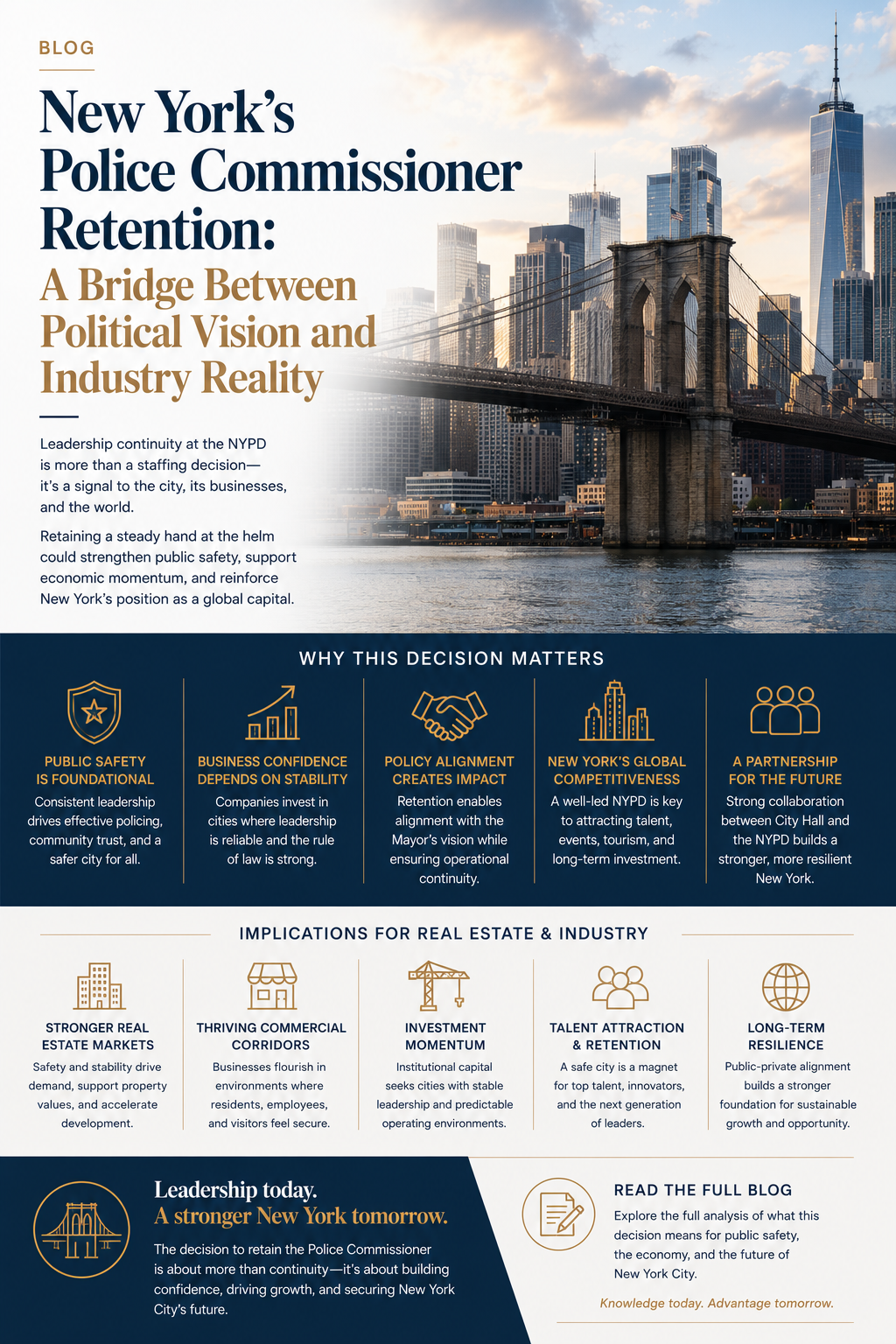
A Strategic Decision That Calms the Waters
In a move that has been welcomed across the political and economic spectrum, New York’s incoming administration has confirmed that Police Commissioner Jessica Tisch will remain in her role, providing continuity in leadership at the city’s police department. The decision, announced jointly by the mayor-elect and the commissioner, signals a pragmatic approach to governance that has reassured a real estate industry deeply concerned about public safety and its connection to economic recovery.
The retention of Commissioner Tisch represents more than just a personnel decision; it is a strategic signal about the administration’s priorities and governing philosophy. By keeping a commissioner who has delivered “historic reductions in violent crime” while simultaneously eliminating corruption within the department’s upper ranks, the incoming administration is demonstrating a commitment to evidence-based public safety policy that transcends ideological divisions.
For the real estate sector, which has watched the incoming mayor’s political evolution with a mixture of hope and apprehension, this decision provides a measure of certainty. The industry’s collective sigh of relief reflects the central importance of public safety to property values, investment decisions, and the broader economic vitality of the city. In a market still recovering from pandemic-related disruptions, the stability that Commissioner Tisch’s continued leadership represents is invaluable.
The Commissioner’s Record: Results That Transcend Politics
Crime Reduction Achievements
Commissioner Tisch’s tenure has been marked by measurable achievements in public safety that have earned her respect across the political spectrum. Under her leadership, the city has experienced significant reductions in violent crime, reversing trends that had concerned residents and businesses alike. These results provide a factual foundation for her continued leadership that transcends the ideological debates that often surround policing policy.
The “historic reductions in violent crime” cited in the announcement reflect a combination of strategic deployment, community engagement, and data-driven policing methods. While the full details of these achievements are subject to ongoing analysis, the trend line has been positive enough to convince the incoming administration that continuity of leadership is preferable to a fresh start.
The elimination of corruption within the department’s upper ranks represents an equally important achievement. Public trust in law enforcement depends not only on crime reduction but also on the integrity of the institutions responsible for public safety. By addressing corruption issues decisively, Commissioner Tisch has strengthened the NYPD’s legitimacy and its ability to function effectively in partnership with the communities it serves.
The Balance of Reform and Enforcement
Commissioner Tisch’s approach to policing has struck a balance that appeals to multiple constituencies. She has maintained enforcement capabilities while embracing reform-minded approaches to community engagement. This balance has made her a figure who can bridge the gap between those who prioritize aggressive crime fighting and those who emphasize the importance of police accountability and community trust.
This balanced approach is particularly valuable in the current political environment, where debates over policing policy have often been polarized. By keeping a commissioner who can navigate these tensions, the incoming administration avoids the immediate controversy that a more ideological appointment might provoke, allowing it to focus on other priorities.
The commissioner’s record on reform includes initiatives to improve police-community relations, enhance transparency, and address the root causes of crime through partnership with social service agencies. These initiatives align with the broader vision of a holistic approach to public safety that includes both enforcement and prevention, a vision that the incoming administration has articulated in its policy proposals.
The Real Estate Industry Response: Relief and Optimism
A Measured Welcome
The real estate industry’s response to Commissioner Tisch’s retention has been measured but unmistakably positive. Industry leaders have framed the decision as good news for the city as a whole, not merely for the business community. This framing reflects an understanding that public safety is a universal concern that affects all New Yorkers, regardless of their economic status or neighborhood.
The Real Estate Board of New York’s president captured this sentiment, noting that Commissioner Tisch “has been a steady hand at the NYPD” and expressing appreciation for her willingness to remain in the role. The statement also looked forward, expressing hope that the incoming administration will “continue to prioritize governmental experience and civic responsibility” in future appointments.
This response is significant because it signals a willingness to engage constructively with an administration that many in the industry had viewed with skepticism. By acknowledging the positive aspects of the decision while expressing hopes for future appointments, industry leaders are opening a channel for continued dialogue and cooperation.
The Public Safety-Economy Connection
The real estate industry’s focus on public safety reflects the direct connection between perceptions of safety and economic outcomes. Property values, investment decisions, and development activity are all influenced by how safe residents and businesses feel in their neighborhoods. When public safety is threatened, economic activity suffers, and the city’s recovery from the pandemic-related disruptions is jeopardized.
The industry’s concerns about policing policy are not merely ideological; they reflect concrete economic calculations. Return-to-office rates, tourism levels, and retail activity are all influenced by perceptions of public safety. Developers and property owners have a direct financial interest in policies that maintain or enhance public safety.
The industry’s support for Commissioner Tisch’s retention is therefore rooted in self-interest, but it also reflects a genuine belief that her approach to policing is effective. The commissioner’s track record of crime reduction provides evidence that her methods work, making her retention a rational choice for those who prioritize public safety.
The Political Evolution of Public Safety Policy
From Defund to Pragmatism
The incoming administration’s evolution on policing issues has been closely watched by industry observers. The mayor-elect’s previous advocacy for defunding the police, before walking back that stance, created uncertainty about how his administration would approach public safety policy. The decision to retain Commissioner Tisch, a figure associated with traditional policing approaches, signals a significant shift toward pragmatism.
This evolution reflects a broader political trend in which progressive politicians have moderated their positions on policing in response to public concerns about crime. The political calculus has shifted as voters have expressed anxiety about public safety, and candidates have adapted their positions accordingly.
The retention of Commissioner Tisch can be understood as part of this adaptation. By keeping a commissioner with a strong record on crime reduction, the incoming administration is demonstrating that it takes public safety seriously, even while pursuing other progressive policy goals.
The Community Safety Framework
The incoming administration’s proposal to create a Department of Community Safety represents an attempt to balance enforcement with social service approaches to public safety. This department would dispatch social workers to respond to issues such as homelessness and mental illness, reducing the burden on police officers while providing more appropriate responses to these challenges.
This proposal reflects a growing recognition that many public safety challenges require responses that go beyond traditional policing. Mental health crises, substance abuse issues, and homelessness are better addressed by trained social workers than by police officers, and diverting these calls to appropriate professionals can improve outcomes while reducing the strain on law enforcement.
The proposal also represents a political compromise. By maintaining traditional policing capacity while adding alternative response capabilities, the administration can claim to be both tough on crime and committed to addressing root causes. This dual approach may prove popular with voters who support both enforcement and prevention.
The Transition Team: Signals of Continuity
Maria Torres-Springer’s Appointment
The appointment of Maria Torres-Springer to the transition team has been noted by real estate observers as another signal that the incoming administration will take a pragmatic approach to economic development and housing policy. Torres-Springer is well-known in the real estate sector and has a reputation as a capable administrator who can navigate complex policy challenges.
This appointment suggests that the incoming administration intends to pursue continuity in certain areas of policy, even while pursuing change in others. By including figures with established relationships with the business community, the transition team is signaling a willingness to engage constructively with industry stakeholders.
The appointment also reflects a recognition that effective governance requires expertise and experience. By bringing in individuals with deep knowledge of the city’s housing and economic development challenges, the administration is positioning itself to address these issues effectively.
Building a Governing Coalition
The transition team’s composition reflects the challenge of building a governing coalition that can effectively address the city’s challenges. The incoming administration must balance the expectations of its progressive base with the practical requirements of governing a complex city with diverse interests and constituencies.
The retention of Commissioner Tisch and the appointment of Torres-Springer are part of this balancing act. By signaling continuity in areas where it benefits the city, the administration can build credibility with constituencies that might otherwise be skeptical. At the same time, it can pursue progressive goals in other areas, maintaining the support of its base.
This balancing act is not unique to the incoming administration; all mayors must navigate similar tensions. The success of the administration will depend on its ability to maintain this balance while achieving tangible results on the issues that matter most to New Yorkers.
Broader Implications for Urban Governance
The Public Safety-Development Nexus
The relationship between public safety and economic development is one of the most important dynamics in urban governance. Cities that successfully manage public safety create conditions for economic growth, while cities that struggle with crime face challenges in attracting investment and retaining residents.
New York’s experience illustrates this dynamic. The city’s recovery from the pandemic has been uneven, with some neighborhoods bouncing back quickly while others continue to struggle. Public safety perceptions play a role in these patterns, with areas perceived as safer attracting more investment and activity.
The retention of Commissioner Tisch signals a commitment to maintaining the progress that has been made in public safety. This commitment is important for the real estate industry, which requires a stable environment to make long-term investment decisions. The industry’s support for the decision reflects this reality.
The Politics of Policing
The policing debate in New York reflects broader national tensions over law enforcement and criminal justice reform. These debates are often polarized, with advocates on both sides presenting their positions in stark terms. However, the practical reality of urban governance requires a more nuanced approach.
Commissioner Tisch’s record suggests that it is possible to pursue both crime reduction and reform. Her approach has been effective enough to earn the support of constituencies that might otherwise disagree on policing policy. This suggests that the dichotomy between “tough on crime” and “reform” is not as rigid as it sometimes appears.
The incoming administration’s approach to policing may offer a model for other cities seeking to navigate these tensions. By retaining a commissioner with a proven record while also pursuing alternative response capabilities, the administration is pursuing a balanced approach that may prove effective and politically sustainable.
What This Decision Means for Different Stakeholders
For Tenants and Residents
For tenants and residents, the retention of Commissioner Tisch means continuity in the city’s approach to public safety. The crime reduction trends that have occurred under her leadership are likely to continue, providing a stable environment for families and communities.
However, residents may also see changes in how the city approaches public safety. The creation of a Department of Community Safety could mean that some calls that previously would have gone to the police are now routed to social workers. This could improve outcomes for individuals experiencing mental health crises or homelessness while also reducing the burden on police.
For Property Owners and Developers
For property owners and developers, the retention of Commissioner Tisch reduces uncertainty about the future direction of policing policy. The industry’s concerns about radical police reforms have been addressed, at least for now, by the decision to keep a commissioner with a traditional approach to crime fighting.
However, property owners and developers should remain attentive to other aspects of the administration’s agenda. The incoming administration has progressive goals in areas such as tenant protections, affordable housing, and building decarbonization that may have significant implications for property owners. The police commissioner decision should not be read as a signal that the administration will moderate its approach in these other areas.
For the Business Community
For the broader business community, the retention of Commissioner Tisch is a positive signal about the administration’s approach to governance. It suggests that the administration is willing to prioritize competence and experience over ideological purity, a quality that business leaders value.
The business community will continue to watch other appointments and policy decisions for signals about the administration’s direction. The police commissioner decision is a positive data point, but it is only one of many that will determine the administration’s overall relationship with the business community.
For Progressive Advocates
For progressive advocates who supported the incoming administration, the police commissioner decision may be disappointing. The administration’s evolution on policing issues may be seen as a retreat from the ambitious reforms that were promised during the campaign.
However, progressive advocates may find some consolation in the other aspects of the administration’s agenda. The creation of a Department of Community Safety, the appointment of progressive figures to other positions, and the pursuit of tenant protections and affordable housing may provide opportunities for the administration to advance progressive goals even while maintaining continuity in policing.
Looking Ahead: The Road Ahead for Public Safety Policy
The Balancing Act Continues
The incoming administration faces a continuing challenge in balancing the competing demands of public safety and reform. The retention of Commissioner Tisch is one part of this balancing act, but it is not the final word. The administration will continue to make decisions that affect public safety policy, and these decisions will be watched closely by all stakeholders.
The creation of a Department of Community Safety will be a key test of the administration’s approach. If this department is implemented effectively, it could improve outcomes for individuals with mental health and homelessness challenges while reducing the burden on police. If it is implemented poorly, it could create confusion and undermine confidence in the city’s public safety apparatus.
The Political Context
The incoming administration’s approach to public safety will be shaped by the broader political context in which it operates. The mayor faces re-election pressures that may influence his policy decisions, and the political climate in the city may shift in ways that affect public safety policy.
The national debate over policing will also affect the city’s approach. The administration will need to navigate pressures from both sides of the political spectrum, finding a path that maintains public safety while addressing legitimate concerns about police accountability and reform.
The Role of the Real Estate Industry
The real estate industry will continue to play a role in public safety debates, advocating for policies that create a stable environment for investment and development. However, the industry may need to adapt its approach as the political landscape evolves.
The industry’s support for Commissioner Tisch’s retention reflects a recognition that pragmatic engagement is more effective than ideological opposition. By working constructively with the administration, the industry can influence policy outcomes even when it does not agree with all aspects of the administration’s agenda.
Conclusion: A Signal of Pragmatic Governance
The retention of Police Commissioner Jessica Tisch represents a significant signal about the incoming administration’s approach to governance. By keeping a commissioner with a proven track record on crime reduction and a balanced approach to policing policy, the administration is demonstrating a commitment to pragmatism and continuity in an area of critical importance to the city’s economy and quality of life.
For the real estate industry, this decision provides reassurance that the city’s approach to public safety will not be subject to radical change. The industry’s concerns about the incoming administration’s previous advocacy for defunding the police have been addressed, at least for now, by the decision to retain a commissioner with traditional policing credentials.
However, this decision is only one piece of a complex puzzle. The incoming administration has progressive goals in many areas that will affect the real estate industry, and the police commissioner decision should not be interpreted as a signal that the administration will moderate its approach across the board. The industry should remain attentive to other policy developments while appreciating the stability that Commissioner Tisch’s retention provides.
The broader significance of this decision extends beyond the real estate industry to the city as a whole. By signaling a commitment to effective, balanced governance, the incoming administration is creating conditions for continued recovery and growth. The retention of a capable police commissioner is an important step in building the trust and confidence that the city needs to address its many challenges.
The road ahead is uncertain, and the administration will face many tests of its commitment to pragmatic governance. However, the police commissioner decision provides an early indication that the administration is willing to prioritize competence and results over ideological purity. This is a positive signal for all New Yorkers who care about public safety, economic recovery, and the future of the city.