
 by
by 
BXP’s $1.2 Billion Bet on Manhattan: Why 343 Madison Avenue Signals a New Era for Trophy Office Development
Boston Properties secures a $1.2 billion construction loan for 343 Madison Avenue, highlighting strong demand for Manhattan office market trophy buildings, Grand Central connectivity, and the future of premium commercial real estate.
- Manhattan’s Premium Office Market Shows Signs of Strength
- A Trophy Development Backed by Major Institutional Confidence
- A Rare Construction Loan Shows Banks Are Reassessing Manhattan Offices
- The Grand Central Advantage: Location Becomes the Ultimate Amenity
- Manhattan’s Office Market Is Splitting Into Two Different Economies
- Scarcity Is Creating Pricing Power for Premium Office Owners
- The Return of Landlord Pricing Power
- Why Companies Still Want Premium Manhattan Offices
- BXP’s Search for Equity Partners Reflects a New Development Model
- Implications for Manhattan Real Estate
- Conclusion: Manhattan’s Office Market Reset
Manhattan’s Premium Office Market Shows Signs of Strength
After several years of uncertainty in commercial real estate, one of Manhattan’s largest office development projects has hit a major milestone — one that could point to renewed confidence in the city’s top-tier office sector.
Boston Properties (BXP) has secured a $1.2 billion construction loan for 343 Madison Avenue, a nearly 1 million-square-foot office tower connected directly to Grand Central Terminal. It’s one of the largest financing commitments to a new New York real estate office development since rising interest rates and remote work upended the commercial real estate market.
The project highlights a growing split in Manhattan’s office market: older buildings continue to struggle, while demand for modern, amenity-rich, transit-connected trophy office buildings remains exceptionally strong.
At a time when many developers have paused new construction, BXP’s project suggests the future of Manhattan offices won’t be defined by quantity — but by quality.
A Trophy Development Backed by Major Institutional Confidence
Located next to Grand Central Terminal, 343 Madison Avenue is one of the few large-scale, ground-up office projects currently moving forward in Manhattan.
Project Highlights
The 46-story tower will include:
- Approximately 930,000 square feet of office space
- Direct access to Grand Central Terminal
- Premium workplace amenities
- Modern building infrastructure
- High-end office environments designed for major corporate tenants
The roughly $2 billion development is expected to be completed in 2029 and has already reached about 50% preleasing — a notable achievement in today’s office market.
Major Preleasing Commitments
Major commitments include:
- Insurance company Starr, which expanded its lease to approximately 325,000 square feet
- Law firm McDermott Will & Schulte, which signed for approximately 150,000 square feet
Strong leasing activity well ahead of completion shows that demand for the highest-quality Class A offices remains solid.
A Rare Construction Loan Shows Banks Are Reassessing Manhattan Offices
As construction lending in commercial real estate remains constrained across the country, the financing milestone at 343 Madison Avenue stands out as a rare exception. The infographic below breaks down how a world-class lender syndicate assembled a $1.2 billion package for a ground-up Manhattan office development — a deal type that has largely disappeared from the market since 2022. For investors tracking Boston Properties’ Manhattan strategy, this visual summary captures why institutional capital is selectively returning to trophy assets.
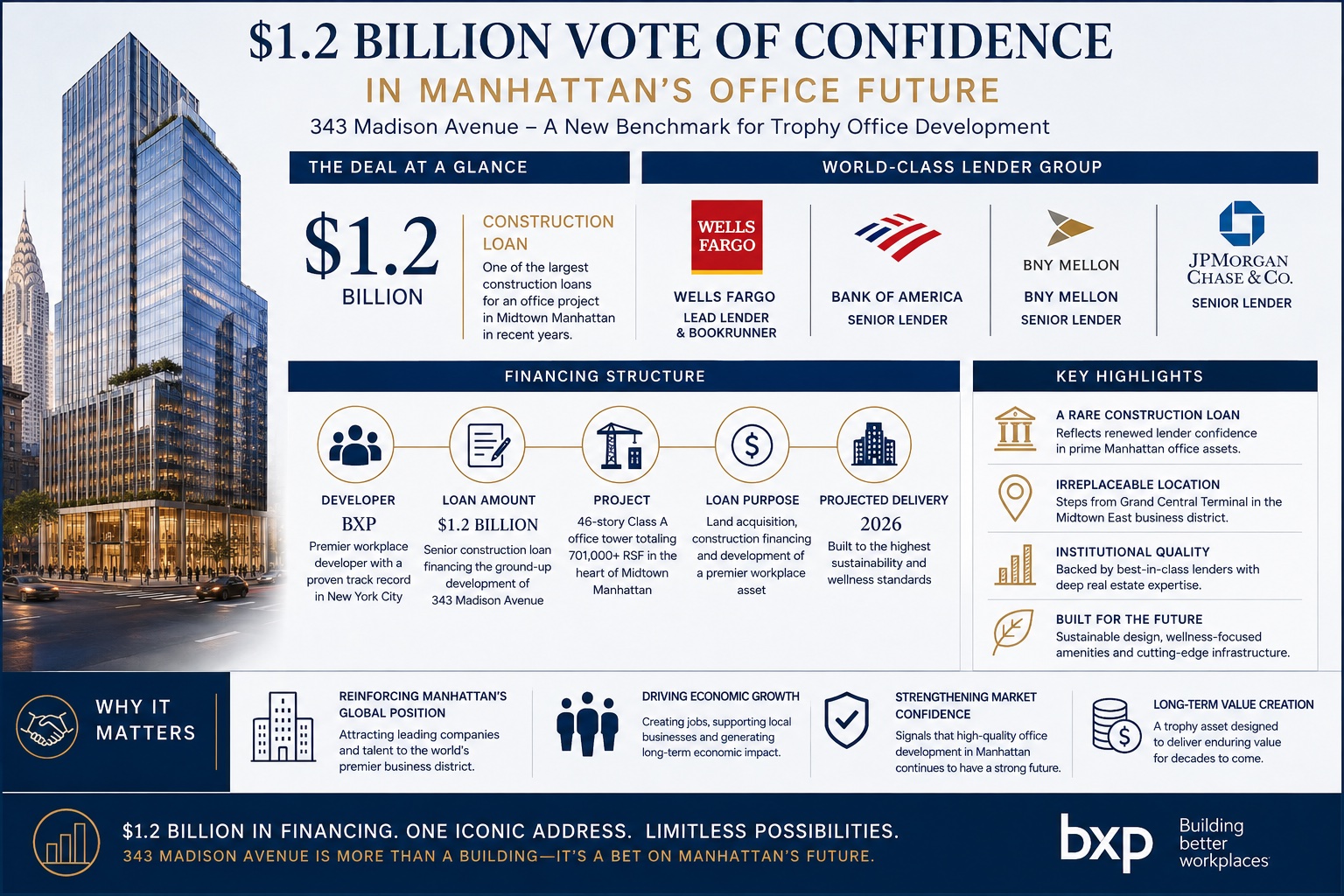
This infographic presents a comprehensive overview of Boston Properties’ $1.2 billion senior construction loan for 343 Madison Avenue, framing the deal as a vote of confidence in Manhattan’s office future. On the left, an architectural rendering shows the proposed 46-story glass tower with landscaped terrace setbacks and the Chrysler Building visible in the Midtown skyline. The right side identifies the world-class lender group: Wells Fargo as lead lender and bookrunner, with Bank of America, BNY Mellon, and JPMorgan Chase serving as senior lenders. Key deal metrics include 701,000+ rentable square feet, ground-up Class A development, and projected delivery in 2026 built to high sustainability and wellness standards. Four highlighted strengths — a rare construction loan, irreplaceable Grand Central location, institutional-quality sponsorship, and future-ready design — explain why lenders re-engaged despite industry-wide caution. The bottom section ties the project to global business positioning, economic growth, market confidence, and long-term value creation. For readers following Manhattan office market recovery, this visual confirms that banks will finance premium projects when preleasing, location, and sponsor track records align. It directly supports the article’s thesis that selective lender appetite — not a broad market rebound — is driving the next wave of trophy office development in New York City.
The construction loan infographic above illustrates why major banks are willing to underwrite ground-up office development again when fundamentals are exceptional. With roughly 50% preleasing secured and a direct Grand Central District connection, 343 Madison Avenue offered lenders the de-risked profile that scarce construction lending capital now demands — making this one of the most closely watched deals in premium New York real estate.
The $1.2 billion financing package is a significant vote of confidence from the financial sector.
Why Office Construction Lending Has Become Scarce
Construction lending for office projects has grown increasingly scarce, driven by:
- Higher interest rates
- Declining office valuations
- Uncertainty around workplace demand
- Rising construction costs
Many office developments nationwide have been delayed or scrapped as lenders turned cautious.
Institutional Lenders Behind the Deal
343 Madison Avenue, however, secured financing led by major institutions, including:
- Wells Fargo as lead lender
- Bank of America
- BNY Mellon
- JPMorgan Chase
The deal shows lenders remain willing to back projects with strong fundamentals — especially those in premier markets with exceptional transit access.
The Grand Central Advantage: Location Becomes the Ultimate Amenity
In today’s post-pandemic workplace, location has evolved from a convenience into a decisive competitive advantage. The map infographic below shows why 343 Madison Avenue’s position — just one minute on foot from Grand Central Terminal — makes it a benchmark for transit-oriented office development in Midtown Manhattan. Tenants evaluating Class A offices increasingly weigh commute friction as heavily as rent, and this visualization quantifies the connectivity that premium employers now require.
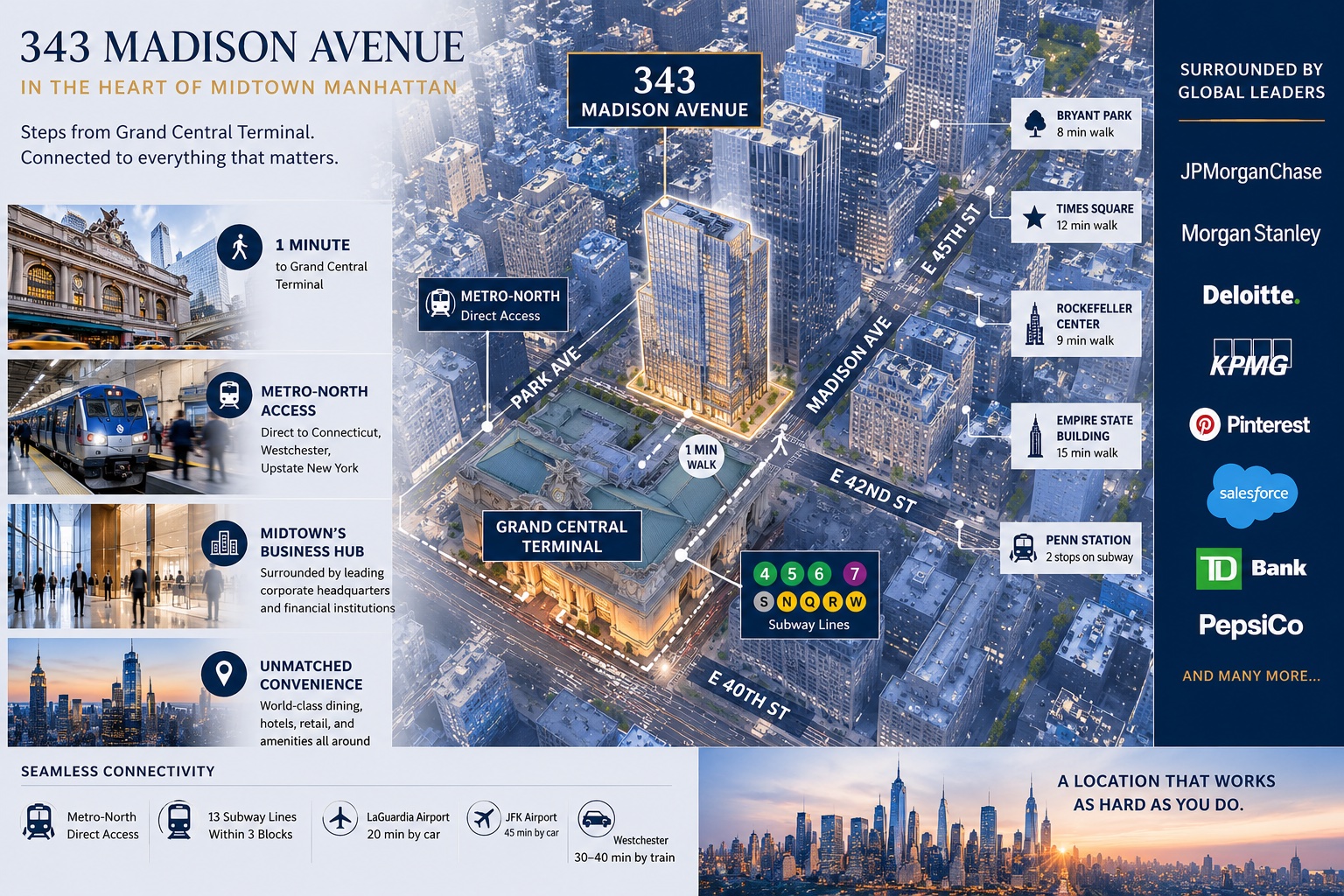
This location infographic positions 343 Madison Avenue at the center of Midtown Manhattan’s most connected office submarket. An aerial map highlights the tower at Madison Avenue and East 45th Street, outlined in gold and adjacent to Grand Central Terminal’s iconic green roof, with a dashed line marking a one-minute walk to the terminal entrance. Subway connectivity icons show access to the 4, 5, 6, 7, S, N, Q, R, and W lines, while walking-time callouts reference Bryant Park (8 minutes), Times Square (12 minutes), Rockefeller Center (9 minutes), the Empire State Building (15 minutes), and Penn Station (two subway stops). The left sidebar reinforces four location pillars: one-minute Grand Central access, Metro-North commuter rail reach into Connecticut and Westchester, Midtown’s status as a global business hub, and unmatched convenience for dining, hotels, and retail. The right sidebar lists corporate neighbors including JPMorgan Chase, Morgan Stanley, Deloitte, KPMG, Pinterest, Salesforce, TD Bank, and PepsiCo. A bottom connectivity bar adds airport drive times and regional rail schedules. For companies prioritizing employee accessibility, this map demonstrates why transit-proximate trophy buildings command premium rents — a dynamic explored further in our coverage of the Grand Central District office submarket and the broader shift toward location-as-amenity workplace strategy.
As the Grand Central location map demonstrates, direct terminal access is an amenity that cannot be replicated through building upgrades alone. Companies signing leases at 343 Madison gain seamless connections to Metro-North, multiple subway lines, and the corporate density of East Midtown — a combination that explains why transit-oriented development continues to outperform secondary office locations across the Manhattan office market.
One of 343 Madison Avenue’s strongest competitive advantages is its direct connection to Grand Central Terminal.
Why Transit Connectivity Matters
In the post-pandemic office market, accessibility matters more than ever. Companies are increasingly prioritizing buildings that offer:
- Easy commuting options
- Reduced travel friction for employees
- Central locations
- High-quality workplace environments
Grand Central’s Competitive Edge
Grand Central connects tenants to:
- Metro-North Railroad
- Multiple subway lines
- Midtown’s business district
- Major corporate headquarters
It’s a location that simply can’t be replicated. In today’s market, transit-oriented office development has become one of the most valuable forms of real estate infrastructure.
Manhattan’s Office Market Is Splitting Into Two Different Economies
Manhattan’s office recovery is not uniform — it is increasingly bifurcated between trophy assets and aging commodity stock. The comparison infographic below visualizes this divide across six dimensions that matter most to tenants and investors, from transit proximity to rental performance. Understanding this split is essential for anyone analyzing why 343 Madison Avenue secured financing while many older buildings face conversion pressure, as explored in our report on Class A vs. Class B offices in Manhattan.
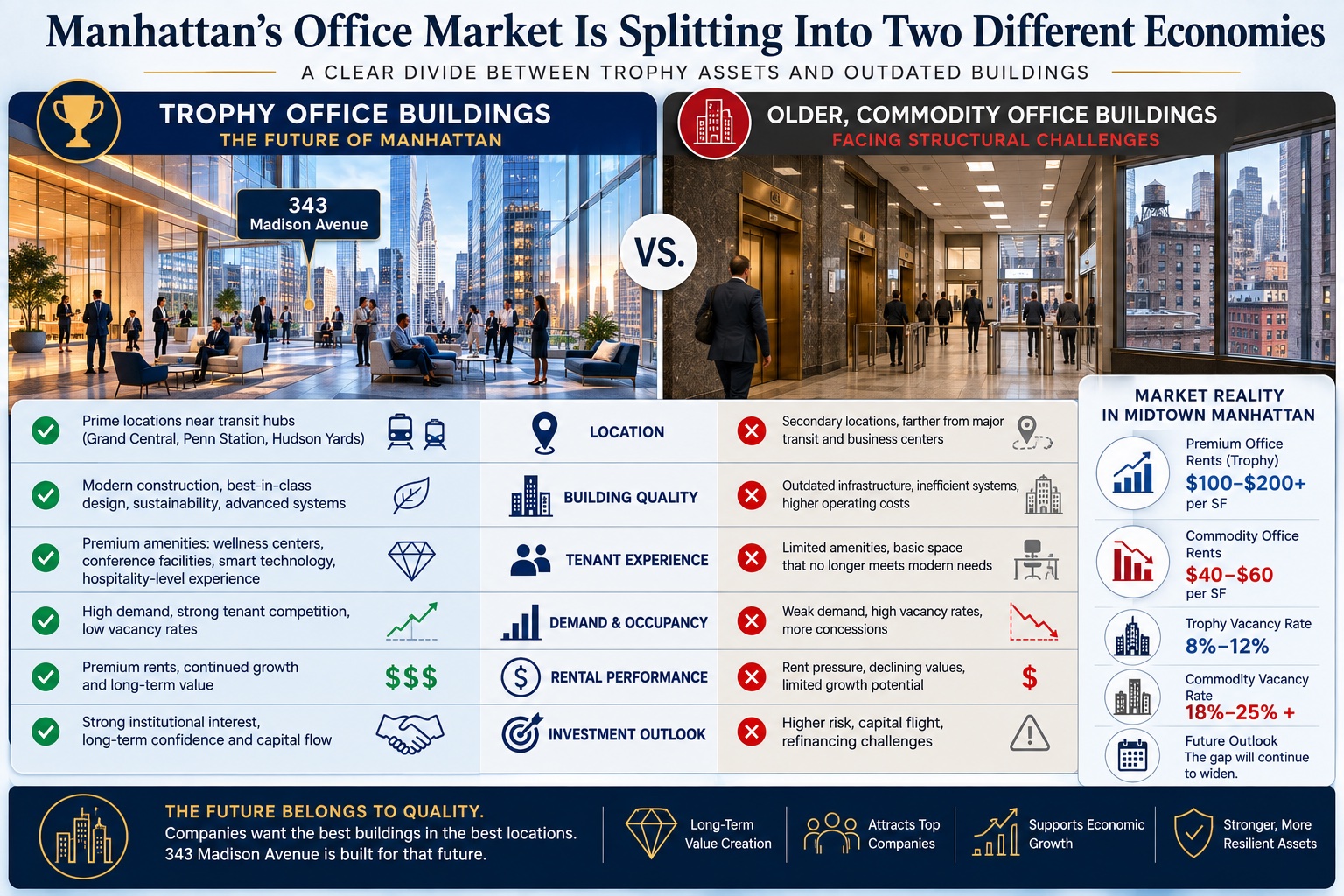
This infographic titled “Manhattan’s Office Market Is Splitting Into Two Different Economies” presents a side-by-side comparison between trophy office buildings and commodity office buildings. The top section contrasts a modern terrace lounge at 343 Madison Avenue — with glass walls, contemporary furnishings, and Chrysler Building views — against a dated lobby with wood-paneled elevators and security turnstiles overlooking older brick buildings. A six-row comparison table evaluates location, building quality, tenant experience, demand and occupancy, rental performance, and investment outlook, using green checkmarks for trophy assets and red X marks for commodity properties. Trophy buildings win on prime transit-hub locations, modern sustainable construction, hospitality-level amenities, high demand, premium rents, and strong institutional investment interest. Commodity buildings lose on secondary locations, outdated infrastructure, basic tenant experiences, weak demand, rent pressure, and refinancing risk. A sidebar quantifies Midtown Manhattan market reality: premium trophy rents at $100–$200+ per square foot versus commodity rents at $40–$60, with trophy vacancy at 8–12% compared to commodity vacancy at 18–25%+. The footer declares that the future belongs to quality, positioning 343 Madison Avenue as built for companies seeking the best buildings in the best locations. This visual directly explains the article’s central argument: financing flows to trophy development because the market’s two-tier structure is widening, not converging.


Join The Discussion