 by
by 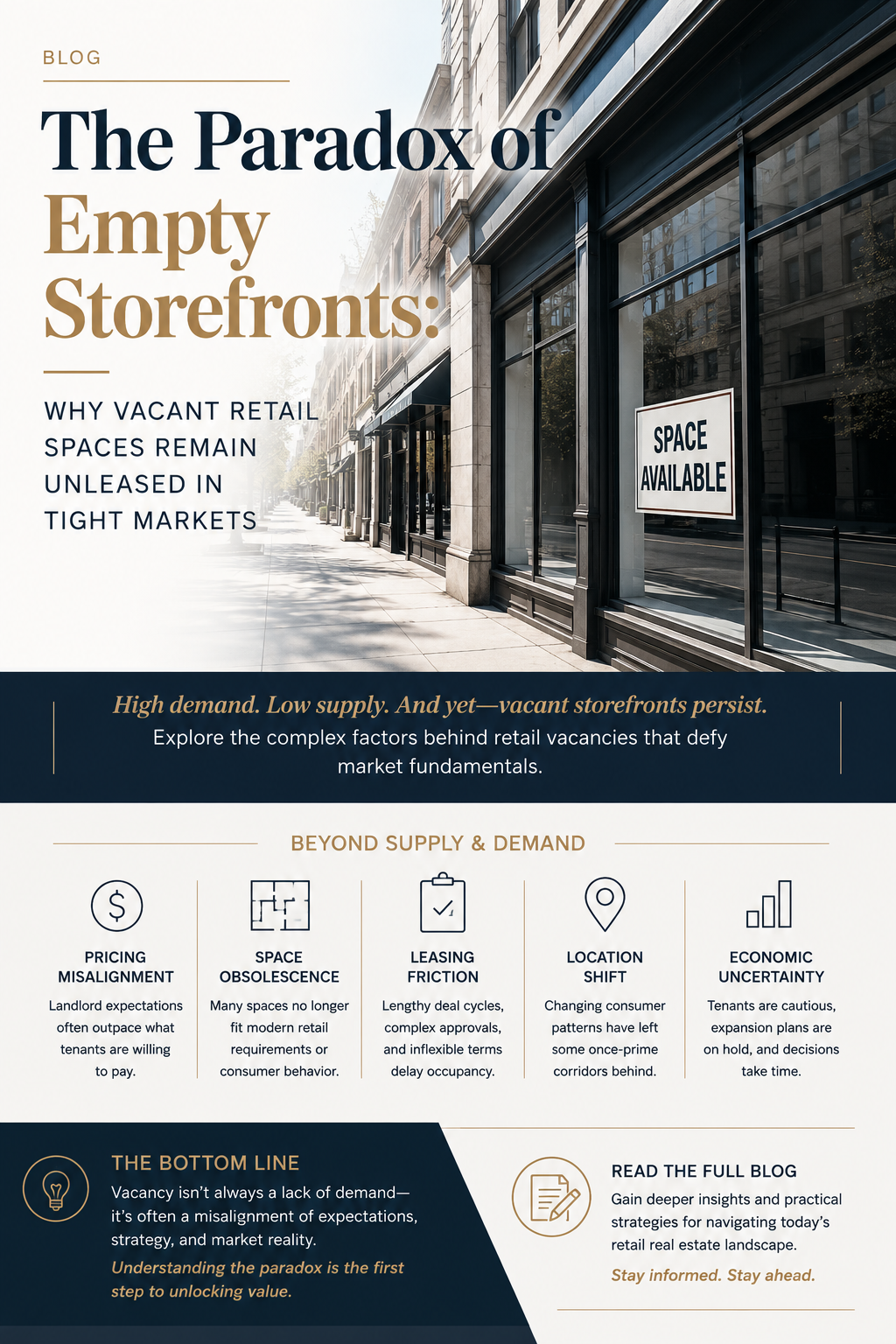
Understanding the Disconnect Between Low Vacancy Rates and Stubborn Storefront Emptiness
The Morristown Green, a historic town square in New Jersey that dates back to the Revolutionary War, presents a puzzling retail paradox. Three of the streets surrounding it are bustling with bars and restaurants, but one stretch, North Park Place, has been plagued with storefront vacancies for years, lined with empty stores including a former Rite Aid pharmacy. This scenario is emblematic of central business districts across the country plastered with “For Lease” signs, creating a disconnect that confounds casual observers and industry professionals alike.
The U.S. retail market is extremely tight, with low vacancy rates and new construction scarce. Yet some storefronts—defined as a retail site having a facade, entrance, or display windows facing the street—remain stubbornly unoccupied. These vacancies persist not always because of weak demand but because many spaces no longer meet tenant needs or landlord expectations, creating a complex web of structural, financial, and strategic challenges that defy simple solutions.
The ICSC Conference: A Spotlight on Storefront Challenges
The topic of storefront vacancies was front and center at the ICSC retail real estate conference in Las Vegas this week, where a Monday session discussed how cities and the public sector are activating empty ground-floor retail spaces. The discussion highlighted the multidimensional nature of the problem, with panelists framing it as a convergence of real estate, community, and planning issues.
“We’ve been talking about downtown retail vacancy as a crisis for over a decade,” said Davon Barbour, CEO of Downtown Austin Alliance in Austin, Texas. “Are we dealing with a real estate problem, a community problem, a planning problem, or is it all three?” Nina Albert, deputy mayor for planning and economic development in Washington, D.C., responded definitively: “I think it’s all three.”
Strategies to address the issue include creative leasing strategies and even pop-ups, a tack that Pittsburgh used to help fill 74 of its 89 downtown retail vacancies in advance of the NFL draft last month, according to Cate Irvin, senior economic development director for the Pittsburgh Downtown Partnership. This creative approach demonstrates that while the challenges are significant, innovative solutions can produce tangible results.
Why Storefronts Remain Empty: The Hidden Dynamics
The Landlord Factor: Picky, Pricey, and Unyielding
The casual observer may be perplexed about why a store in a busy downtown center isn’t leased, but there are a variety of explanations that may not be obvious to someone who isn’t a broker or a tenant. The broker for the vacant North Park Place strip, Cushman & Wakefield Director of Retail Services Blake Shanaphy, told CoStar News he’s had “a hundred-plus” offers from tenants for those sites over time. The demand is there. But the landlord, Dave Brown, is particular about whom he wants as a tenant, so the space remains empty.
Brown doesn’t want any franchisees or food establishments, but rather institutional-caliber, totally creditworthy tenants for that space, which severely limits the pool of potential occupants. From the landlords’ perspective, they are trying to guard against getting a tenant that ends up not being able to pay its rent or going out of business. This selectivity, while financially prudent, can create prolonged vacancies that harm the surrounding commercial ecosystem.
Multiple brokers told CoStar News that landlords have thwarted efforts to lease their vacant storefronts by looking to charge above-market rents and being unwilling to subdivide large spaces or foot the bill for tenant improvements. Or they are so picky about whom they want as tenants that it is near impossible to find a match. This combination of financial and strategic barriers creates a leasing environment where even high-demand properties can remain empty for extended periods.
Public Sector Intervention and Legal Challenges
The public sector in Morristown has stepped in to try to address the retail vacancy issue. In the case of a years-vacant, 132,000-square-foot Century 21 department store owned by Brown at North Park Place and Speedwell Avenue, the town of Morristown declared the parcel blighted and classified it as an area in need of redevelopment. The proposed plan is for the site to be transformed into apartments, offices, and ground-level retail space.
However, Brown has sued the town to block the redevelopment, alleging the municipality’s action is illegal. This legal battle illustrates the tension between public sector efforts to revitalize blighted areas and private property rights, creating additional barriers to addressing storefront vacancies. The outcome of such cases can have significant implications for how cities approach retail revitalization efforts.
New York City: Similar Dynamics in a Different Scale
Similar dynamics are evident in New York City, where brokers marketing retail space say interest is strong, but tenant demand is highly specific. On Central Park West, national retailers tend to favor high-traffic corridors such as nearby Broadway, while quieter residential blocks draw a narrower pool of service-oriented tenants such as pharmacies, salons, and healthcare providers. Even well-located spaces can linger if they do not match tenant requirements or expected buildouts.
“There’s not as much visibility on Central Park West as there is on Broadway,” according to Zach Landes, a broker with Royal Properties. He is marketing two retail spaces, the former Valery Joseph Salon and a vacant pharmacy, on Central Park West between West 62nd and 63rd streets. The sites, with views of Central Park, are at the base of the luxury Century Condominiums.
“The flip side is this is such a tremendous local residential destination,” Landes said. “There are a tremendous amount of high-net-worth individuals living in the surrounding buildings. And the area is sort of starved for local service uses.” This pattern reflects a broader trend where residential neighborhoods increasingly demand service-oriented retail, but the physical characteristics and landlord expectations of existing spaces often fail to align with these needs.
Macroeconomic and Structural Challenges
The Pandemic and Hybrid Work Impact
The pandemic and the advent of hybrid work schedules led to less foot traffic in some downtowns and retail corridors that “were built around a much larger daytime office population,” said Sid Singer, vice president of leasing for Levin Management Group. This was a dark cloud over storefronts, cutting lunchtime business and reducing the customer base that had sustained many downtown retailers. However, at least one retail analyst said back-to-the-office mandates have helped alleviate that particular issue.
Decades ago, the rise of enclosed malls was a blow to downtown storefront retail. But today, malls may not be viable for smaller retailers who want to stay local and within their communities and cannot afford high rents. Storefronts and malls each have their own different sets of advantages for different tenants, according to retail consultant Rudy Milian.
“Storefronts, whether street-level retail or unique freestanding stores in open-air shopping centers, offer brand independence, direct access, great visibility and flexible operating hours,” Milian said in an email to CoStar News. “Mall spaces provide high, consistent foot traffic, shared security, amenities and tremendous cross-shopping opportunities within a managed complex.” National chains such as Starbucks and Chipotle Mexican Grill have locations in both formats, but the calculus for smaller retailers often favors the independence and community connection of storefront spaces.
Parking as a Deal-Breaker
For busy consumers, being able to run in and out of a store quickly is important. That is why some chains, including Shake Shack and Chick-fil-A, are opening more drive-thrus. But in some bustling downtowns, including Morristown, there is little on-street parking available. That is a big issue—and a deal-breaker—for some tenants in terms of storefronts, various brokers told CoStar News.
“Downtowns are tricky because of the parking,” Danielle Brunelli, president of RJ Brunelli & Co., said in an interview. “If the parking is not convenient, customers just tend to not to go there. There’s only so much time in a day. If there’s a busy shopping center, people would rather be able to park and then go shopping. That’s why the lifestyle centers do so well.”
The Evolution of Retail Tenant Demand
Storefronts were once typically leased by stores selling apparel, shoes, and goods. But last year, for the first time on record, service-based retailers leased more space than traditional goods-based tenants, according to CoStar data. This fundamental shift in tenant composition reflects changing consumer preferences and the evolution of retail itself.
“The tenants most interested in storefronts today are generally the ones that really benefit from visibility, easy access and being part of the surrounding neighborhood,” Singer said. “That includes restaurants, coffee shops and fast casual concepts, as well as fitness and wellness users like Pilates, yoga, boutique gyms and med spas. We’re also seeing more service-oriented businesses and experiential retailers that want a strong street presence and a local feel.”
But those types of tenants have their own infrastructure requirements, more than, say, a dress shop would. For example, they may need a location with a loading dock. “Restaurants, fitness, wellness and medical users may need different layouts, ventilation, plumbing, parking or other improvements, and older storefronts can be costly to adapt,” Singer told CoStar News. A retail space not having a loading dock will be a no-go for some potential tenants, according to several brokers.
Infrastructure Incompatibility: The Restaurant Challenge
One of the biggest challenges of leasing a storefront is trying to adapt a site to accommodate a restaurant, according to brokers. Eateries require venting to release airborne contaminants, gases, and smoke from cooking. Making such infrastructure changes can not only be physically difficult or impossible but also pricey, various brokers said.
Craig Parcells, a JLL executive vice president, faced this issue when he looked for tenants for a vacant Morristown Starbucks. The chain closed that cafe, located on an otherwise leased-up block on the Morristown Green across from North Park Place, last September. Starbucks closed dozens of locations across the United States at that time, including a number of downtown storefronts.
The closed Morristown location performed well, but Starbucks has another site in town with a drive-thru, a tack the coffee chain has been leaning into. Street parking in front of the now-vacant store is scarce, and a drive-thru is not feasible there. Parcells considered a restaurant tenant for the property, but instead opted for “a dry use, meaning a non-restaurant use for that space.” That lease is being finalized.
Morris County, which includes Morristown, requires venting all the way to the roof for restaurants, and there is housing above the Starbucks space. “We’d have to go out and then up for the vent because you can’t really go through somebody’s apartment,” Parcells said. This regulatory requirement, combined with the physical constraints of the building, made a restaurant tenant impractical and forced a more limited tenant search.
Strategies for Addressing Storefront Vacancies
Creative Leasing and Pop-Ups
Pittsburgh’s success in filling 74 of its 89 downtown retail vacancies in advance of the NFL draft demonstrates the potential of creative approaches. Pop-up retail, short-term leases, and activation strategies can help bridge the gap between vacancy and permanent tenancy, generating interest and demonstrating the viability of spaces that might otherwise remain dark.
Public-Private Partnerships
The public sector has a role to play in addressing storefront vacancies, as demonstrated by Morristown’s attempt to redevelop the Century 21 site. While such efforts can face legal challenges, they reflect a growing recognition that the market alone may not be sufficient to address the structural challenges facing many downtown retail corridors.
Infrastructure Investment
For older storefronts, infrastructure upgrades may be necessary to accommodate modern tenant requirements. This can include ventilation for restaurants, loading docks for goods-based retailers, and accessibility improvements. The cost of such upgrades is often a barrier, but public incentives or landlord investments can help bridge the gap.
Key Takeaways for Real Estate Professionals
Tenant Demands Are Evolving: The shift from goods-based to service-based retail represents a fundamental change in the market. Storefronts that cannot accommodate the infrastructure requirements of these tenants will continue to struggle.
Landlord Selectivity Creates Barriers: While it is prudent to seek creditworthy tenants, excessive selectivity can create prolonged vacancies that harm the broader commercial ecosystem.
Parking and Accessibility Matter: For busy consumers, convenience is paramount. Storefronts without adequate parking or accessible drop-off zones will face persistent challenges.
Infrastructure Incompatibility Is a Major Hurdle: Older storefronts may not be equipped for modern tenants, particularly restaurants and fitness centers, requiring expensive upgrades that may not pencil out.
Creative Solutions Can Work: Pop-ups, short-term leases, and activation strategies can help address vacancies while demonstrating the viability of spaces and attracting permanent tenants.
Conclusion: A Multifaceted Challenge Requiring Multidimensional Solutions
The paradox of vacant storefronts in a tight retail market reflects a complex interplay of structural, financial, and strategic factors. Demand alone is not sufficient; the physical characteristics of spaces, landlord expectations, regulatory requirements, and consumer preferences all play critical roles in determining whether a storefront is leased or remains empty.
As Davon Barbour noted, this is not simply a real estate problem but also a community and planning challenge. Addressing it will require collaboration between property owners, brokers, public officials, and community stakeholders, as well as creative approaches to leasing, infrastructure investment, and regulatory reform. The success of Pittsburgh’s pop-up strategy and the ongoing efforts in Morristown and other communities demonstrate that progress is possible, but sustained attention and coordinated action are necessary to achieve meaningful results.
For real estate professionals, understanding these dynamics is essential to navigating the evolving retail landscape. The storefronts that succeed will be those that align with tenant needs, landlord expectations, and consumer preferences in a rapidly changing market.