 by
by 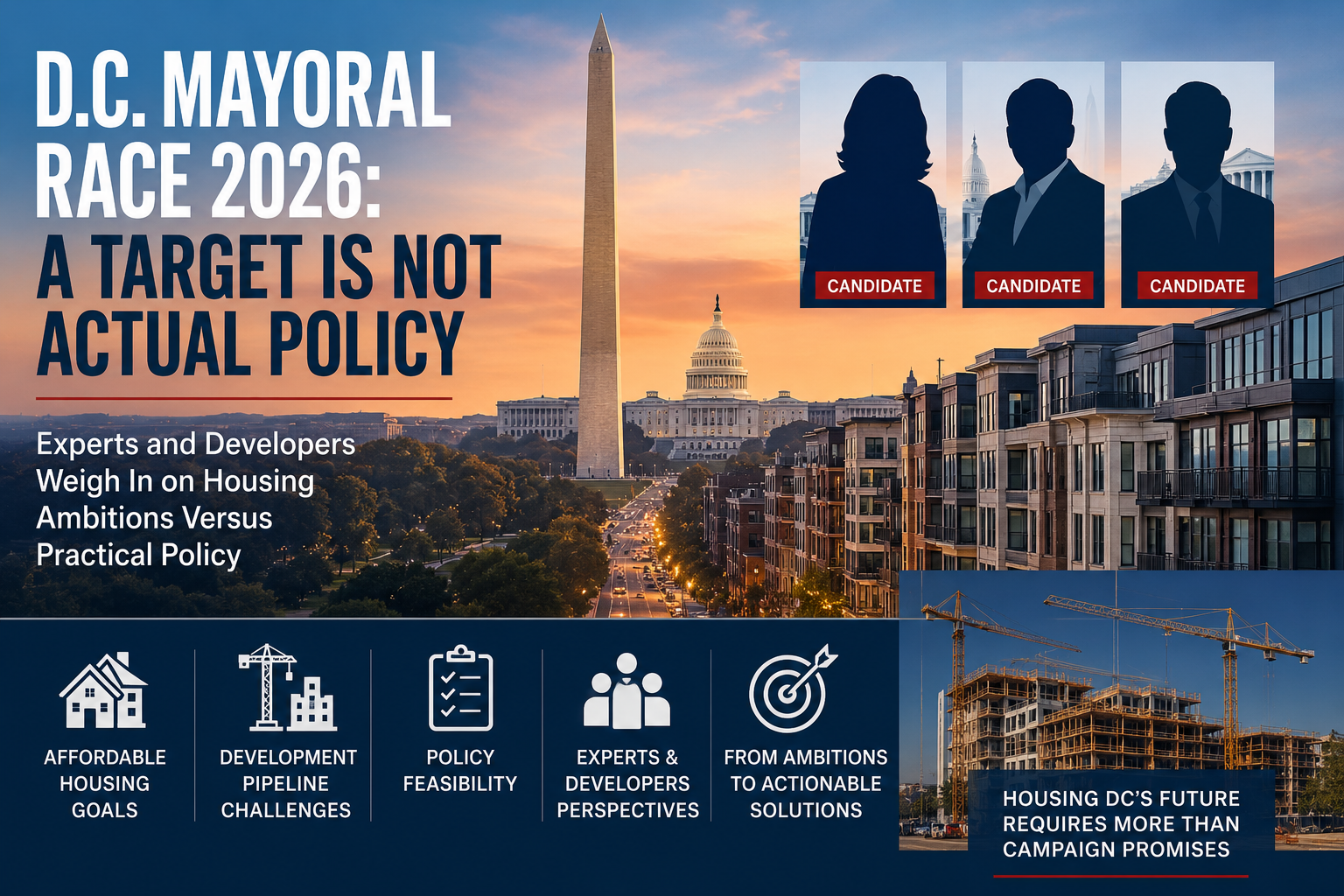
Experts and Developers Weigh In on Housing Ambitions Versus Practical Policy
As Washington, D.C., voters prepare for the June 16 primary election to select a new mayor, real estate stakeholders are sending a clear message: it isn’t about how many houses and apartments the candidates are pledging to build—it’s about policy . Developers, building owners, agents, and experts contend that the nation’s capital remains a challenging environment for multifamily projects and other residential developments, and the city’s next top elected official needs to drive capital back into the market .
The Bowser Era: A Legacy of Housing Production
Longtime Mayor Muriel Bowser made good on her second-term promise to develop 36,000 homes in the city by 2025, reaching that goal five months ahead of schedule. While most of that was new construction, a small portion consisted of existing residences preserved under affordability covenants. Since Bowser first entered office in 2015, the city has seen more than 50,000 homes built, a quarter of them affordable .
Bowser, who has a reputation for being business- and developer-friendly, is also committed to bringing 15,000 new residents to downtown by 2028, with a series of office-to-residential conversions throughout the city helping to achieve that goal. Since her start in the first quarter of 2015, office vacancy across the Washington area has risen from 13.6% to 17.6%, while retail vacancy remains consistent at around 4.4% .
Among her most high-profile accomplishments was securing control of nearly 180 acres of federal land along the banks of the Anacostia River to establish a new stadium for the NFL’s Washington Commanders and create a wider mixed-use neighborhood. Keeping the nation’s capital a sports destination with the ongoing revitalization of Capital One Arena, seeing through the development of The Wharf neighborhood on the Southwest waterfront, and selecting a wellness retreat to transform underdeveloped land in Southeast Washington are just a handful of the other projects the city has moved forward with in the past decade .
However, Bowser’s tenure hasn’t been without obstacles, including the COVID-19 pandemic and sweeping federal workforce layoffs. The city continues to face the consequences of federal job losses, relatively high office vacancy, limited new construction, and a reported drop in both consumer spending and visitor demand .
The Candidates and Their Housing Visions
When Bowser announced in the fall that she would not run for another term, several candidates stepped up for what is set to be the first election in the District to use ranked-choice voting.
Kenyan McDuffie: The Pragmatic Approach
Former D.C. Councilmember Kenyan McDuffie, who spent more than a dozen years in the local legislative body, is backed by the Small Multifamily Owners Association, Associated Builders and Contractors Metro Washington, the Greater Capital Area Association of Realtors, the District of Columbia Association of Realtors, and the Restaurant Association Metropolitan Washington .
McDuffie has set his sights on creating 12,000 housing units by 2030 and preserving 20,000 affordable residences. He has been critical of his opponent’s more ambitious targets, stating in a debate earlier this spring: “There’s no way that she’s going to build 72,000 units of housing. It costs too much to build in Washington, D.C.”
McDuffie has positioned himself as the pragmatic choice, arguing that his agenda is more likely to get done than sweeping promises. He has vowed to cut permitting red tape so housing can get built faster, and he has voiced support for easing the Height Act in certain corridors without a sweeping rewrite . He also supports baby bonds and has suggested looking at property tax relief .
Janeese Lewis George: The Progressive Vision
Current D.C. Councilmember Janeese Lewis George, a self-described democratic socialist who has been compared to New York Mayor Zohran Mamdani, has served on the council since 2021 and is supported by a number of labor unions, the nonprofit Greater Greater Washington, and DC YIMBYs .
Lewis George is aiming for a whopping 72,000 new homes over the next five years. To pay for her plan, she said she’ll leverage federal dollars and the city’s Housing Production Trust Fund, a special revenue allocation used to produce and preserve affordable homes. The fund gets its money from deed recordation and transfer taxes, as well as the District’s general fund. She also plans to streamline the building permitting process and overhaul the building code .
In response to criticism that her plan is unrealistic, Lewis George said her opponent’s plan is “not ambitious enough. It doesn’t meet the moment. It doesn’t meet the crisis” . She has argued that the scale of the housing crisis requires ambitious goals and that she believes D.C. needs someone who will show up and fight for all residents .
Other Candidates and Their Platforms
Others competing to become mayor include real estate developer Gary Goodweather, broker Ernest Johnson, former Councilmember Vincent Orange, former Georgetown Business Association vice president Hope Solomon, and federal contractor Rini Sampath .
Goodweather has proposed 50,000 new homes by 2032. Independent candidate Rhonda Hamilton, a small business owner and mental health advocate, plans to provide more affordable, income-restricted units for subsidized housing and conduct audits of existing housing waitlists to ensure efficiency . Robert Gross, a member of the D.C. Statehood Green Party, has proposed modernizing government through artificial intelligence integration to streamline permits and housing development approvals .
What Real Estate Experts and Developers Say Is Feasible
“I used to drive around the city and see cranes everywhere. They’re few and far between now,” Ian Ruel, the co-founder and managing principal of Feldman Ruel, told CoStar News. He added that McDuffie’s number is more realistic .
Nigel Crayton, a senior director at Greysteel and co-leader of the firm’s mid-Atlantic multifamily team, emphasized that “certainty and partnership” is what the industry is looking for from the next mayor, meaning assurance of consistent policies .
Patrick McAnaney, a director of development at Somerset Development Co., explained the core challenge succinctly: “Whether one has a higher number of units, and whether we can achieve that number of units, to me is not actually important. It is what are the actual policies that they will put around it, because a target is not actual policy” .
The Market Reality
Multifamily Construction Slows
Multifamily construction in Washington has been leveling off, given tighter capital markets, rising costs, and a sharp reduction in groundbreakings. Developers delivered more than 15,500 units during the past year, as an additional 19,943 units were under construction going into 2026 . Multifamily sales in metro Washington, D.C., exceeded $2.3 billion last year, remaining well below the $4.4 billion recorded in 2024 .
Average advertised asking rents dipped 0.5% on a trailing three-month basis through December, to $2,191, exceeding the 0.3% national decline . Luxury properties have seen vacancy rates rise to 11.9% in Q1 2026, while workforce housing (B and C class) vacancy rates were 7.9% in the same time period .
Federal Job Losses Impact the Market
The D.C. area shed 104,000 jobs between January 2025 and January 2026, the largest decline since the region lost over 200,000 jobs during the pandemic, according to the Bureau of Labor Statistics . The federal government eliminated an estimated 348,000 jobs in 2025, according to the Pew Research Center .
Uncertainty around federal workforce reductions and their spillover effects into the private sector continue to temper expectations for 2026 . However, month-over-month rents are trending upward, reflecting a stronger spring leasing season .
Despite increased listings, fallen sales, and price cuts, median list prices in the D.C. MSA have only slightly decreased (2%) since 2024, and median sale prices have actually increased by 12% . The median sale price in the D.C. MSA currently exceeds the median list price—for the first time since 2022—by 8% .
Townhouse and Single-Family Homebuilding Limited
Meanwhile, townhouse and single-family detached homebuilding have been limited, with an average of 237 houses built each year over the past decade, according to the U.S. Census Bureau. The number dropped to 181 last year .
Policy Solutions and Legislative Wins
The RENTAL Act
McAnaney cited the passing last year of the RENTAL Act—legislation that exempts certain multifamily buildings from requiring an offer of sale to tenants—as a step toward addressing the situation. But he acknowledged that it is not enough, and that it will take time to determine whether it is working and what else needs to be done .
Office-to-Residential Conversions
The city has expanded tax breaks for converting offices to residences and granted a 20-year tax abatement to projects that would turn workspaces into homes . The D.C. Council has also allowed office properties set to be converted into multifamily buildings to be classified as residential as soon as work gets underway, meaning such conversions would be taxed at lower rates from their commencement .
The city launched its “Office to Anything” program to get underutilized office space to convert to other commercial uses that could increase foot traffic, economic activity, and tax revenue for the city . Combined, the projects approved for tax breaks are expected to produce approximately 1,134 units, including roughly 114 affordable units .
Single-Stairwell and Other Regulatory Changes
Other recent legislative moves the industry is watching include a council-approved measure to allow six-story residential buildings to have a single stairwell, replacing a previous three-story limit; new legislation to expand short-term rental options; and the creation of tax break programs like the 20-year abatement initiatives known as Housing in Downtown and Office to Anything to spur conversions .
Building Up Neighborhoods and Major Corridors
More than 50,000 new market-rate and affordable residences have been built during Bowser’s tenure. More than half of them are concentrated in two of the city’s eight wards, with a large share in the city’s NoMa, Wharf, and Navy Yard neighborhoods. The new housing has consisted mainly of large multifamily buildings, with a tendency toward studios and one-bedroom apartments rather than larger family-sized units .
While the city has a vision for some additional large-site housing projects, including at the Robert F. Kennedy Stadium site near the Anacostia River, some policy experts and real estate agents said the answer is not to try to build more of the same. Instead, they said, the city should emphasize infill, building more in older neighborhoods and along major commercial and transportation corridors .
“In order for the city to grow, it requires all types of housing, not just multifamily,” Yesim Sayin, D.C. Policy Center executive director, told CoStar News. “You need start-up units, maybe small townhouses and single-family, low-rise multifamily. Those things are extremely difficult to build in D.C. right now because there is simply no room” .
A report released last month by Sayin’s group calls for doubling the share of the city’s land area where multifamily housing is permitted to 50%. In areas where only single-family houses are currently allowed, the report said, this could generate 4,500 new residences over 10 years in small buildings with two to four units. The group also backs eliminating parking requirements, allowing smaller lots, and encouraging accessory dwelling units to stimulate new construction. And it said the city should allow residential buildings in certain neighborhoods up to the limits of the federal Height Act, or 90 feet .
The Need to Streamline Permitting
To encourage more housing development, the city needs to streamline the permitting process, experts said. “When you look at permits, the first step one has to take is to get one, and it’s generally two to four years before the actual unit materializes,” Sayin said. Her group’s recent report describes the city’s permit system as “slow, fragmented and difficult to navigate,” making it hard for developers to justify the cost of some projects .
Harrison Beacher of Keller Williams Capital Properties, who is also president of the D.C. Association of Realtors, told CoStar News that he agrees the city seems to put up many obstacles to construction. “You’ve got to do inspections, do things safely, correctly, but also move them along the pipeline,” Beacher said. “For people who still want to invest in the city, how do we reduce the friction?”
What Industry Leaders Say the Next Mayor Must Do
Formal Invitation to Investors
Liz DeBarros, CEO of the District of Columbia Building Industry Association, said her team is not endorsing a candidate, but whoever is chosen should look at “rigid, mandatory regulations that offer no flexibility” and can be “cost-prohibitive,” such as those on bird glass and moving heritage trees. “The city’s going to have to formally invite investors back. There’s too many moving parts and too many hurdles to build,” DeBarros told CoStar News. “Collectively, these issues make it incredibly difficult to get a shovel in the ground for commercial development and most certainly for new housing in this rewired DC market. If we want more housing, we have to address the stability of the process itself” .
Stabilizing the Process
Industry leaders said officials need to double down on legislative changes that incentivize investment. “Certainty and partnership” is what the industry is looking for from the next mayor, meaning assurance of consistent policies .
Addressing the Private Capital Conundrum
Mark Simpson, director of Planning & Economic Development for the DowntownDC Business Improvement District, said during a conference earlier this year: “We need more housing. For a myriad of reasons, we need to be building more. But, these visions cannot become a reality if we do not continue the policy gains like the ones we saw in the RENTAL Act, the investments and abatements and things like the Housing in Downtown program or the Office to Anything program, and we need to look creatively at public financing mechanisms that can make projects pencil that otherwise would be stuck in the pipeline” .
Key Takeaways for Real Estate Professionals
Targets Are Not Policy: As McAnaney emphasized, “a target is not actual policy.” The next mayor must focus on creating the regulatory and financial conditions that enable development .
Permitting Reform Is Critical: The city’s permit system is “slow, fragmented and difficult to navigate,” making it hard for developers to justify the cost of some projects. Streamlining this process is essential .
Investment Must Be Invited: D.C. must “formally invite investors back” by addressing the “too many moving parts and too many hurdles to build” .
Balance Ambition and Feasibility: The debate between McDuffie’s 12,000 units and Lewis George’s 72,000 units highlights the tension between ambitious goals and practical reality. Both candidates have expressed support for reforming the city’s rules to allow more housing types, but they have shared few specific policy changes .
Workforce Housing Presents Opportunities: Occupancy levels for workforce housing are notably better than the luxury segment, with rental rates showing resilience. Workforce housing provides opportunities for long-horizon investors in Washington, D.C. As some institutional investors shrink their D.C. portfolios, local capital with dry powder is stepping in to buy, with some clients achieving up to a 10% cash-on-cash return after leverage in current yield .
Conclusion: A Critical Juncture for D.C.’s Housing Future
The D.C. mayoral race presents a clear choice between two fundamentally different approaches to addressing the city’s housing challenges. McDuffie’s pragmatic, incremental approach focuses on achievable targets and regulatory reform, while Lewis George’s ambitious, progressive vision calls for dramatic government intervention and massive production targets .
Whoever wins the Democratic primary—and by extension, the general election—will inherit a city facing significant headwinds: federal job losses, high office vacancy, limited new construction, and a reported drop in both consumer spending and visitor demand . The next mayor will need to navigate the tension between tenant advocates calling for rent freezes and affordability measures and the real estate industry seeking regulatory certainty and investment incentives.
As Liz DeBarros put it: “If we want more housing, we have to address the stability of the process itself.” Whether through McDuffie’s market-friendly reforms or Lewis George’s more expansive approach, the next mayor must create the conditions for private capital to flow back into the city’s housing market